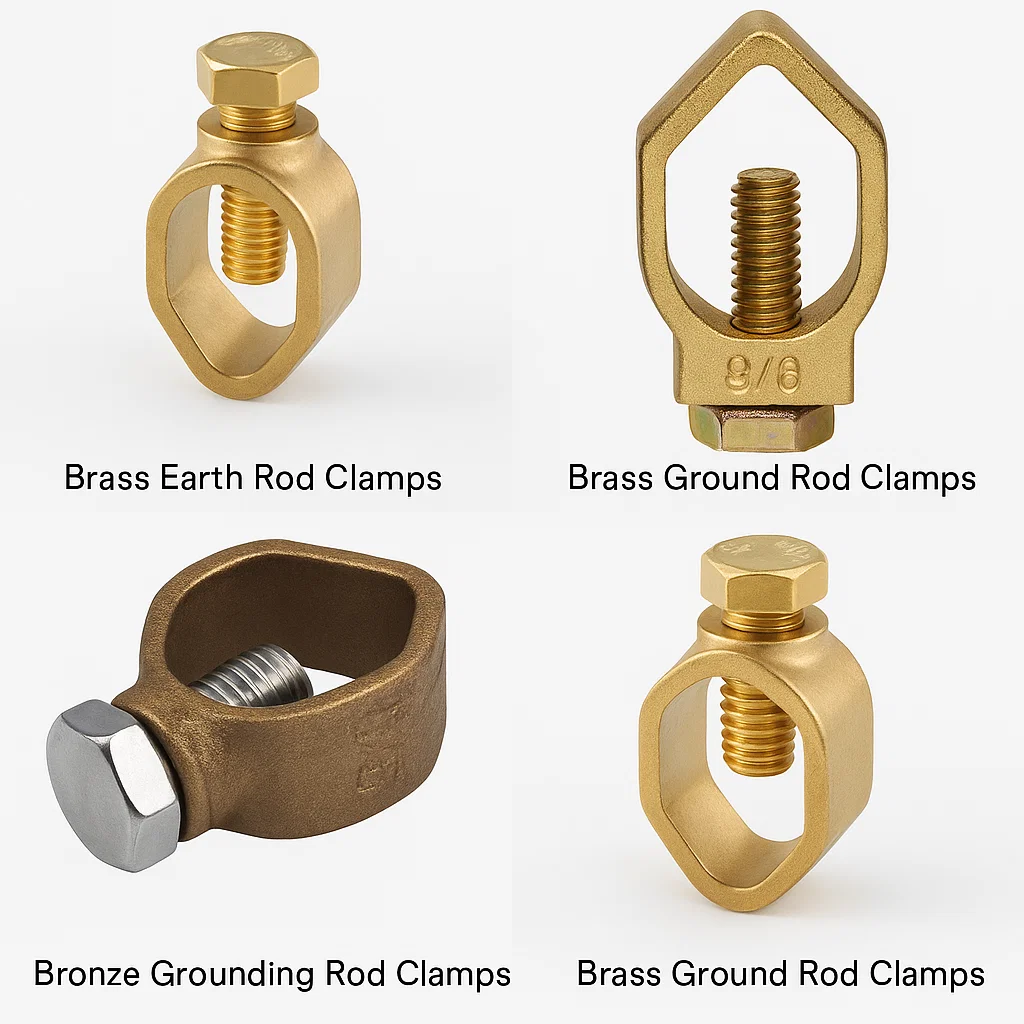

Brass Earth Rod Clamps, Brass Ground Rod Clamps, Bronze Grounding Rod Clamps
Comprehensive Overview of Earth Rod Clamps and Ground Rod Connection Systems
We are one of the leading manufacturers and exporters of Brass Earth Rod Clamps, Brass Ground Rod Clamps, Bronze Grounding Rod Clamps, and Bronze Acorn Clamps from India. We have been supplying precision-engineered grounding hardware to the world market for many decades. Our earthing rod clamps represent the culmination of over thirty years of metallurgical expertise, advanced manufacturing capabilities, and deep understanding of electrical grounding requirements across diverse international markets. These critical components serve as the mechanical and electrical interface between ground conductors and earth rods, ensuring reliable fault current dissipation, lightning protection, and equipment safety in electrical installations worldwide. Manufacturing earth rod clamps requires sophisticated understanding of contact resistance principles, galvanic compatibility, mechanical strength requirements, and environmental durability – disciplines we’ve perfected through continuous innovation and rigorous quality control protocols that meet the stringent demands of utility companies, electrical contractors, renewable energy installations, telecommunications infrastructure, industrial facilities, and commercial construction projects across North America, Europe, Australia, and beyond.
Our Earth Rod Clamps are engineered to provide permanent, low-resistance connections between grounding conductors and driven earth rods in electrical grounding systems. These clamps utilize high-conductivity Brass or Bronze alloys that maintain excellent electrical performance while resisting corrosion in underground environments. The design incorporates precision-machined contact surfaces, heavy-duty compression hardware, and optimized geometry that ensures maximum contact area between the conductor and the earth rod. Each clamp undergoes dimensional verification, conductivity testing, and mechanical load analysis before certification for shipment. We manufacture these essential grounding components in standard sizes including 3/8 inch, 1/2 inch, 5/8 inch, and 3/4 inch rod diameters, accommodating conductor ranges from #6 AWG through 2/0 AWG depending on the specific clamp configuration. The mechanical design features robust casting or forging processes that eliminate porosity, ensure structural integrity under compression loads, and provide consistent clamping force across the entire contact interface.
Brass Ground Rod Clamps manufactured in our facility utilize premium-grade Brass alloys specifically selected for their superior electrical conductivity, excellent corrosion resistance, and optimal mechanical properties for grounding applications. These clamps feature precision-engineered geometries that accommodate both solid and stranded copper conductors while maintaining secure mechanical connection to galvanized steel, copper-bonded steel, or stainless steel ground rods. The manufacturing process incorporates hot forging followed by precision machining to achieve tight dimensional tolerances, smooth contact surfaces, and properly sized compression hardware. Our Brass ground rod clamps excel in applications requiring long-term reliability in moderately corrosive environments, including commercial building grounding systems, industrial equipment earthing, telecommunications tower grounding, and temporary power distribution installations. The inherent antimicrobial properties of Brass also make these clamps particularly suitable for food processing facilities, pharmaceutical manufacturing environments, and healthcare installations where hygiene considerations intersect with electrical safety requirements.
Bronze Grounding Rod Clamps represent our premium offering for the most demanding environmental conditions and critical grounding applications. Bronze alloys provide superior corrosion resistance compared to Brass, particularly in marine environments, industrial atmospheres with high sulfur content, and installations exposed to chemical processing environments. We manufacture these clamps using tin Bronze (copper-tin alloys) and aluminum Bronze (copper-aluminum alloys) depending on specific application requirements and customer specifications. The metallurgical composition of Bronze creates a more robust oxide layer that protects the underlying metal from atmospheric degradation while maintaining excellent electrical conductivity throughout decades of service. Bronze grounding rod clamps find extensive application in coastal electrical installations, offshore platforms, marine terminals, chemical processing facilities, wastewater treatment plants, and any environment where long-term reliability justifies the premium investment in superior materials. Our manufacturing process includes solution heat treatment followed by controlled cooling to optimize the grain structure, maximize mechanical strength, and ensure consistent electrical properties throughout each production batch.
Select the grounding clamp for the actual electrode diameter and conductor range specified in the grounding-system design. A 5/8-inch rod is one available size, not a universal requirement for all codes or projects. Confirm the model’s connection arrangement, installation torque and any direct-burial approval.
Bronze Acorn Clamps derive their name from the distinctive acorn-shaped design that provides exceptional mechanical strength, weather protection, and ease of installation in grounding applications. These specialized clamps feature a protective cap or hood that shields the conductor connection point from moisture infiltration, debris accumulation, and mechanical damage during installation and throughout the service life of the grounding system. The acorn configuration also provides enhanced mechanical retention compared to conventional C-clamps or bolted connections, making these components particularly valuable in applications subject to vibration, thermal cycling, or ground movement. We manufacture Bronze acorn clamps using precision investment casting followed by CNC machining of critical surfaces, ensuring consistent quality and performance across high-volume production runs. These clamps excel in telecommunications installations, utility substations, renewable energy grounding systems, and industrial facilities where installation quality directly impacts system reliability and safety compliance. The enclosed design significantly reduces the risk of loose connections developing over time due to thermal expansion, mechanical vibration, or installation errors.
Material Specifications and International Grade Standards
Our Earth Rod Clamps and Ground Rod Clamps are manufactured from carefully selected Copper alloys that meet or exceed multiple international material standards:
Brass Alloys (Copper-Zinc):
- C36000 (Free-Cutting Brass) – ASTM B16, UNS C36000, CuZn36Pb3 (DIN CW603N), 61-63% Copper, excellent machinability
- C37700 (Forging Brass) – ASTM B124, UNS C37700, CuZn39Pb3 (DIN CW614N), superior mechanical properties
- C46400 (Naval Brass) – ASTM B21, UNS C46400, BS 2874 CZ112, 60% Copper/39.25% Zinc/0.75% Tin, enhanced corrosion resistance
- Indian Standard: IS 291 (Brass Rod, Bar, Section), IS 319 (Brass Castings)
- British Standard: BS 2874 (Copper and Copper alloys – Rods and sections), BS 2872 (Forging Stock)
- Chinese Standard: GB/T 4423 (Copper-Zinc alloy rods), GB/T 1176 (Casting Copper alloys)
- Japanese Standard: JIS H3250 (Copper and Copper alloy rods), JIS H5120 (Copper alloy castings)
Bronze Alloys (Copper-Tin and Copper-Aluminum):
- C90700 (Tin Bronze 89-11) – ASTM B584, UNS C90700, 88-90% Copper/10-12% Tin, excellent casting characteristics
- C95400 (Aluminum Bronze) – ASTM B148, UNS C95400, 85% Copper/11% Aluminum/4% Iron, superior strength and corrosion resistance
- C86300 (Manganese Bronze) – ASTM B30, UNS C86300, high-strength forging applications
- Phosphor Bronze C51000 – ASTM B139, UNS C51000, 95% Copper/5% Tin, excellent spring properties
- Indian Standard: IS 305 (Phosphor Bronze), IS 318 (Copper alloy ingots and castings)
- British Standard: BS 1400 (Copper alloy ingots and castings), BS 2870 (Rolled Copper and Copper alloys)
- German Standard: DIN 1705 (Bronze castings), DIN 17660 (Copper-Tin wrought alloys)
- Chinese Standard: GB/T 13808 (Casting Bronze alloys), GB/T 4423 (Wrought Copper alloys)
- Japanese Standard: JIS H5111 (Bronze castings), JIS H3110 (Phosphor Bronze strips)
Chemical Composition Requirements
| Element | Brass C36000 | Naval Brass C46400 | Tin Bronze C90700 | Aluminum Bronze C95400 |
|---|---|---|---|---|
| Copper (Cu) | 60.0-63.0% | 59.0-62.0% | 88.0-90.0% | 83.0-87.0% |
| Zinc (Zn) | Balance | 37.0-40.0% | 0.50% max | 0.50% max |
| Tin (Sn) | – | 0.50-1.00% | 10.0-12.0% | – |
| Lead (Pb) | 2.5-3.7% | 0.20% max | 0.10% max | 0.05% max |
| Iron (Fe) | 0.35% max | 0.15% max | 0.15% max | 3.0-5.0% |
| Aluminum (Al) | – | – | – | 10.0-11.5% |
| Nickel (Ni) | – | – | 1.0% max | 1.5% max |
| Manganese (Mn) | – | – | – | 0.50% max |
Physical and Electrical Properties
| Property | Brass Alloys | Bronze Alloys | Test Standard |
|---|---|---|---|
| Electrical Conductivity | 27-28% IACS | 12-15% IACS (Tin Bronze) 14-18% IACS (Al Bronze) |
ASTM B193 |
| Tensile Strength | 50,000-70,000 psi | 65,000-90,000 psi | ASTM E8 |
| Yield Strength | 20,000-45,000 psi | 35,000-50,000 psi | ASTM E8 |
| Elongation | 15-35% | 12-25% | ASTM E8 |
| Hardness | 65-95 HRB | 75-110 HRB | ASTM E18 |
| Density | 8.50 g/cm³ | 8.70-8.90 g/cm³ | ASTM B311 |
| Thermal Conductivity | 115-120 W/m·K | 50-75 W/m·K | ASTM E1461 |
| Coefficient of Thermal Expansion | 20.5 × 10⁻⁶/°C | 16.8-18.0 × 10⁻⁶/°C | ASTM E228 |
Advanced Manufacturing Processes and Production Capabilities
Manufacturing precision Earth Rod Clamps and Grounding Rod Clamps requires sophisticated metallurgical processes, advanced machinery, and rigorous quality control systems that ensure consistent performance across thousands of components. Our manufacturing facility in India employs multiple production methodologies depending on component geometry, production volume requirements, and performance specifications.
Investment Casting Process (Lost Wax Method): Complex geometries such as Bronze acorn clamps are manufactured using precision investment casting. This process begins with injection molding of wax patterns using aluminum tooling, followed by ceramic shell building through repeated slurry dipping and stucco application. After dewaxing in autoclave systems, the ceramic shells undergo high-temperature firing to develop structural integrity. Molten Brass or Bronze alloys are poured at precisely controlled temperatures (1950-2100°F for Bronze, 1750-1850°F for Brass) into the preheated shells. Following solidification and cooling, the ceramic shells are broken away through mechanical vibration and chemical cleaning, revealing near-net-shape components requiring minimal subsequent machining. This process enables complex undercuts, intricate geometries, and excellent surface finish while maintaining dimensional tolerances within ±0.015 inches on as-cast surfaces.
Hot Forging Process: High-volume production of robust ground rod clamps utilizes hot forging on pneumatic hammers and hydraulic presses ranging from 150-ton to 500-ton capacity. Brass or Bronze billets are heated to forging temperature (1200-1450°F depending on alloy) in induction furnaces, then transferred to precision-machined dies where multiple blows progressively form the component geometry. Hot forging aligns the grain structure along stress lines, eliminates internal porosity, and produces components with superior mechanical properties compared to cast alternatives. Following the forging operation, components undergo controlled cooling, shot blasting to remove scale, and heat treatment when required to optimize mechanical properties. Dimensional tolerances of ±0.010 inches are routinely achieved on forged components before final machining operations.
CNC Machining Operations: All critical surfaces including rod contact areas, conductor contact surfaces, and threaded holes receive precision CNC machining to achieve optimal electrical performance and mechanical reliability. Our machine shop operates multiple CNC machining centers including 3-axis vertical machining centers, 4-axis horizontal machining centers, and multi-spindle CNC lathes with live tooling capabilities. Rod contact bores are machined to precise diameters (+0.002/-0.000 inches tolerance) with surface finish specifications of 32 Ra or better to minimize contact resistance. Conductor clamping surfaces receive precision milling or grinding to achieve flatness within 0.003 inches across the entire contact area. Threading operations for compression hardware utilize precision ground taps and thread-rolling dies to produce UNC, UNF, or metric threads meeting Class 2B or better tolerance specifications. Every machined component undergoes automated dimensional inspection using coordinate measuring machines (CMM) with accuracy to ±0.0005 inches.
Surface Preparation and Finishing: Following machining operations, all components undergo thorough degreasing in multi-stage alkaline cleaning systems, followed by rinsing and drying. Components receiving electroplated finishes are prepared through acid activation, while components requiring natural finish receive passivation treatment to stabilize the surface oxide layer. Our quality control procedures include adhesion testing, thickness verification using X-ray fluorescence analyzers, and salt spray testing per ASTM B117 to verify corrosion resistance performance.
Manufacturing Equipment and Quality Control Systems
Primary Production Equipment:
- Investment Casting Shell Room: Automated wax injection systems, precision slurry tanks, controlled-atmosphere dewax autoclaves
- Melting Furnaces: Induction melting furnaces with capacity ranging from 250 kg to 1000 kg, precise temperature control ±5°C
- Hot Forging Department: 150-ton to 500-ton capacity pneumatic hammers and hydraulic presses with digital controls
- CNC Machining: 15+ CNC machining centers including Haas, DMG Mori, and Mazak equipment with automatic tool changers
- Turning Operations: Multi-spindle CNC lathes with live tooling, bar feeders for high-volume production
- Threading Equipment: CNC thread rolling machines, precision tapping centers with torque monitoring
- Heat Treatment: Controlled-atmosphere heat treatment furnaces, quench tanks with agitation systems
- Surface Finishing: Automated electroplating lines, vibratory finishing equipment, shot blasting systems
Quality Control and Testing Equipment:
- Coordinate Measuring Machines (CMM): Accuracy to ±0.0005 inches, programmable inspection routines
- Optical Emission Spectrometers: Verify alloy composition within seconds, ensure material conformance
- X-Ray Fluorescence (XRF) Analyzers: Non-destructive plating thickness measurement, composition verification
- Universal Testing Machines: Tensile, compression, and bend testing per ASTM standards
- Hardness Testers: Rockwell, Brinell, and Vickers hardness testing across production batches
- Electrical Resistance Meters: Micro-ohm meters verify contact resistance below 5 micro-ohms
- Salt Spray Chambers: ASTM B117 corrosion testing, minimum 500-hour exposure capability
- Dimensional Inspection: Optical comparators, digital micrometers, gauge blocks traceable to NIST standards
Technical Specifications and Dimensional Standards
Rod Diameter and Conductor Range Specifications
| Rod Diameter | Conductor Range | Bolt Size | Overall Length | Width | Typical Weight |
|---|---|---|---|---|---|
| 3/8″ (9.5mm) | #6 AWG – #2 AWG | 5/16″-18 UNC | 2.5″ (63.5mm) | 1.25″ (31.8mm) | 0.15 lbs (68g) |
| 1/2″ (12.7mm) | #6 AWG – 1/0 AWG | 3/8″-16 UNC | 2.75″ (69.9mm) | 1.5″ (38.1mm) | 0.22 lbs (100g) |
| 5/8″ (15.9mm) | #6 AWG – 2/0 AWG | 3/8″-16 UNC | 3.0″ (76.2mm) | 1.75″ (44.5mm) | 0.30 lbs (136g) |
| 3/4″ (19.1mm) | #4 AWG – 4/0 AWG | 1/2″-13 UNC | 3.5″ (88.9mm) | 2.0″ (50.8mm) | 0.45 lbs (204g) |
Detailed Dimensional Tolerances
Critical Dimensions and Tolerances:
- Rod Contact Bore Diameter: +0.002/-0.000 inches (Class H7 tolerance per ISO 286)
- Conductor Contact Surface Flatness: 0.003 inches maximum deviation across entire surface
- Bolt Hole Position Tolerance: ±0.005 inches from nominal centerline
- Thread Specifications: Unified Coarse (UNC) threads per ASME B1.1, Class 2B internal threads
- Surface Finish on Contact Areas: 32 Ra maximum (micro-inches), measured per ASME B46.1
- Overall Length Tolerance: ±0.030 inches for cast components, ±0.015 inches for machined components
- Material Thickness at Load Points: Minimum 0.125 inches to prevent deformation under compression
Mechanical Performance Specifications
Compression Load Requirements:
- Minimum Clamping Force: 1200 lbs at rated torque specification
- Proof Load Testing: 150% of rated working load without permanent deformation
- Ultimate Breaking Load: Minimum 2.5:1 safety factor versus rated working load
- Torque Specifications: 15-20 ft-lbs for 5/16″ bolts, 25-30 ft-lbs for 3/8″ bolts, 45-55 ft-lbs for 1/2″ bolts
- Thread Engagement: Minimum 1.5× bolt diameter for full strength development
Electrical Performance Specifications:
- Contact Resistance: Less than 5 micro-ohms when properly installed per IEEE 837
- Current Carrying Capacity: Based on conductor size, minimum 200% of conductor ampacity
- Fault Current Withstand: Minimum 40,000 amperes RMS symmetrical for 3 seconds (typical utility requirement)
- Temperature Rise: Less than 30°C above ambient at rated continuous current per UL 467
- Conductor Pull-Out Force: Minimum 500 lbs without slippage at rated compression
Surface Finishes and Protective Coatings
Natural Brass/Bronze Finish: Components supplied with natural mill finish undergo passivation treatment that stabilizes the surface oxide layer, providing basic atmospheric corrosion protection suitable for indoor applications or dry environments. The natural finish maintains maximum electrical conductivity while allowing for routine inspection of component condition. This economical option meets requirements for temporary installations, above-ground junction boxes, and applications where aesthetics are secondary to electrical performance.
Tin Electroplating: Bright tin plating applied at 0.0002-0.0005 inch thickness provides excellent solderability, enhanced corrosion resistance, and improved electrical contact properties. Tin-plated clamps excel in applications requiring field soldering of conductors, installations in moderate humidity environments, and systems where long-term contact resistance stability is critical. The tin coating also provides sacrificial protection to the underlying Brass or Bronze substrate. Our electroplating process follows ASTM B545 Type I specifications with adhesion testing per ASTM B571 and minimum 96-hour salt spray resistance per ASTM B117.
Nickel Electroplating: Semi-bright nickel plating at 0.0003-0.0008 inch thickness offers superior corrosion protection compared to tin while maintaining good electrical conductivity. Nickel-plated ground rod clamps provide extended service life in industrial atmospheres, coastal environments with salt spray exposure, and underground installations in aggressive soil conditions. The nickel layer also provides enhanced wear resistance during installation and excellent resistance to most industrial chemicals. Our nickel plating process conforms to ASTM B456 with sulfate bath chemistry, achieving minimum 500-hour salt spray resistance.
Hot-Dip Tinning: For maximum corrosion protection and optimal electrical performance, hot-dip tinning immerses finished components in molten pure tin at controlled temperature, creating a thick, adherent coating of 0.001-0.003 inches. This process produces an alloy layer at the interface between tin and the base metal, providing superior adhesion compared to electroplating. Hot-tinned clamps meet the most demanding utility specifications including those for substation grounding, transmission line installations, and critical telecommunications grounding systems. Hot-tin finish provides exceptional resistance to galvanic corrosion when connecting dissimilar metals in grounding systems.
Coating Performance Comparison
| Coating Type | Thickness | Salt Spray Resistance | Electrical Conductivity | Typical Applications | Cost Factor |
|---|---|---|---|---|---|
| Natural (Passivated) | Surface only | 48-72 hours | 100% baseline | Indoor, temporary | 1.0× |
| Electroplated Tin | 0.0002-0.0005″ | 96-200 hours | 95-98% | General purpose, moderate environment | 1.3× |
| Electroplated Nickel | 0.0003-0.0008″ | 500-1000 hours | 85-90% | Industrial, coastal | 1.5× |
| Hot-Dip Tin | 0.001-0.003″ | 1000+ hours | 92-95% | Utility, critical systems | 1.8× |
Industries and Applications Served
Electric Utility and Power Generation: Our ground rod clamps serve as critical components in utility substation grounding grids, transmission tower earthing systems, distribution pole grounding, transformer neutral connections, and generating station equipment bonding. These installations require components that can withstand fault currents exceeding 40,000 amperes while maintaining low contact resistance throughout decades of service in harsh outdoor environments. Utility specifications often mandate hot-dip tinned Bronze clamps for their superior corrosion resistance and long-term reliability.
Telecommunications Infrastructure: Cell tower grounding systems, central office earthing, fiber optic cable bonding, microwave tower lightning protection, and radio broadcasting antenna grounding all depend on reliable earth rod clamps that maintain electrical integrity throughout the equipment lifecycle. Telecommunications applications particularly value the low contact resistance and corrosion stability of Bronze clamps because signal quality and equipment protection directly depend on grounding system performance. Our clamps meet or exceed Telcordia GR-487 specifications for telecommunications equipment bonding and grounding.
Renewable Energy Systems: Solar photovoltaic array grounding, wind turbine earthing systems, battery energy storage system bonding, and inverter grounding all require specialized earth rod clamps that accommodate the unique requirements of renewable energy installations. These systems often combine DC and AC grounding requirements, require compatibility with aluminum conductors, and must function reliably in remote locations with minimal maintenance access. Our engineering team can provide customized solutions for challenging renewable energy grounding applications.
Commercial and Industrial Construction: Building electrical system grounding, equipment bonding, lightning protection systems, structural steel grounding, and elevator shaft earthing represent high-volume applications for our ground rod clamps. These installations must comply with National Electrical Code (NEC) Article 250 requirements while meeting local jurisdiction specifications and building owner requirements. Contractors particularly value our consistent quality, competitive pricing, and reliable delivery schedules that support project timelines.
Data Centers and Mission-Critical Facilities: Server rack grounding, raised floor bonding, UPS system earthing, generator grounding, and telecommunications entry point bonding all demand components that provide ultra-low resistance connections and long-term stability. Data center operators cannot tolerate grounding system failures that could result in equipment damage, data corruption, or facility downtime. Our Bronze rod clamps provide the reliability and performance that these critical applications demand.
Chemical Processing and Petrochemical Facilities: Hazardous area grounding, static dissipation systems, cathodic protection connections, tank farm earthing, and process equipment bonding require earth rod clamps that maintain electrical integrity in corrosive industrial atmospheres containing sulfur compounds, chlorides, and other aggressive chemicals. These demanding environments justify the premium investment in Bronze alloy clamps that provide decades of reliable service.
Marine and Offshore Applications: Port facility grounding, offshore platform earthing, shipyard electrical systems, marina power pedestals, and coastal infrastructure installations all face accelerated corrosion from salt spray and marine atmospheres. Our Bronze ground rod clamps, particularly those manufactured from aluminum Bronze alloys, provide exceptional corrosion resistance that extends service life and reduces maintenance requirements in these challenging environments.
Transportation Infrastructure: Railway electrification grounding, airport lighting systems, highway tunnel electrical installations, bridge structure bonding, and traffic signal grounding all utilize our earth rod clamps in applications where reliability and safety are paramount. These critical infrastructure installations often require special certifications, extended warranty periods, and documentation that demonstrates compliance with multiple regulatory requirements.
Manufacturing Tolerances and Quality Standards
Dimensional Tolerances: Our manufacturing processes routinely achieve and maintain tight dimensional tolerances that ensure proper fit, optimal electrical contact, and reliable mechanical performance:
- Machined Bore Diameters: +0.002/-0.000 inches (H7 tolerance class per ISO 286-2)
- Threaded Hole Position: ±0.005 inches from true position per ASME Y14.5
- Overall Length Dimensions: ±0.030 inches for cast components, ±0.015 inches after machining
- Contact Surface Flatness: 0.003 inches total indicator reading across entire surface
- Thread Quality: Class 2B internal threads per ASME B1.1 with Go/No-Go verification
- Bolt Hole Diameter: +0.005/-0.000 inches to ensure proper bolt clearance
- Material Thickness: ±0.010 inches at critical load-bearing sections
Quality Control Procedures: Every production batch undergoes comprehensive inspection protocols:
- First Article Inspection (FAI): Complete dimensional verification, material certification, performance testing
- In-Process Inspection: Statistical process control with sample inspection at defined intervals
- Final Inspection: 100% visual inspection, dimensional verification of critical features, electrical testing
- Material Verification: Optical emission spectroscopy confirms alloy composition meets specifications
- Mechanical Testing: Sample testing for hardness, tensile strength, proof load per ASTM standards
- Electrical Performance: Contact resistance measurement using precision micro-ohm meters
- Corrosion Resistance: Salt spray testing per ASTM B117 for coated components
- Documentation: Full traceability with material certificates, inspection reports, test data
Compliance with International Standards:
- IEEE Standards: IEEE 837 (Qualifying Permanent Connections Used in Substation Grounding)
- UL Standards: UL 467 (Grounding and Bonding Equipment), UL 486 (Wire Connectors)
- NFPA Standards: NFPA 70 (National Electrical Code Article 250), NFPA 780 (Lightning Protection)
- ASTM Standards: ASTM B8 (Concentric-Lay-Stranded Copper Conductors), B33, B152, B139
- British Standards: BS 7430 (Code of Practice for Earthing), BS EN 50164 (Lightning Protection Components)
- IEC Standards: IEC 62561 (Lightning Protection System Components), IEC 61936 (Power Installations)
- Indian Standards: IS 3043 (Code of Practice for Earthing), IS 2309 (Earthing Electrodes)
- Australian Standards: AS/NZS 3000 (Electrical Installations), AS/NZS 3835 (Earthing)
Standard Production Timeline and Turnaround
Manufacturing Lead Time: 4-6 Weeks from order confirmation to shipment readiness. This production schedule accounts for material procurement, manufacturing operations, quality inspection, finishing processes, and packaging preparation. Our disciplined production planning system ensures predictable delivery schedules that support contractor timelines, project milestones, and seasonal demand variations.
Expedited Production Available: For urgent project requirements, we can accommodate accelerated production schedules with lead times as short as 2-3 weeks for standard configurations. Expedited production requires early coordination, confirmation of material availability, and may involve premium freight arrangements. Our production planning team evaluates each expedited request individually to ensure we can meet promised delivery dates without compromising quality standards.
Production Volume Flexibility: Unlike rigid manufacturing operations, our facility can efficiently handle production runs ranging from 500 pieces to 50,000+ pieces per order. Small batch production accommodates prototype requirements, specialized applications, and custom specifications, while high-volume production leverages economies of scale to provide competitive pricing for large projects and distributor stock orders.
Custom Manufacturing Capability: Our engineering team can develop custom earth rod clamp configurations that address unique application requirements, accommodate non-standard conductor sizes, integrate special features, or meet proprietary specifications. Custom development typically requires 8-10 weeks for initial prototype production including engineering review, tooling fabrication, sample production, and customer approval before full production commencement.
Why Choose Our Earth Rod Clamps Over Competitors
Three Decades of Manufacturing Excellence: Since establishing our metallurgical manufacturing operations in India during the early 1990s, we have continuously refined our production processes, expanded our technical capabilities, and deepened our understanding of global grounding equipment requirements. This accumulated experience translates into superior product quality, reliable performance, and the ability to solve complex technical challenges that newer manufacturers cannot address. Our long-term relationships with international customers provide continuous feedback that drives product improvement and innovation.
Unmatched Technical Expertise: Our engineering team combines metallurgical knowledge, electrical engineering expertise, and practical field experience that enables us to provide technical support that goes far beyond simple product supply. We routinely assist customers with conductor sizing calculations, fault current analysis, soil resistivity considerations, dissimilar metal compatibility evaluation, and grounding system design optimization. This technical advisory capability helps customers avoid costly mistakes, optimize system performance, and ensure regulatory compliance.
Superior Communication and Responsiveness: In the global manufacturing environment, communication quality often determines project success or failure. Our customer service team includes engineers and technical specialists who understand both the products and the applications, enabling them to provide accurate information, technical guidance, and responsive problem-solving. We maintain communication channels including email, phone, WhatsApp, and video conferencing to ensure customers can reach us through their preferred method. Response times typically measure in hours rather than days, and we proactively communicate production status, shipping updates, and any issues requiring customer attention.
Flexible Manufacturing Capabilities: While many manufacturers force customers into rigid specifications and standard configurations, our production capabilities enable customization across multiple dimensions including materials, dimensions, finishes, marking, packaging, and labeling. This flexibility allows customers to obtain exactly the components their applications require without forcing compromises or accepting “close enough” alternatives. Our engineering team can review technical drawings, suggest improvements, and develop optimized solutions that may reduce costs while improving performance.
Customized Packaging Solutions: Beyond the product itself, we recognize that packaging significantly impacts handling efficiency, inventory management, and installation productivity. We offer customized packaging options including customer-specific labeling, logo printing, product identification marking, bar coding, and specialized protective packaging for sensitive components. Distributor customers particularly value our ability to create retail-ready packaging that supports their point-of-sale requirements and brand positioning strategies.
Competitive Pricing with Consistent Quality: Manufacturing in India provides inherent cost advantages through lower labor costs, competitive raw material pricing, and efficient production systems. We pass these savings to customers while maintaining quality standards that meet or exceed products manufactured in higher-cost regions. Unlike competitors who compromise quality to achieve low pricing, we maintain consistent metallurgical standards, dimensional tolerances, and performance specifications across all production volumes.
Global Logistics Experience: Three decades of international export operations have given us deep expertise in customs documentation, freight forwarding, shipping container optimization, and international trade compliance. We work with reliable freight partners who provide competitive ocean freight rates, air freight options for urgent shipments, and door-to-door delivery service to major markets including the United States, Canada, United Kingdom, Australia, Europe, and Middle East. Our export documentation includes complete material certificates, country of origin certification, third-party inspection reports when required, and all paperwork necessary for smooth customs clearance.
Quality Assurance and Warranty: Unlike manufacturers who hide behind disclaimers and limitations, we stand behind our products with comprehensive quality assurance and warranty commitments. Every shipment includes material test certificates traceable to production batches, dimensional inspection reports documenting conformance to specifications, and performance test data verifying electrical and mechanical properties. In the rare event of manufacturing defects, we provide prompt replacement, credit, or corrective action without bureaucratic delays or blame-shifting.
Consistent Supply Reliability: Project managers and purchasing professionals value suppliers who consistently deliver on promises without surprises, excuses, or last-minute problems. Our production planning systems, inventory management practices, and quality control procedures are specifically designed to provide this reliability. We maintain buffer inventory for standard components, schedule production to accommodate seasonal demand variations, and communicate proactively about any potential delays before they become problems.
Packaging, Labeling, and International Shipping
Standard Packaging: Earth rod clamps are packaged in sturdy corrugated cartons with internal dividers or foam inserts that prevent component contact during shipping. Standard carton sizes are optimized for container loading efficiency while remaining within manual handling weight limits. Each carton includes packing list documentation showing part number, quantity, production batch number, and country of origin. Exterior carton marking includes component identification, quantity, gross weight, and customer purchase order reference for easy receiving and inventory management.
Export Packaging: International shipments utilize enhanced packaging designed to withstand multiple handling events, extended transit times, and potential exposure to moisture or temperature variations. Components receive vapor phase inhibitor (VPI) paper wrapping that provides corrosion protection during ocean transit. Cartons are strapped to wooden pallets or skids that facilitate forklift handling and maximize container cube utilization. Pallet wrapping with stretch film and corner protectors ensures carton integrity throughout the shipping process.
Custom Labeling Options: We accommodate customer-specific labeling requirements including private label branding, bar code identification, lot tracking numbers, installation instructions, safety warnings, and regulatory compliance marking. This capability enables distributor customers to receive products ready for their warehouse systems or retail sales channels without requiring additional handling or re-labeling operations.
International Shipping Documentation: Our export department prepares comprehensive shipping documentation including commercial invoices, packing lists, certificates of origin, material test certificates, inspection reports, and any specialized documentation required by destination country regulations. We work with experienced freight forwarders who understand international trade requirements and can navigate customs procedures in major markets. For large orders, we provide proforma invoices and detailed shipping estimates that enable customers to evaluate total landed costs before committing to purchases.
Freight Options: Standard ocean freight provides economical transportation with typical transit times of 4-6 weeks from India to major North American ports, 3-4 weeks to European ports, and 2-3 weeks to Middle East and Southeast Asian destinations. Air freight options accommodate urgent requirements with typical transit times of 5-7 days to major international airports, though at significantly higher cost than ocean transport. We work with customers to optimize the balance between transit time, freight cost, and delivery deadline requirements.
Performance Testing and Certification
Electrical Performance Testing: Every production lot undergoes electrical performance verification including contact resistance measurement using precision micro-ohm meters. Assembled clamps are tested with simulated conductor and rod installations to verify that contact resistance remains below 5 micro-ohms under rated compression. High-current testing confirms components can sustain rated current without excessive temperature rise. Samples from each production batch undergo fault current simulation testing that applies high-magnitude short-duration current pulses to verify mechanical and electrical integrity under fault conditions.
Mechanical Performance Testing: Proof load testing verifies components can sustain 150% of rated working load without permanent deformation. Ultimate strength testing determines failure modes and safety margins under extreme loading. Torque-tension relationship testing establishes proper installation torque values that achieve required clamping force without overstressing threads or causing component damage. Fatigue testing on sample components simulates thermal cycling, vibration exposure, and repeated load application to verify long-term reliability.
Corrosion Resistance Testing: Coated components undergo salt spray testing per ASTM B117 with exposure durations appropriate to coating type and application requirements. Tin-plated components typically receive 96-200 hour exposure, while nickel-plated and hot-dip tinned components undergo 500-1000 hour exposure. Post-test evaluation examines coating adhesion, corrosion product formation, and electrical resistance changes. Accelerated aging tests simulate years of outdoor exposure within weeks of controlled laboratory conditions.
Third-Party Testing and Certification: For applications requiring independent verification, we can arrange third-party testing through accredited laboratories including UL, CSA, TÜV, or other recognized certification bodies. Test reports document compliance with applicable standards and provide the documentation necessary for equipment listings, utility approvals, and regulatory compliance demonstrations. Testing costs and timelines vary depending on specific requirements, but we maintain relationships with testing organizations that can provide efficient service and competitive pricing.
Technical Questions and Expert Answers
What is the difference between Brass and Bronze ground rod clamps? Brass clamps contain primarily Copper and Zinc, offering excellent conductivity and good corrosion resistance at economical cost, making them suitable for general-purpose grounding applications in moderate environments. Bronze clamps contain Copper with Tin or Aluminum additions, providing superior corrosion resistance particularly in marine, coastal, or chemically aggressive environments, justifying their higher cost for critical long-term installations where reliability is paramount.
How do I select the correct clamp size for my ground rod? Match the clamp rod diameter specification to your driven ground rod diameter, accounting for any galvanizing or protective coatings that increase effective diameter. Standard rod sizes include 3/8 inch, 1/2 inch, 5/8 inch (most common in USA), and 3/4 inch. Verify the clamp conductor range accommodates your grounding conductor size, and select clamping hardware appropriate for the required compression force based on conductor material and diameter.
What torque should be applied when installing earth rod clamps? Apply 15-20 foot-pounds for 5/16 inch bolts, 25-30 foot-pounds for 3/8 inch bolts, and 45-55 foot-pounds for 1/2 inch bolts. Use calibrated torque wrenches to achieve consistent installation quality and avoid under-tightening that causes high contact resistance or over-tightening that damages threads or deforms components. Clean all contact surfaces before assembly and apply approved anti-oxidant compound to enhance long-term performance.
Can these clamps be used in direct burial applications? Yes, Bronze clamps particularly are designed for direct burial in soil conditions ranging from relatively benign to highly corrosive. Tin-plated or hot-dip tinned finishes provide additional protection in aggressive soil chemistries. Ensure proper backfill compaction around connections to minimize moisture infiltration and consider using waterproof tape or sealant compounds around exposed conductor connections where moisture exclusion is critical.
Are your clamps compatible with copper-bonded steel ground rods? Absolutely, our clamps are specifically designed for copper-bonded steel ground rods which represent the most common ground rod type in North America. The Bronze or Brass construction provides excellent galvanic compatibility with the copper bonding layer while the mechanical design accommodates the dimensional characteristics of copper-bonded steel electrodes including variations in bonding thickness and surface condition.
What conductor types can be connected with these clamps? Our ground rod clamps accommodate solid or stranded Copper conductors, aluminum conductors where appropriate, and copper-clad aluminum conductors within the specified size ranges. Stranded conductors should be properly consolidated before insertion into the clamp to maximize contact area. Aluminum conductors require special attention to surface preparation and may benefit from specialized anti-oxidant compounds to ensure long-term connection integrity.
How do these clamps perform in high-fault current applications? Our clamps are designed to withstand fault currents exceeding 40,000 amperes RMS symmetrical for three seconds, meeting typical utility substation requirements per IEEE 837 standards. The robust mechanical construction prevents deformation under the electromagnetic forces generated during fault conditions, while the high-conductivity materials minimize heating and voltage drop that could compromise grounding system performance during critical fault clearing operations.
What is the expected service life of Bronze rod clamps in marine environments? When properly installed with appropriate surface finishes, Bronze clamps routinely provide 25-30 years of reliable service in coastal or marine atmospheric exposure. Aluminum Bronze alloys offer even longer service life in direct salt water immersion applications. Regular inspection and maintenance of connections, particularly checking for loose hardware or corrosion product buildup, maximizes longevity and maintains electrical performance throughout the service life.
Can you supply clamps with metric threading or non-standard configurations? Yes, our manufacturing capabilities include metric threading per DIN or ISO standards, non-standard rod diameters, special conductor ranges, custom materials, and application-specific designs. Our engineering team can review technical requirements, develop appropriate specifications, and provide sampling for approval before full production. Custom configurations typically require minimum order quantities of 500-1000 pieces depending on tooling and setup requirements.
What documentation do you provide with clamp shipments? Every shipment includes detailed packing lists, material test certificates showing actual chemistry analysis from production batches, dimensional inspection reports documenting conformance to specifications, country of origin certification, and commercial invoices. For certified products, we provide copies of applicable testing reports and approval documentation. Additional documentation including specific inspection reports, compliance certifications, or third-party test results can be arranged to meet project requirements.
How do your prices compare to USA-manufactured alternatives? Our manufacturing costs in India enable us to provide pricing typically 30-40% below comparable USA-manufactured products while maintaining equivalent or superior quality standards. Volume pricing becomes increasingly competitive on larger orders, and we work with customers to optimize order quantities, specifications, and delivery schedules that maximize value while meeting project requirements and budget constraints.
What is your minimum order quantity for standard configurations? Standard configurations of earth rod clamps have minimum order quantities of 500 pieces per size, enabling economical production while accommodating moderate project requirements. For stock distributors or larger projects, we offer volume discounts on quantities exceeding 2500 pieces per size. Mixed container loads combining multiple sizes or products help customers optimize inventory investment while qualifying for volume pricing advantages.
Can you provide samples for evaluation before placing production orders? We routinely provide evaluation samples for qualified customers to verify product quality, dimensional fit, installation characteristics, and electrical performance before committing to production quantities. Sample costs typically range from $25-75 per sample depending on size and finish, with costs credited against subsequent production orders exceeding minimum quantity thresholds. Sample lead time is typically 2-3 weeks including manufacturing and international shipping.
What inspection or testing can be performed before shipment? Beyond our standard quality control procedures, we accommodate customer-specified inspection requirements, third-party inspection services, pre-shipment testing protocols, and additional documentation. Common requests include dimensional inspection reports with measurement data, material certificates traceable to heat/batch numbers, electrical resistance testing with recorded measurements, mechanical proof load testing with documented results, and photographic documentation of finished products and packaging.
How do you handle warranty claims or defective products? In the rare event of manufacturing defects, we provide immediate replacement at no cost including freight charges, or credit against future orders at customer preference. Our quality systems include full traceability enabling us to identify root causes, implement corrective actions, and prevent recurrence. We request photographic documentation and return samples for analysis when practical, but never delay customer relief while investigating issues.
Can these clamps be used for lightning protection system connections? Yes, Bronze ground rod clamps meet requirements for lightning protection system grounding connections per NFPA 780 and UL 96A standards when properly selected and installed. The high current-carrying capacity and mechanical strength make them suitable for direct lightning strike current dissipation. For critical lightning protection applications, consider hot-dip tinned Bronze clamps that provide maximum long-term reliability and lowest contact resistance throughout decades of outdoor exposure.
What makes your manufacturing quality more reliable than other suppliers? Our quality advantage derives from multiple factors including mature manufacturing processes refined over three decades, sophisticated CNC machining equipment that maintains tight tolerances, comprehensive inspection protocols that catch defects before shipping, highly trained technical workforce with low turnover rates, and management systems that prioritize long-term customer relationships over short-term cost reduction. We invest continuously in equipment upgrades, training programs, and quality system improvements that compound our competitive advantages.
How quickly can you respond to urgent project requirements? Our production planning systems maintain flexibility to accommodate urgent requirements through dedicated production runs, expedited manufacturing schedules, and premium freight arrangements. For truly urgent needs, we can sometimes ship partial quantities by air freight while balance follows by ocean freight, enabling customers to begin installations while awaiting full delivery. Contact our sales team with specific deadlines and quantities to evaluate options and develop solutions that meet your project timeline constraints.
Dimensional Reference Chart for Standard Configurations
Complete Size Range Specifications
| Specification | 3/8″ Rod Size | 1/2″ Rod Size | 5/8″ Rod Size | 3/4″ Rod Size |
|---|---|---|---|---|
| Rod Diameter Range | 0.375″ – 0.385″ | 0.500″ – 0.510″ | 0.625″ – 0.635″ | 0.750″ – 0.760″ |
| Conductor Size Range | #6 AWG – #2 AWG | #6 AWG – 1/0 AWG | #6 AWG – 2/0 AWG | #4 AWG – 4/0 AWG |
| Clamping Bolt | 5/16″-18 UNC | 3/8″-16 UNC | 3/8″-16 UNC | 1/2″-13 UNC |
| Conductor Bolt | 5/16″-18 UNC | 5/16″-18 UNC | 3/8″-16 UNC | 3/8″-16 UNC |
| Overall Length (A) | 2.50″ ±0.03″ | 2.75″ ±0.03″ | 3.00″ ±0.03″ | 3.50″ ±0.03″ |
| Overall Width (B) | 1.25″ ±0.02″ | 1.50″ ±0.02″ | 1.75″ ±0.02″ | 2.00″ ±0.02″ |
| Material Thickness (C) | 0.188″ minimum | 0.219″ minimum | 0.250″ minimum | 0.313″ minimum |
| Rod Contact Depth (D) | 1.00″ minimum | 1.125″ minimum | 1.25″ minimum | 1.50″ minimum |
| Weight per Piece | 0.15 lbs (68g) | 0.22 lbs (100g) | 0.30 lbs (136g) | 0.45 lbs (204g) |
| Package Quantity | 100 pieces/carton | 50 pieces/carton | 50 pieces/carton | 25 pieces/carton |
Bronze Acorn Clamp Additional Specifications
| Feature | 5/8″ Acorn Clamp | 3/4″ Acorn Clamp |
|---|---|---|
| Hood Diameter | 1.50″ | 1.75″ |
| Hood Height | 0.75″ | 0.875″ |
| Weather Seal Type | Neoprene gasket | Neoprene gasket |
| UV Resistance | 500+ hours per ASTM G154 | 500+ hours per ASTM G154 |
| Temperature Range | -40°F to +180°F | -40°F to +180°F |
Customer Testimonials from Global Markets
James Mitchell, Electrical Contractor – Denver, Colorado, USA: “After struggling with inconsistent quality from multiple suppliers, finding Ctheir Bronze ground rod clamps transformed our substation grounding installations”.
David Thompson, Project Manager – Sydney, Australia: “Working on large-scale solar farm installations across Australia requires grounding components that can withstand harsh environmental conditions including intense UV exposure, temperature extremes, and occasional flooding during monsoon seasons. Their Aluminum Bronze clamps have proven exceptionally reliable across fifteen solar projects totaling over 500 megawatts of generation capacity. .”
Glossary of Technical Terms
AWG (American Wire Gauge): Standardized wire gauge system used in North America to specify conductor diameter, with larger numbers indicating smaller wire diameters. Common grounding conductors range from #6 AWG (0.162″ diameter) through 4/0 AWG (0.460″ diameter).
Acorn Clamp: Ground rod clamp design featuring protective hood or cap that shields conductor connection from weather, debris, and mechanical damage while providing enhanced mechanical retention compared to open clamp designs.
Contact Resistance: Electrical resistance at the interface between connected components, measured in micro-ohms, critical for grounding system performance as high contact resistance generates heat and reduces fault current flow.
Copper-Bonded Steel Rod: Ground rod manufactured from low-carbon steel core with electroplated or molecularly-bonded Copper coating providing corrosion protection and enhanced conductivity compared to galvanized steel electrodes.
Earth Electrode: Conductive element embedded in earth to establish electrical connection to ground, including driven rods, buried plates, building foundation electrodes, and ground rings.
Equipotential Bonding: Practice of connecting metallic components to eliminate voltage differences between objects, reducing shock hazard and electromagnetic interference in electrical systems.
Fault Current: Current flowing during abnormal conditions such as ground faults, short circuits, or lightning strikes, often reaching thousands or tens of thousands of amperes requiring robust grounding connections.
Galvanic Corrosion: Accelerated corrosion occurring when dissimilar metals contact in presence of electrolyte, critical consideration when connecting Brass/Bronze clamps to steel rods or aluminum conductors.
Ground Grid: Network of buried conductors interconnected to provide low-resistance path for fault currents, common in utility substations and industrial facilities requiring comprehensive grounding systems.
Hot-Dip Tinning: Process of immersing components in molten tin to apply thick, highly adherent coating providing superior corrosion protection and optimal electrical performance compared to electroplating methods.
IACS (International Annealed Copper Standard): Reference standard for electrical conductivity where pure annealed Copper defines 100% IACS, used to express conductivity of other materials as percentage relative to Copper.
IEEE 837: Institute of Electrical and Electronics Engineers standard for qualifying permanent connections used in substation grounding, including performance testing requirements for ground clamps and connectors.
Lightning Protection System: Coordinated system of air terminals, conductors, and grounding electrodes designed to intercept lightning strikes and safely dissipate energy into earth, protecting structures and equipment.
NEC Article 250: National Electrical Code section governing grounding and bonding requirements for electrical installations in United States, establishing minimum safety standards for grounding system design and installation.
Proof Load: Test load typically 150% of rated working load applied to components to verify structural integrity and establish safety margins without causing permanent deformation or failure.
Soil Resistivity: Electrical resistance of earth expressed in ohm-meters, critical factor determining ground electrode performance and number of electrodes required to achieve specified grounding resistance.
UNC (Unified National Coarse): Standard thread form used in North America for fasteners, specified as diameter-threads per inch (e.g., 3/8″-16 UNC indicates 3/8″ diameter with 16 threads per inch).
Related Parts:
Earth grounding clamps, ground rod connectors, Brass earthing clamps, Bronze ground clamps, copper ground rod clamps, grounding system hardware, earth electrode connections, ground wire clamps, grounding rod fittings, earth bonding clamps, electrical grounding connectors, substation grounding hardware, ground grid clamps, lightning protection clamps, telecommunications grounding, tower earthing hardware, solar grounding clamps, Bronze grounding Lugs,
Request Your Free Technical Consultation and Quote
Selecting the optimal grounding hardware for your specific application requires understanding site conditions, electrical system characteristics, environmental factors, and regulatory requirements. Our engineering team brings three decades of experience solving complex grounding challenges across diverse industries and global markets. Contact us today for personalized technical assistance, product recommendations, detailed quotations, and delivery schedules that align with your project timeline.
📧 Email us for comprehensive product literature including detailed technical specifications, dimensional drawings, material certificates, and application guidelines tailored to your requirements.
📞 Call our technical sales team during business hours (Monday-Friday, 9:00 AM – 6:00 PM IST / GMT+5:30) for immediate assistance with product selection, custom configuration options, volume pricing, and expedited delivery arrangements.
💬 WhatsApp our customer service representatives for rapid response to urgent inquiries, order status updates, technical questions, or documentation requests. Our mobile support ensures you can reach qualified assistance regardless of time zone differences.
📄 Request detailed quotations including complete pricing, international freight estimates, delivery schedules, packaging options, and total landed cost analysis. We provide transparent pricing with no hidden charges, enabling accurate project budgeting and procurement planning.
🎯 Discuss customization options with our engineering staff including special materials, non-standard dimensions, modified finishes, customer-specific marking, private label branding, and application-specific design modifications that optimize performance for your unique requirements.
Whether you’re sourcing components for a single project or establishing long-term supply relationships for ongoing requirements, we deliver the combination of product quality, technical expertise, responsive communication, and competitive value that successful projects demand. Let us demonstrate why leading contractors, utilities, and industrial facilities across North America trust our grounding hardware for their most critical installations.
Updated: 2025-2026 | Product specifications, material standards, and manufacturing capabilities subject to continuous improvement. Contact our technical team to verify current specifications and confirm product availability for your specific requirements.
Brass Earth Rod Clamps, Brass Ground Rod Clamps, Bronze Grounding Rod Clamps
Comprehensive Overview of Earth Rod Clamps and Ground Rod Connection Systems
We are one of the leading manufacturers and exporters of Brass Earth Rod Clamps, Brass Ground Rod Clamps, Bronze Grounding Rod Clamps, and Bronze Acorn Clamps from India. We have been supplying precision-engineered grounding hardware to the world market for many decades. Our earthing rod clamps represent the culmination of over thirty years of metallurgical expertise, advanced manufacturing capabilities, and deep understanding of electrical grounding requirements across diverse international markets. These critical components serve as the mechanical and electrical interface between ground conductors and earth rods, ensuring reliable fault current dissipation, lightning protection, and equipment safety in electrical installations worldwide. Manufacturing earth rod clamps requires sophisticated understanding of contact resistance principles, galvanic compatibility, mechanical strength requirements, and environmental durability – disciplines we’ve perfected through continuous innovation and rigorous quality control protocols that meet the stringent demands of utility companies, electrical contractors, renewable energy installations, telecommunications infrastructure, industrial facilities, and commercial construction projects across North America, Europe, Australia, and beyond.
Our Earth Rod Clamps are engineered to provide permanent, low-resistance connections between grounding conductors and driven earth rods in electrical grounding systems. These clamps utilize high-conductivity Brass or Bronze alloys that maintain excellent electrical performance while resisting corrosion in underground environments. The design incorporates precision-machined contact surfaces, heavy-duty compression hardware, and optimized geometry that ensures maximum contact area between the conductor and the earth rod. Each clamp undergoes dimensional verification, conductivity testing, and mechanical load analysis before certification for shipment. We manufacture these essential grounding components in standard sizes including 3/8 inch, 1/2 inch, 5/8 inch, and 3/4 inch rod diameters, accommodating conductor ranges from #6 AWG through 2/0 AWG depending on the specific clamp configuration. The mechanical design features robust casting or forging processes that eliminate porosity, ensure structural integrity under compression loads, and provide consistent clamping force across the entire contact interface.
Brass Ground Rod Clamps manufactured in our facility utilize premium-grade Brass alloys specifically selected for their superior electrical conductivity, excellent corrosion resistance, and optimal mechanical properties for grounding applications. These clamps feature precision-engineered geometries that accommodate both solid and stranded copper conductors while maintaining secure mechanical connection to galvanized steel, copper-bonded steel, or stainless steel ground rods. The manufacturing process incorporates hot forging followed by precision machining to achieve tight dimensional tolerances, smooth contact surfaces, and properly sized compression hardware. Our Brass ground rod clamps excel in applications requiring long-term reliability in moderately corrosive environments, including commercial building grounding systems, industrial equipment earthing, telecommunications tower grounding, and temporary power distribution installations. The inherent antimicrobial properties of Brass also make these clamps particularly suitable for food processing facilities, pharmaceutical manufacturing environments, and healthcare installations where hygiene considerations intersect with electrical safety requirements.
Bronze Grounding Rod Clamps represent our premium offering for the most demanding environmental conditions and critical grounding applications. Bronze alloys provide superior corrosion resistance compared to Brass, particularly in marine environments, industrial atmospheres with high sulfur content, and installations exposed to chemical processing environments. We manufacture these clamps using tin Bronze (copper-tin alloys) and aluminum Bronze (copper-aluminum alloys) depending on specific application requirements and customer specifications. The metallurgical composition of Bronze creates a more robust oxide layer that protects the underlying metal from atmospheric degradation while maintaining excellent electrical conductivity throughout decades of service. Bronze grounding rod clamps find extensive application in coastal electrical installations, offshore platforms, marine terminals, chemical processing facilities, wastewater treatment plants, and any environment where long-term reliability justifies the premium investment in superior materials. Our manufacturing process includes solution heat treatment followed by controlled cooling to optimize the grain structure, maximize mechanical strength, and ensure consistent electrical properties throughout each production batch.
5/8″ Bronze Rod to Conductor Clamps are specifically engineered for the most common earth rod diameter used in North American electrical grounding installations. The 5/8 inch (15.875mm) diameter represents the standard specified in most electrical codes, utility specifications, and engineering guidelines throughout the United States and Canada. These specialized clamps feature optimized geometry that provides maximum contact area with standard 5/8″ copper-bonded ground rods while accommodating conductor sizes from #6 AWG through 2/0 AWG. The design incorporates dual compression points – one securing the clamp to the rod and another providing reliable conductor termination – ensuring both mechanical stability and optimal electrical performance. Manufacturing these precision components requires five-axis CNC machining centers that can maintain tolerances within ±0.005 inches across all critical dimensions, investment casting capabilities for complex geometries, and advanced quality control systems that verify both dimensional accuracy and electrical resistance characteristics. Our engineering team has optimized the contact surface geometry through finite element analysis and extensive field testing to minimize contact resistance while maximizing mechanical strength and environmental durability.
Bronze Acorn Clamps derive their name from the distinctive acorn-shaped design that provides exceptional mechanical strength, weather protection, and ease of installation in grounding applications. These specialized clamps feature a protective cap or hood that shields the conductor connection point from moisture infiltration, debris accumulation, and mechanical damage during installation and throughout the service life of the grounding system. The acorn configuration also provides enhanced mechanical retention compared to conventional C-clamps or bolted connections, making these components particularly valuable in applications subject to vibration, thermal cycling, or ground movement. We manufacture Bronze acorn clamps using precision investment casting followed by CNC machining of critical surfaces, ensuring consistent quality and performance across high-volume production runs. These clamps excel in telecommunications installations, utility substations, renewable energy grounding systems, and industrial facilities where installation quality directly impacts system reliability and safety compliance. The enclosed design significantly reduces the risk of loose connections developing over time due to thermal expansion, mechanical vibration, or installation errors.
Material Specifications and International Grade Standards
Our Earth Rod Clamps and Ground Rod Clamps are manufactured from carefully selected Copper alloys that meet or exceed multiple international material standards:
Brass Alloys (Copper-Zinc):
- C36000 (Free-Cutting Brass) – ASTM B16, UNS C36000, CuZn36Pb3 (DIN CW603N), 61-63% Copper, excellent machinability
- C37700 (Forging Brass) – ASTM B124, UNS C37700, CuZn39Pb3 (DIN CW614N), superior mechanical properties
- C46400 (Naval Brass) – ASTM B21, UNS C46400, BS 2874 CZ112, 60% Copper/39.25% Zinc/0.75% Tin, enhanced corrosion resistance
- Indian Standard: IS 291 (Brass Rod, Bar, Section), IS 319 (Brass Castings)
- British Standard: BS 2874 (Copper and Copper alloys – Rods and sections), BS 2872 (Forging Stock)
- Chinese Standard: GB/T 4423 (Copper-Zinc alloy rods), GB/T 1176 (Casting Copper alloys)
- Japanese Standard: JIS H3250 (Copper and Copper alloy rods), JIS H5120 (Copper alloy castings)
Bronze Alloys (Copper-Tin and Copper-Aluminum):
- C90700 (Tin Bronze 89-11) – ASTM B584, UNS C90700, 88-90% Copper/10-12% Tin, excellent casting characteristics
- C95400 (Aluminum Bronze) – ASTM B148, UNS C95400, 85% Copper/11% Aluminum/4% Iron, superior strength and corrosion resistance
- C86300 (Manganese Bronze) – ASTM B30, UNS C86300, high-strength forging applications
- Phosphor Bronze C51000 – ASTM B139, UNS C51000, 95% Copper/5% Tin, excellent spring properties
- Indian Standard: IS 305 (Phosphor Bronze), IS 318 (Copper alloy ingots and castings)
- British Standard: BS 1400 (Copper alloy ingots and castings), BS 2870 (Rolled Copper and Copper alloys)
- German Standard: DIN 1705 (Bronze castings), DIN 17660 (Copper-Tin wrought alloys)
- Chinese Standard: GB/T 13808 (Casting Bronze alloys), GB/T 4423 (Wrought Copper alloys)
- Japanese Standard: JIS H5111 (Bronze castings), JIS H3110 (Phosphor Bronze strips)
Chemical Composition Requirements
| Element | Brass C36000 | Naval Brass C46400 | Tin Bronze C90700 | Aluminum Bronze C95400 |
|---|---|---|---|---|
| Copper (Cu) | 60.0-63.0% | 59.0-62.0% | 88.0-90.0% | 83.0-87.0% |
| Zinc (Zn) | Balance | 37.0-40.0% | 0.50% max | 0.50% max |
| Tin (Sn) | – | 0.50-1.00% | 10.0-12.0% | – |
| Lead (Pb) | 2.5-3.7% | 0.20% max | 0.10% max | 0.05% max |
| Iron (Fe) | 0.35% max | 0.15% max | 0.15% max | 3.0-5.0% |
| Aluminum (Al) | – | – | – | 10.0-11.5% |
| Nickel (Ni) | – | – | 1.0% max | 1.5% max |
| Manganese (Mn) | – | – | – | 0.50% max |
Physical and Electrical Properties
| Property | Brass Alloys | Bronze Alloys | Test Standard |
|---|---|---|---|
| Electrical Conductivity | 27-28% IACS | 12-15% IACS (Tin Bronze) 14-18% IACS (Al Bronze) |
ASTM B193 |
| Tensile Strength | 50,000-70,000 psi | 65,000-90,000 psi | ASTM E8 |
| Yield Strength | 20,000-45,000 psi | 35,000-50,000 psi | ASTM E8 |
| Elongation | 15-35% | 12-25% | ASTM E8 |
| Hardness | 65-95 HRB | 75-110 HRB | ASTM E18 |
| Density | 8.50 g/cm³ | 8.70-8.90 g/cm³ | ASTM B311 |
| Thermal Conductivity | 115-120 W/m·K | 50-75 W/m·K | ASTM E1461 |
| Coefficient of Thermal Expansion | 20.5 × 10⁻⁶/°C | 16.8-18.0 × 10⁻⁶/°C | ASTM E228 |
Advanced Manufacturing Processes and Production Capabilities
Manufacturing precision Earth Rod Clamps and Grounding Rod Clamps requires sophisticated metallurgical processes, advanced machinery, and rigorous quality control systems that ensure consistent performance across thousands of components. Our manufacturing facility in India employs multiple production methodologies depending on component geometry, production volume requirements, and performance specifications.
Investment Casting Process (Lost Wax Method): Complex geometries such as Bronze acorn clamps are manufactured using precision investment casting. This process begins with injection molding of wax patterns using aluminum tooling, followed by ceramic shell building through repeated slurry dipping and stucco application. After dewaxing in autoclave systems, the ceramic shells undergo high-temperature firing to develop structural integrity. Molten Brass or Bronze alloys are poured at precisely controlled temperatures (1950-2100°F for Bronze, 1750-1850°F for Brass) into the preheated shells. Following solidification and cooling, the ceramic shells are broken away through mechanical vibration and chemical cleaning, revealing near-net-shape components requiring minimal subsequent machining. This process enables complex undercuts, intricate geometries, and excellent surface finish while maintaining dimensional tolerances within ±0.015 inches on as-cast surfaces.
Hot Forging Process: High-volume production of robust ground rod clamps utilizes hot forging on pneumatic hammers and hydraulic presses ranging from 150-ton to 500-ton capacity. Brass or Bronze billets are heated to forging temperature (1200-1450°F depending on alloy) in induction furnaces, then transferred to precision-machined dies where multiple blows progressively form the component geometry. Hot forging aligns the grain structure along stress lines, eliminates internal porosity, and produces components with superior mechanical properties compared to cast alternatives. Following the forging operation, components undergo controlled cooling, shot blasting to remove scale, and heat treatment when required to optimize mechanical properties. Dimensional tolerances of ±0.010 inches are routinely achieved on forged components before final machining operations.
CNC Machining Operations: All critical surfaces including rod contact areas, conductor contact surfaces, and threaded holes receive precision CNC machining to achieve optimal electrical performance and mechanical reliability. Our machine shop operates multiple CNC machining centers including 3-axis vertical machining centers, 4-axis horizontal machining centers, and multi-spindle CNC lathes with live tooling capabilities. Rod contact bores are machined to precise diameters (+0.002/-0.000 inches tolerance) with surface finish specifications of 32 Ra or better to minimize contact resistance. Conductor clamping surfaces receive precision milling or grinding to achieve flatness within 0.003 inches across the entire contact area. Threading operations for compression hardware utilize precision ground taps and thread-rolling dies to produce UNC, UNF, or metric threads meeting Class 2B or better tolerance specifications. Every machined component undergoes automated dimensional inspection using coordinate measuring machines (CMM) with accuracy to ±0.0005 inches.
Surface Preparation and Finishing: Following machining operations, all components undergo thorough degreasing in multi-stage alkaline cleaning systems, followed by rinsing and drying. Components receiving electroplated finishes are prepared through acid activation, while components requiring natural finish receive passivation treatment to stabilize the surface oxide layer. Our quality control procedures include adhesion testing, thickness verification using X-ray fluorescence analyzers, and salt spray testing per ASTM B117 to verify corrosion resistance performance.
Manufacturing Equipment and Quality Control Systems
Primary Production Equipment:
- Investment Casting Shell Room: Automated wax injection systems, precision slurry tanks, controlled-atmosphere dewax autoclaves
- Melting Furnaces: Induction melting furnaces with capacity ranging from 250 kg to 1000 kg, precise temperature control ±5°C
- Hot Forging Department: 150-ton to 500-ton capacity pneumatic hammers and hydraulic presses with digital controls
- CNC Machining: 15+ CNC machining centers including Haas, DMG Mori, and Mazak equipment with automatic tool changers
- Turning Operations: Multi-spindle CNC lathes with live tooling, bar feeders for high-volume production
- Threading Equipment: CNC thread rolling machines, precision tapping centers with torque monitoring
- Heat Treatment: Controlled-atmosphere heat treatment furnaces, quench tanks with agitation systems
- Surface Finishing: Automated electroplating lines, vibratory finishing equipment, shot blasting systems
Quality Control and Testing Equipment:
- Coordinate Measuring Machines (CMM): Accuracy to ±0.0005 inches, programmable inspection routines
- Optical Emission Spectrometers: Verify alloy composition within seconds, ensure material conformance
- X-Ray Fluorescence (XRF) Analyzers: Non-destructive plating thickness measurement, composition verification
- Universal Testing Machines: Tensile, compression, and bend testing per ASTM standards
- Hardness Testers: Rockwell, Brinell, and Vickers hardness testing across production batches
- Electrical Resistance Meters: Micro-ohm meters verify contact resistance below 5 micro-ohms
- Salt Spray Chambers: ASTM B117 corrosion testing, minimum 500-hour exposure capability
- Dimensional Inspection: Optical comparators, digital micrometers, gauge blocks traceable to NIST standards
Technical Specifications and Dimensional Standards
Rod Diameter and Conductor Range Specifications
| Rod Diameter | Conductor Range | Bolt Size | Overall Length | Width | Typical Weight |
|---|---|---|---|---|---|
| 3/8″ (9.5mm) | #6 AWG – #2 AWG | 5/16″-18 UNC | 2.5″ (63.5mm) | 1.25″ (31.8mm) | 0.15 lbs (68g) |
| 1/2″ (12.7mm) | #6 AWG – 1/0 AWG | 3/8″-16 UNC | 2.75″ (69.9mm) | 1.5″ (38.1mm) | 0.22 lbs (100g) |
| 5/8″ (15.9mm) | #6 AWG – 2/0 AWG | 3/8″-16 UNC | 3.0″ (76.2mm) | 1.75″ (44.5mm) | 0.30 lbs (136g) |
| 3/4″ (19.1mm) | #4 AWG – 4/0 AWG | 1/2″-13 UNC | 3.5″ (88.9mm) | 2.0″ (50.8mm) | 0.45 lbs (204g) |
Detailed Dimensional Tolerances
Critical Dimensions and Tolerances:
- Rod Contact Bore Diameter: +0.002/-0.000 inches (Class H7 tolerance per ISO 286)
- Conductor Contact Surface Flatness: 0.003 inches maximum deviation across entire surface
- Bolt Hole Position Tolerance: ±0.005 inches from nominal centerline
- Thread Specifications: Unified Coarse (UNC) threads per ASME B1.1, Class 2B internal threads
- Surface Finish on Contact Areas: 32 Ra maximum (micro-inches), measured per ASME B46.1
- Overall Length Tolerance: ±0.030 inches for cast components, ±0.015 inches for machined components
- Material Thickness at Load Points: Minimum 0.125 inches to prevent deformation under compression
Mechanical Performance Specifications
Compression Load Requirements:
- Minimum Clamping Force: 1200 lbs at rated torque specification
- Proof Load Testing: 150% of rated working load without permanent deformation
- Ultimate Breaking Load: Minimum 2.5:1 safety factor versus rated working load
- Torque Specifications: 15-20 ft-lbs for 5/16″ bolts, 25-30 ft-lbs for 3/8″ bolts, 45-55 ft-lbs for 1/2″ bolts
- Thread Engagement: Minimum 1.5× bolt diameter for full strength development
Electrical Performance Specifications:
- Contact Resistance: Less than 5 micro-ohms when properly installed per IEEE 837
- Current Carrying Capacity: Based on conductor size, minimum 200% of conductor ampacity
- Fault Current Withstand: Minimum 40,000 amperes RMS symmetrical for 3 seconds (typical utility requirement)
- Temperature Rise: Less than 30°C above ambient at rated continuous current per UL 467
- Conductor Pull-Out Force: Minimum 500 lbs without slippage at rated compression
Surface Finishes and Protective Coatings
Natural Brass/Bronze Finish: Components supplied with natural mill finish undergo passivation treatment that stabilizes the surface oxide layer, providing basic atmospheric corrosion protection suitable for indoor applications or dry environments. The natural finish maintains maximum electrical conductivity while allowing for routine inspection of component condition. This economical option meets requirements for temporary installations, above-ground junction boxes, and applications where aesthetics are secondary to electrical performance.
Tin Electroplating: Bright tin plating applied at 0.0002-0.0005 inch thickness provides excellent solderability, enhanced corrosion resistance, and improved electrical contact properties. Tin-plated clamps excel in applications requiring field soldering of conductors, installations in moderate humidity environments, and systems where long-term contact resistance stability is critical. The tin coating also provides sacrificial protection to the underlying Brass or Bronze substrate. Our electroplating process follows ASTM B545 Type I specifications with adhesion testing per ASTM B571 and minimum 96-hour salt spray resistance per ASTM B117.
Nickel Electroplating: Semi-bright nickel plating at 0.0003-0.0008 inch thickness offers superior corrosion protection compared to tin while maintaining good electrical conductivity. Nickel-plated ground rod clamps provide extended service life in industrial atmospheres, coastal environments with salt spray exposure, and underground installations in aggressive soil conditions. The nickel layer also provides enhanced wear resistance during installation and excellent resistance to most industrial chemicals. Our nickel plating process conforms to ASTM B456 with sulfate bath chemistry, achieving minimum 500-hour salt spray resistance.
Hot-Dip Tinning: For maximum corrosion protection and optimal electrical performance, hot-dip tinning immerses finished components in molten pure tin at controlled temperature, creating a thick, adherent coating of 0.001-0.003 inches. This process produces an alloy layer at the interface between tin and the base metal, providing superior adhesion compared to electroplating. Hot-tinned clamps meet the most demanding utility specifications including those for substation grounding, transmission line installations, and critical telecommunications grounding systems. Hot-tin finish provides exceptional resistance to galvanic corrosion when connecting dissimilar metals in grounding systems.
Coating Performance Comparison
| Coating Type | Thickness | Salt Spray Resistance | Electrical Conductivity | Typical Applications | Cost Factor |
|---|---|---|---|---|---|
| Natural (Passivated) | Surface only | 48-72 hours | 100% baseline | Indoor, temporary | 1.0× |
| Electroplated Tin | 0.0002-0.0005″ | 96-200 hours | 95-98% | General purpose, moderate environment | 1.3× |
| Electroplated Nickel | 0.0003-0.0008″ | 500-1000 hours | 85-90% | Industrial, coastal | 1.5× |
| Hot-Dip Tin | 0.001-0.003″ | 1000+ hours | 92-95% | Utility, critical systems | 1.8× |
Industries and Applications Served
Electric Utility and Power Generation: Our ground rod clamps serve as critical components in utility substation grounding grids, transmission tower earthing systems, distribution pole grounding, transformer neutral connections, and generating station equipment bonding. These installations require components that can withstand fault currents exceeding 40,000 amperes while maintaining low contact resistance throughout decades of service in harsh outdoor environments. Utility specifications often mandate hot-dip tinned Bronze clamps for their superior corrosion resistance and long-term reliability.
Telecommunications Infrastructure: Cell tower grounding systems, central office earthing, fiber optic cable bonding, microwave tower lightning protection, and radio broadcasting antenna grounding all depend on reliable earth rod clamps that maintain electrical integrity throughout the equipment lifecycle. Telecommunications applications particularly value the low contact resistance and corrosion stability of Bronze clamps because signal quality and equipment protection directly depend on grounding system performance. Our clamps meet or exceed Telcordia GR-487 specifications for telecommunications equipment bonding and grounding.
Renewable Energy Systems: Solar photovoltaic array grounding, wind turbine earthing systems, battery energy storage system bonding, and inverter grounding all require specialized earth rod clamps that accommodate the unique requirements of renewable energy installations. These systems often combine DC and AC grounding requirements, require compatibility with aluminum conductors, and must function reliably in remote locations with minimal maintenance access. Our engineering team can provide customized solutions for challenging renewable energy grounding applications.
Commercial and Industrial Construction: Building electrical system grounding, equipment bonding, lightning protection systems, structural steel grounding, and elevator shaft earthing represent high-volume applications for our ground rod clamps. These installations must comply with National Electrical Code (NEC) Article 250 requirements while meeting local jurisdiction specifications and building owner requirements. Contractors particularly value our consistent quality, competitive pricing, and reliable delivery schedules that support project timelines.
Data Centers and Mission-Critical Facilities: Server rack grounding, raised floor bonding, UPS system earthing, generator grounding, and telecommunications entry point bonding all demand components that provide ultra-low resistance connections and long-term stability. Data center operators cannot tolerate grounding system failures that could result in equipment damage, data corruption, or facility downtime. Our Bronze rod clamps provide the reliability and performance that these critical applications demand.
Chemical Processing and Petrochemical Facilities: Hazardous area grounding, static dissipation systems, cathodic protection connections, tank farm earthing, and process equipment bonding require earth rod clamps that maintain electrical integrity in corrosive industrial atmospheres containing sulfur compounds, chlorides, and other aggressive chemicals. These demanding environments justify the premium investment in Bronze alloy clamps that provide decades of reliable service.
Marine and Offshore Applications: Port facility grounding, offshore platform earthing, shipyard electrical systems, marina power pedestals, and coastal infrastructure installations all face accelerated corrosion from salt spray and marine atmospheres. Our Bronze ground rod clamps, particularly those manufactured from aluminum Bronze alloys, provide exceptional corrosion resistance that extends service life and reduces maintenance requirements in these challenging environments.
Transportation Infrastructure: Railway electrification grounding, airport lighting systems, highway tunnel electrical installations, bridge structure bonding, and traffic signal grounding all utilize our earth rod clamps in applications where reliability and safety are paramount. These critical infrastructure installations often require special certifications, extended warranty periods, and documentation that demonstrates compliance with multiple regulatory requirements.
Manufacturing Tolerances and Quality Standards
Dimensional Tolerances: Our manufacturing processes routinely achieve and maintain tight dimensional tolerances that ensure proper fit, optimal electrical contact, and reliable mechanical performance:
- Machined Bore Diameters: +0.002/-0.000 inches (H7 tolerance class per ISO 286-2)
- Threaded Hole Position: ±0.005 inches from true position per ASME Y14.5
- Overall Length Dimensions: ±0.030 inches for cast components, ±0.015 inches after machining
- Contact Surface Flatness: 0.003 inches total indicator reading across entire surface
- Thread Quality: Class 2B internal threads per ASME B1.1 with Go/No-Go verification
- Bolt Hole Diameter: +0.005/-0.000 inches to ensure proper bolt clearance
- Material Thickness: ±0.010 inches at critical load-bearing sections
Quality Control Procedures: Every production batch undergoes comprehensive inspection protocols:
- First Article Inspection (FAI): Complete dimensional verification, material certification, performance testing
- In-Process Inspection: Statistical process control with sample inspection at defined intervals
- Final Inspection: 100% visual inspection, dimensional verification of critical features, electrical testing
- Material Verification: Optical emission spectroscopy confirms alloy composition meets specifications
- Mechanical Testing: Sample testing for hardness, tensile strength, proof load per ASTM standards
- Electrical Performance: Contact resistance measurement using precision micro-ohm meters
- Corrosion Resistance: Salt spray testing per ASTM B117 for coated components
- Documentation: Full traceability with material certificates, inspection reports, test data
Compliance with International Standards:
- IEEE Standards: IEEE 837 (Qualifying Permanent Connections Used in Substation Grounding)
- UL Standards: UL 467 (Grounding and Bonding Equipment), UL 486 (Wire Connectors)
- NFPA Standards: NFPA 70 (National Electrical Code Article 250), NFPA 780 (Lightning Protection)
- ASTM Standards: ASTM B8 (Concentric-Lay-Stranded Copper Conductors), B33, B152, B139
- British Standards: BS 7430 (Code of Practice for Earthing), BS EN 50164 (Lightning Protection Components)
- IEC Standards: IEC 62561 (Lightning Protection System Components), IEC 61936 (Power Installations)
- Indian Standards: IS 3043 (Code of Practice for Earthing), IS 2309 (Earthing Electrodes)
- Australian Standards: AS/NZS 3000 (Electrical Installations), AS/NZS 3835 (Earthing)
Standard Production Timeline and Turnaround
Manufacturing Lead Time: 4-6 Weeks from order confirmation to shipment readiness. This production schedule accounts for material procurement, manufacturing operations, quality inspection, finishing processes, and packaging preparation. Our disciplined production planning system ensures predictable delivery schedules that support contractor timelines, project milestones, and seasonal demand variations.
Expedited Production Available: For urgent project requirements, we can accommodate accelerated production schedules with lead times as short as 2-3 weeks for standard configurations. Expedited production requires early coordination, confirmation of material availability, and may involve premium freight arrangements. Our production planning team evaluates each expedited request individually to ensure we can meet promised delivery dates without compromising quality standards.
Production Volume Flexibility: Unlike rigid manufacturing operations, our facility can efficiently handle production runs ranging from 500 pieces to 50,000+ pieces per order. Small batch production accommodates prototype requirements, specialized applications, and custom specifications, while high-volume production leverages economies of scale to provide competitive pricing for large projects and distributor stock orders.
Custom Manufacturing Capability: Our engineering team can develop custom earth rod clamp configurations that address unique application requirements, accommodate non-standard conductor sizes, integrate special features, or meet proprietary specifications. Custom development typically requires 8-10 weeks for initial prototype production including engineering review, tooling fabrication, sample production, and customer approval before full production commencement.
Why Choose Our Earth Rod Clamps Over Competitors
Three Decades of Manufacturing Excellence: Since establishing our metallurgical manufacturing operations in India during the early 1990s, we have continuously refined our production processes, expanded our technical capabilities, and deepened our understanding of global grounding equipment requirements. This accumulated experience translates into superior product quality, reliable performance, and the ability to solve complex technical challenges that newer manufacturers cannot address. Our long-term relationships with international customers provide continuous feedback that drives product improvement and innovation.
Unmatched Technical Expertise: Our engineering team combines metallurgical knowledge, electrical engineering expertise, and practical field experience that enables us to provide technical support that goes far beyond simple product supply. We routinely assist customers with conductor sizing calculations, fault current analysis, soil resistivity considerations, dissimilar metal compatibility evaluation, and grounding system design optimization. This technical advisory capability helps customers avoid costly mistakes, optimize system performance, and ensure regulatory compliance.
Superior Communication and Responsiveness: In the global manufacturing environment, communication quality often determines project success or failure. Our customer service team includes engineers and technical specialists who understand both the products and the applications, enabling them to provide accurate information, technical guidance, and responsive problem-solving. We maintain communication channels including email, phone, WhatsApp, and video conferencing to ensure customers can reach us through their preferred method. Response times typically measure in hours rather than days, and we proactively communicate production status, shipping updates, and any issues requiring customer attention.
Flexible Manufacturing Capabilities: While many manufacturers force customers into rigid specifications and standard configurations, our production capabilities enable customization across multiple dimensions including materials, dimensions, finishes, marking, packaging, and labeling. This flexibility allows customers to obtain exactly the components their applications require without forcing compromises or accepting “close enough” alternatives. Our engineering team can review technical drawings, suggest improvements, and develop optimized solutions that may reduce costs while improving performance.
Customized Packaging Solutions: Beyond the product itself, we recognize that packaging significantly impacts handling efficiency, inventory management, and installation productivity. We offer customized packaging options including customer-specific labeling, logo printing, product identification marking, bar coding, and specialized protective packaging for sensitive components. Distributor customers particularly value our ability to create retail-ready packaging that supports their point-of-sale requirements and brand positioning strategies.
Competitive Pricing with Consistent Quality: Manufacturing in India provides inherent cost advantages through lower labor costs, competitive raw material pricing, and efficient production systems. We pass these savings to customers while maintaining quality standards that meet or exceed products manufactured in higher-cost regions. Unlike competitors who compromise quality to achieve low pricing, we maintain consistent metallurgical standards, dimensional tolerances, and performance specifications across all production volumes.
Global Logistics Experience: Three decades of international export operations have given us deep expertise in customs documentation, freight forwarding, shipping container optimization, and international trade compliance. We work with reliable freight partners who provide competitive ocean freight rates, air freight options for urgent shipments, and door-to-door delivery service to major markets including the United States, Canada, United Kingdom, Australia, Europe, and Middle East. Our export documentation includes complete material certificates, country of origin certification, third-party inspection reports when required, and all paperwork necessary for smooth customs clearance.
Quality Assurance and Warranty: Unlike manufacturers who hide behind disclaimers and limitations, we stand behind our products with comprehensive quality assurance and warranty commitments. Every shipment includes material test certificates traceable to production batches, dimensional inspection reports documenting conformance to specifications, and performance test data verifying electrical and mechanical properties. In the rare event of manufacturing defects, we provide prompt replacement, credit, or corrective action without bureaucratic delays or blame-shifting.
Consistent Supply Reliability: Project managers and purchasing professionals value suppliers who consistently deliver on promises without surprises, excuses, or last-minute problems. Our production planning systems, inventory management practices, and quality control procedures are specifically designed to provide this reliability. We maintain buffer inventory for standard components, schedule production to accommodate seasonal demand variations, and communicate proactively about any potential delays before they become problems.
Packaging, Labeling, and International Shipping
Standard Packaging: Earth rod clamps are packaged in sturdy corrugated cartons with internal dividers or foam inserts that prevent component contact during shipping. Standard carton sizes are optimized for container loading efficiency while remaining within manual handling weight limits. Each carton includes packing list documentation showing part number, quantity, production batch number, and country of origin. Exterior carton marking includes component identification, quantity, gross weight, and customer purchase order reference for easy receiving and inventory management.
Export Packaging: International shipments utilize enhanced packaging designed to withstand multiple handling events, extended transit times, and potential exposure to moisture or temperature variations. Components receive vapor phase inhibitor (VPI) paper wrapping that provides corrosion protection during ocean transit. Cartons are strapped to wooden pallets or skids that facilitate forklift handling and maximize container cube utilization. Pallet wrapping with stretch film and corner protectors ensures carton integrity throughout the shipping process.
Custom Labeling Options: We accommodate customer-specific labeling requirements including private label branding, bar code identification, lot tracking numbers, installation instructions, safety warnings, and regulatory compliance marking. This capability enables distributor customers to receive products ready for their warehouse systems or retail sales channels without requiring additional handling or re-labeling operations.
International Shipping Documentation: Our export department prepares comprehensive shipping documentation including commercial invoices, packing lists, certificates of origin, material test certificates, inspection reports, and any specialized documentation required by destination country regulations. We work with experienced freight forwarders who understand international trade requirements and can navigate customs procedures in major markets. For large orders, we provide proforma invoices and detailed shipping estimates that enable customers to evaluate total landed costs before committing to purchases.
Freight Options: Standard ocean freight provides economical transportation with typical transit times of 4-6 weeks from India to major North American ports, 3-4 weeks to European ports, and 2-3 weeks to Middle East and Southeast Asian destinations. Air freight options accommodate urgent requirements with typical transit times of 5-7 days to major international airports, though at significantly higher cost than ocean transport. We work with customers to optimize the balance between transit time, freight cost, and delivery deadline requirements.
Performance Testing and Certification
Electrical Performance Testing: Every production lot undergoes electrical performance verification including contact resistance measurement using precision micro-ohm meters. Assembled clamps are tested with simulated conductor and rod installations to verify that contact resistance remains below 5 micro-ohms under rated compression. High-current testing confirms components can sustain rated current without excessive temperature rise. Samples from each production batch undergo fault current simulation testing that applies high-magnitude short-duration current pulses to verify mechanical and electrical integrity under fault conditions.
Mechanical Performance Testing: Proof load testing verifies components can sustain 150% of rated working load without permanent deformation. Ultimate strength testing determines failure modes and safety margins under extreme loading. Torque-tension relationship testing establishes proper installation torque values that achieve required clamping force without overstressing threads or causing component damage. Fatigue testing on sample components simulates thermal cycling, vibration exposure, and repeated load application to verify long-term reliability.
Corrosion Resistance Testing: Coated components undergo salt spray testing per ASTM B117 with exposure durations appropriate to coating type and application requirements. Tin-plated components typically receive 96-200 hour exposure, while nickel-plated and hot-dip tinned components undergo 500-1000 hour exposure. Post-test evaluation examines coating adhesion, corrosion product formation, and electrical resistance changes. Accelerated aging tests simulate years of outdoor exposure within weeks of controlled laboratory conditions.
Third-Party Testing and Certification: For applications requiring independent verification, we can arrange third-party testing through accredited laboratories including UL, CSA, TÜV, or other recognized certification bodies. Test reports document compliance with applicable standards and provide the documentation necessary for equipment listings, utility approvals, and regulatory compliance demonstrations. Testing costs and timelines vary depending on specific requirements, but we maintain relationships with testing organizations that can provide efficient service and competitive pricing.
Technical Questions and Expert Answers
What is the difference between Brass and Bronze ground rod clamps? Brass clamps contain primarily Copper and Zinc, offering excellent conductivity and good corrosion resistance at economical cost, making them suitable for general-purpose grounding applications in moderate environments. Bronze clamps contain Copper with Tin or Aluminum additions, providing superior corrosion resistance particularly in marine, coastal, or chemically aggressive environments, justifying their higher cost for critical long-term installations where reliability is paramount.
How do I select the correct clamp size for my ground rod? Match the clamp rod diameter specification to your driven ground rod diameter, accounting for any galvanizing or protective coatings that increase effective diameter. Standard rod sizes include 3/8 inch, 1/2 inch, 5/8 inch (most common in USA), and 3/4 inch. Verify the clamp conductor range accommodates your grounding conductor size, and select clamping hardware appropriate for the required compression force based on conductor material and diameter.
What torque should be applied when installing earth rod clamps? Apply 15-20 foot-pounds for 5/16 inch bolts, 25-30 foot-pounds for 3/8 inch bolts, and 45-55 foot-pounds for 1/2 inch bolts. Use calibrated torque wrenches to achieve consistent installation quality and avoid under-tightening that causes high contact resistance or over-tightening that damages threads or deforms components. Clean all contact surfaces before assembly and apply approved anti-oxidant compound to enhance long-term performance.
Can these clamps be used in direct burial applications? Yes, Bronze clamps particularly are designed for direct burial in soil conditions ranging from relatively benign to highly corrosive. Tin-plated or hot-dip tinned finishes provide additional protection in aggressive soil chemistries. Ensure proper backfill compaction around connections to minimize moisture infiltration and consider using waterproof tape or sealant compounds around exposed conductor connections where moisture exclusion is critical.
Are your clamps compatible with copper-bonded steel ground rods? Absolutely, our clamps are specifically designed for copper-bonded steel ground rods which represent the most common ground rod type in North America. The Bronze or Brass construction provides excellent galvanic compatibility with the copper bonding layer while the mechanical design accommodates the dimensional characteristics of copper-bonded steel electrodes including variations in bonding thickness and surface condition.
What conductor types can be connected with these clamps? Our ground rod clamps accommodate solid or stranded Copper conductors, aluminum conductors where appropriate, and copper-clad aluminum conductors within the specified size ranges. Stranded conductors should be properly consolidated before insertion into the clamp to maximize contact area. Aluminum conductors require special attention to surface preparation and may benefit from specialized anti-oxidant compounds to ensure long-term connection integrity.
How do these clamps perform in high-fault current applications? Our clamps are designed to withstand fault currents exceeding 40,000 amperes RMS symmetrical for three seconds, meeting typical utility substation requirements per IEEE 837 standards. The robust mechanical construction prevents deformation under the electromagnetic forces generated during fault conditions, while the high-conductivity materials minimize heating and voltage drop that could compromise grounding system performance during critical fault clearing operations.
What is the expected service life of Bronze rod clamps in marine environments? When properly installed with appropriate surface finishes, Bronze clamps routinely provide 25-30 years of reliable service in coastal or marine atmospheric exposure. Aluminum Bronze alloys offer even longer service life in direct salt water immersion applications. Regular inspection and maintenance of connections, particularly checking for loose hardware or corrosion product buildup, maximizes longevity and maintains electrical performance throughout the service life.
Can you supply clamps with metric threading or non-standard configurations? Yes, our manufacturing capabilities include metric threading per DIN or ISO standards, non-standard rod diameters, special conductor ranges, custom materials, and application-specific designs. Our engineering team can review technical requirements, develop appropriate specifications, and provide sampling for approval before full production. Custom configurations typically require minimum order quantities of 500-1000 pieces depending on tooling and setup requirements.
What documentation do you provide with clamp shipments? Every shipment includes detailed packing lists, material test certificates showing actual chemistry analysis from production batches, dimensional inspection reports documenting conformance to specifications, country of origin certification, and commercial invoices. For certified products, we provide copies of applicable testing reports and approval documentation. Additional documentation including specific inspection reports, compliance certifications, or third-party test results can be arranged to meet project requirements.
How do your prices compare to USA-manufactured alternatives? Our manufacturing costs in India enable us to provide pricing typically 30-40% below comparable USA-manufactured products while maintaining equivalent or superior quality standards. Volume pricing becomes increasingly competitive on larger orders, and we work with customers to optimize order quantities, specifications, and delivery schedules that maximize value while meeting project requirements and budget constraints.
What is your minimum order quantity for standard configurations? Standard configurations of earth rod clamps have minimum order quantities of 500 pieces per size, enabling economical production while accommodating moderate project requirements. For stock distributors or larger projects, we offer volume discounts on quantities exceeding 2500 pieces per size. Mixed container loads combining multiple sizes or products help customers optimize inventory investment while qualifying for volume pricing advantages.
Can you provide samples for evaluation before placing production orders? We routinely provide evaluation samples for qualified customers to verify product quality, dimensional fit, installation characteristics, and electrical performance before committing to production quantities. Sample costs typically range from $25-75 per sample depending on size and finish, with costs credited against subsequent production orders exceeding minimum quantity thresholds. Sample lead time is typically 2-3 weeks including manufacturing and international shipping.
What inspection or testing can be performed before shipment? Beyond our standard quality control procedures, we accommodate customer-specified inspection requirements, third-party inspection services, pre-shipment testing protocols, and additional documentation. Common requests include dimensional inspection reports with measurement data, material certificates traceable to heat/batch numbers, electrical resistance testing with recorded measurements, mechanical proof load testing with documented results, and photographic documentation of finished products and packaging.
How do you handle warranty claims or defective products? In the rare event of manufacturing defects, we provide immediate replacement at no cost including freight charges, or credit against future orders at customer preference. Our quality systems include full traceability enabling us to identify root causes, implement corrective actions, and prevent recurrence. We request photographic documentation and return samples for analysis when practical, but never delay customer relief while investigating issues.
Can these clamps be used for lightning protection system connections? Yes, Bronze ground rod clamps meet requirements for lightning protection system grounding connections per NFPA 780 and UL 96A standards when properly selected and installed. The high current-carrying capacity and mechanical strength make them suitable for direct lightning strike current dissipation. For critical lightning protection applications, consider hot-dip tinned Bronze clamps that provide maximum long-term reliability and lowest contact resistance throughout decades of outdoor exposure.
What makes your manufacturing quality more reliable than other suppliers? Our quality advantage derives from multiple factors including mature manufacturing processes refined over three decades, sophisticated CNC machining equipment that maintains tight tolerances, comprehensive inspection protocols that catch defects before shipping, highly trained technical workforce with low turnover rates, and management systems that prioritize long-term customer relationships over short-term cost reduction. We invest continuously in equipment upgrades, training programs, and quality system improvements that compound our competitive advantages.
How quickly can you respond to urgent project requirements? Our production planning systems maintain flexibility to accommodate urgent requirements through dedicated production runs, expedited manufacturing schedules, and premium freight arrangements. For truly urgent needs, we can sometimes ship partial quantities by air freight while balance follows by ocean freight, enabling customers to begin installations while awaiting full delivery. Contact our sales team with specific deadlines and quantities to evaluate options and develop solutions that meet your project timeline constraints.
Dimensional Reference Chart for Standard Configurations
Complete Size Range Specifications
| Specification | 3/8″ Rod Size | 1/2″ Rod Size | 5/8″ Rod Size | 3/4″ Rod Size |
|---|---|---|---|---|
| Rod Diameter Range | 0.375″ – 0.385″ | 0.500″ – 0.510″ | 0.625″ – 0.635″ | 0.750″ – 0.760″ |
| Conductor Size Range | #6 AWG – #2 AWG | #6 AWG – 1/0 AWG | #6 AWG – 2/0 AWG | #4 AWG – 4/0 AWG |
| Clamping Bolt | 5/16″-18 UNC | 3/8″-16 UNC | 3/8″-16 UNC | 1/2″-13 UNC |
| Conductor Bolt | 5/16″-18 UNC | 5/16″-18 UNC | 3/8″-16 UNC | 3/8″-16 UNC |
| Overall Length (A) | 2.50″ ±0.03″ | 2.75″ ±0.03″ | 3.00″ ±0.03″ | 3.50″ ±0.03″ |
| Overall Width (B) | 1.25″ ±0.02″ | 1.50″ ±0.02″ | 1.75″ ±0.02″ | 2.00″ ±0.02″ |
| Material Thickness (C) | 0.188″ minimum | 0.219″ minimum | 0.250″ minimum | 0.313″ minimum |
| Rod Contact Depth (D) | 1.00″ minimum | 1.125″ minimum | 1.25″ minimum | 1.50″ minimum |
| Weight per Piece | 0.15 lbs (68g) | 0.22 lbs (100g) | 0.30 lbs (136g) | 0.45 lbs (204g) |
| Package Quantity | 100 pieces/carton | 50 pieces/carton | 50 pieces/carton | 25 pieces/carton |
Bronze Acorn Clamp Additional Specifications
| Feature | 5/8″ Acorn Clamp | 3/4″ Acorn Clamp |
|---|---|---|
| Hood Diameter | 1.50″ | 1.75″ |
| Hood Height | 0.75″ | 0.875″ |
| Weather Seal Type | Neoprene gasket | Neoprene gasket |
| UV Resistance | 500+ hours per ASTM G154 | 500+ hours per ASTM G154 |
| Temperature Range | -40°F to +180°F | -40°F to +180°F |
Customer Testimonials from Global Markets
James Mitchell, Electrical Contractor – Denver, Colorado, USA: “After struggling with inconsistent quality from multiple suppliers, finding Ctheir Bronze ground rod clamps transformed our substation grounding installations”.
David Thompson, Project Manager – Sydney, Australia: “Working on large-scale solar farm installations across Australia requires grounding components that can withstand harsh environmental conditions including intense UV exposure, temperature extremes, and occasional flooding during monsoon seasons. Their Aluminum Bronze clamps have proven exceptionally reliable across fifteen solar projects totaling over 500 megawatts of generation capacity. .”
Glossary of Technical Terms
AWG (American Wire Gauge): Standardized wire gauge system used in North America to specify conductor diameter, with larger numbers indicating smaller wire diameters. Common grounding conductors range from #6 AWG (0.162″ diameter) through 4/0 AWG (0.460″ diameter).
Acorn Clamp: Ground rod clamp design featuring protective hood or cap that shields conductor connection from weather, debris, and mechanical damage while providing enhanced mechanical retention compared to open clamp designs.
Contact Resistance: Electrical resistance at the interface between connected components, measured in micro-ohms, critical for grounding system performance as high contact resistance generates heat and reduces fault current flow.
Copper-Bonded Steel Rod: Ground rod manufactured from low-carbon steel core with electroplated or molecularly-bonded Copper coating providing corrosion protection and enhanced conductivity compared to galvanized steel electrodes.
Earth Electrode: Conductive element embedded in earth to establish electrical connection to ground, including driven rods, buried plates, building foundation electrodes, and ground rings.
Equipotential Bonding: Practice of connecting metallic components to eliminate voltage differences between objects, reducing shock hazard and electromagnetic interference in electrical systems.
Fault Current: Current flowing during abnormal conditions such as ground faults, short circuits, or lightning strikes, often reaching thousands or tens of thousands of amperes requiring robust grounding connections.
Galvanic Corrosion: Accelerated corrosion occurring when dissimilar metals contact in presence of electrolyte, critical consideration when connecting Brass/Bronze clamps to steel rods or aluminum conductors.
Ground Grid: Network of buried conductors interconnected to provide low-resistance path for fault currents, common in utility substations and industrial facilities requiring comprehensive grounding systems.
Hot-Dip Tinning: Process of immersing components in molten tin to apply thick, highly adherent coating providing superior corrosion protection and optimal electrical performance compared to electroplating methods.
IACS (International Annealed Copper Standard): Reference standard for electrical conductivity where pure annealed Copper defines 100% IACS, used to express conductivity of other materials as percentage relative to Copper.
IEEE 837: Institute of Electrical and Electronics Engineers standard for qualifying permanent connections used in substation grounding, including performance testing requirements for ground clamps and connectors.
Lightning Protection System: Coordinated system of air terminals, conductors, and grounding electrodes designed to intercept lightning strikes and safely dissipate energy into earth, protecting structures and equipment.
NEC Article 250: National Electrical Code section governing grounding and bonding requirements for electrical installations in United States, establishing minimum safety standards for grounding system design and installation.
Proof Load: Test load typically 150% of rated working load applied to components to verify structural integrity and establish safety margins without causing permanent deformation or failure.
Soil Resistivity: Electrical resistance of earth expressed in ohm-meters, critical factor determining ground electrode performance and number of electrodes required to achieve specified grounding resistance.
UNC (Unified National Coarse): Standard thread form used in North America for fasteners, specified as diameter-threads per inch (e.g., 3/8″-16 UNC indicates 3/8″ diameter with 16 threads per inch).
Related Parts:
Earth grounding clamps, ground rod connectors, Brass earthing clamps, Bronze ground clamps, copper ground rod clamps, grounding system hardware, earth electrode connections, ground wire clamps, grounding rod fittings, earth bonding clamps, electrical grounding connectors, substation grounding hardware, ground grid clamps, lightning protection clamps, telecommunications grounding, tower earthing hardware, solar grounding clamps, Bronze grounding Lugs,
Request Your Free Technical Consultation and Quote
Selecting the optimal grounding hardware for your specific application requires understanding site conditions, electrical system characteristics, environmental factors, and regulatory requirements. Our engineering team brings three decades of experience solving complex grounding challenges across diverse industries and global markets. Contact us today for personalized technical assistance, product recommendations, detailed quotations, and delivery schedules that align with your project timeline.
📧 Email us for comprehensive product literature including detailed technical specifications, dimensional drawings, material certificates, and application guidelines tailored to your requirements.
📞 Call our technical sales team during business hours (Monday-Friday, 9:00 AM – 6:00 PM IST / GMT+5:30) for immediate assistance with product selection, custom configuration options, volume pricing, and expedited delivery arrangements.
💬 WhatsApp our customer service representatives for rapid response to urgent inquiries, order status updates, technical questions, or documentation requests. Our mobile support ensures you can reach qualified assistance regardless of time zone differences.
📄 Request detailed quotations including complete pricing, international freight estimates, delivery schedules, packaging options, and total landed cost analysis. We provide transparent pricing with no hidden charges, enabling accurate project budgeting and procurement planning.
🎯 Discuss customization options with our engineering staff including special materials, non-standard dimensions, modified finishes, customer-specific marking, private label branding, and application-specific design modifications that optimize performance for your unique requirements.
Whether you’re sourcing components for a single project or establishing long-term supply relationships for ongoing requirements, we deliver the combination of product quality, technical expertise, responsive communication, and competitive value that successful projects demand. Let us demonstrate why leading contractors, utilities, and industrial facilities across North America trust our grounding hardware for their most critical installations.
Updated: 2025-2026 | Product specifications, material standards, and manufacturing capabilities subject to continuous improvement. Contact our technical team to verify current specifications and confirm product availability for your specific requirements.