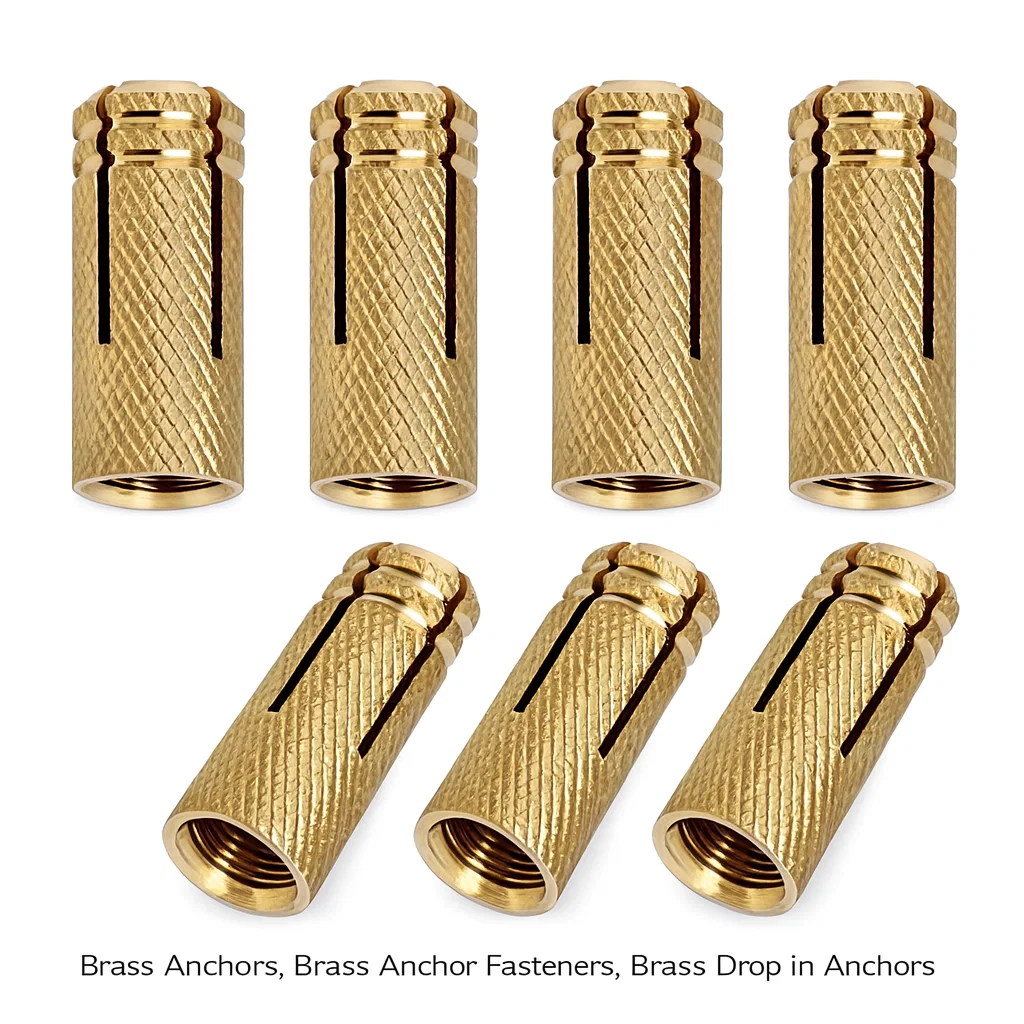

Brass Anchors, Brass Anchor Fasteners, Brass Drop in Anchors
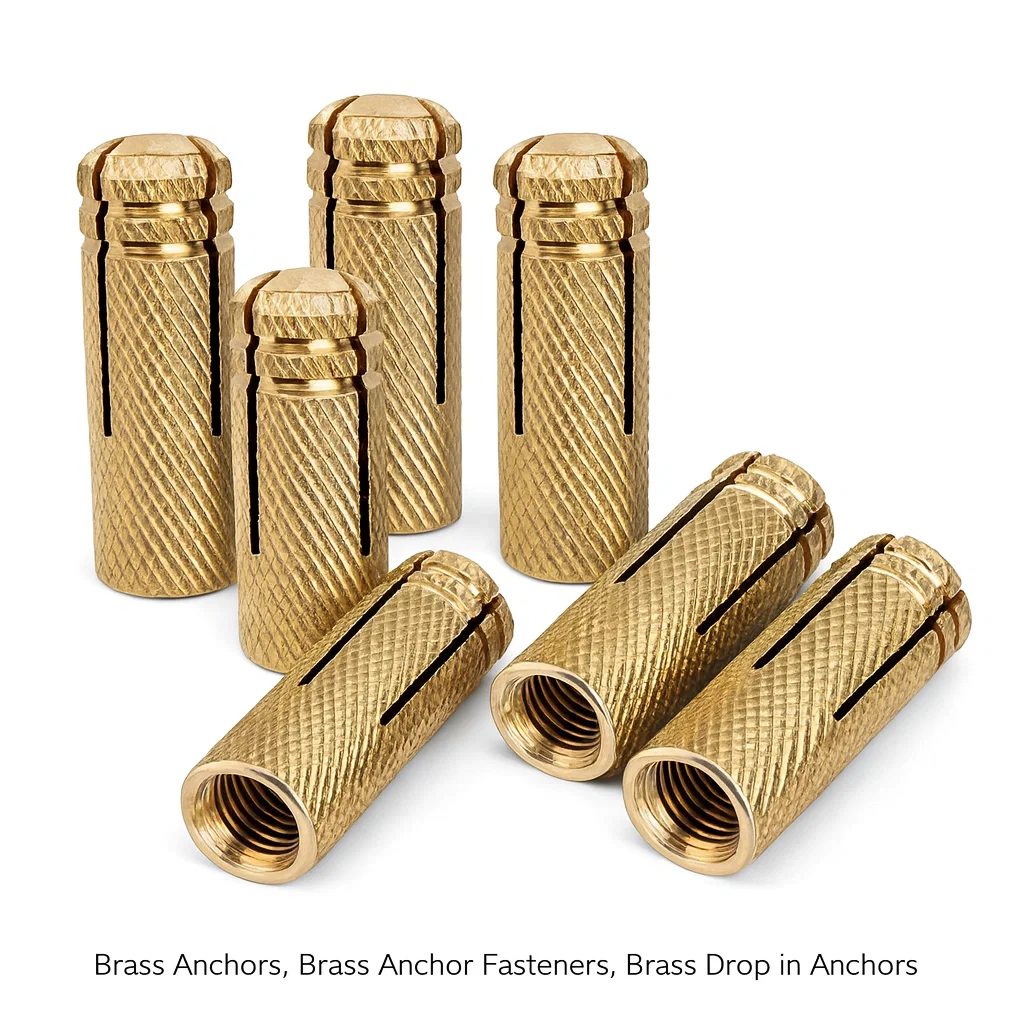
Brass Drop-in Anchors & Brass Expansion Anchors and Brass Anchor Fasteners
Premium Brass Anchoring Solutions for Professional Applications
We manufacture high-precision brass drop-in anchors and expansion fasteners designed for permanent, reliable fastening in concrete, masonry, and specialized substrates. Our brass anchors combine the corrosion resistance of brass alloys with precision-engineered expansion mechanisms for applications where ferrous materials would fail.
We manufacture high-precision brass drop-in anchors and expansion fasteners designed for permanent, reliable fastening in concrete, masonry, and specialized substrates. Our brass anchors combine the corrosion resistance of brass alloys with precision-engineered expansion mechanisms for applications where ferrous materials would fail.
Understanding Brass Drop-in Anchors
Brass drop-in anchors represent a specialized category of expansion fasteners engineered for environments where standard steel anchors would corrode or create galvanic reactions. Unlike traditional steel expansion anchors, our brass variants offer exceptional performance in marine environments, chemical processing facilities, electrical installations, and architectural applications where aesthetics matter.
The drop-in design features an internally threaded expansion sleeve that, when the setting tool is driven, expands against the walls of a pre-drilled hole. This creates a mechanical interlock that distributes loads across a larger surface area than conventional anchors, making brass drop-in anchors particularly effective in concrete, brick, and stone substrates.
Technical Specifications
Available Sizes and Dimensions
| Anchor Size | Thread | Drill Hole Diameter | Minimum Embedment Depth | Overall Length | Maximum Fixture Thickness |
|---|---|---|---|---|---|
| M5 | M5 x 0.8 | 8mm | 25mm | 28-30mm | 5mm |
| M6 | M6 x 1.0 | 10mm | 30mm | 32-35mm | 6mm |
| M8 | M8 x 1.25 | 12mm | 40mm | 42-45mm | 8mm |
| M10 | M10 x 1.5 | 16mm | 50mm | 52-55mm | 10mm |
| M12 | M12 x 1.75 | 18mm | 60mm | 62-65mm | 12mm |
Material Composition and Properties
Our brass drop-in anchors are manufactured from high-quality brass alloys, typically CuZn37 (CW508L) or CuZn39Pb3 (CW614N) conforming to international standards including EN 12164, ASTM B16, and IS 319. The material selection balances strength requirements with machinability and corrosion resistance.
Mechanical Properties
- Tensile Strength: 370-450 MPa
- Yield Strength: 120-280 MPa
- Elongation: 15-25%
- Hardness: 80-120 HV
Physical Properties
- Density: 8.4-8.5 g/cm³
- Thermal Conductivity: 120 W/m·K
- Electrical Conductivity: 28% IACS
- Melting Point: 900-940°C
Corrosion Resistance
- Excellent resistance to atmospheric corrosion
- Superior performance in marine environments
- Resistant to dezincification in most conditions
- Compatible with masonry alkalinity
Key Advantages of Brass Anchor Fasteners
Choosing brass over steel for anchor applications isn’t merely a corrosion consideration. The unique properties of brass alloys deliver performance benefits that extend the service life and reliability of installed systems.
Corrosion Resistance and Longevity
Brass anchors excel in environments where moisture, salt spray, or chemical exposure would rapidly degrade ferrous fasteners. In coastal construction, swimming pool installations, and outdoor architectural applications, brass drop-in anchors maintain their holding strength for decades. The natural patina that develops on brass surfaces actually provides additional protection rather than compromising structural integrity.
Non-Magnetic Properties
For installations in medical facilities, laboratories, and sensitive electronic environments, the non-magnetic nature of brass prevents interference with imaging equipment, precision instruments, and electromagnetic fields. This makes brass anchors the preferred choice for MRI rooms, research laboratories, and telecommunications installations.
Electrical Conductivity
While providing electrical grounding where needed, brass anchors also offer controlled conductivity that prevents galvanic corrosion when securing brass, copper, or bronze fixtures. The electrical properties of brass eliminate the galvanic couples that occur when dissimilar metals contact in the presence of electrolytes.
Aesthetic Appeal
In architectural and decorative applications, brass anchors can remain visible without detracting from the design. The warm golden tone of brass complements bronze fixtures, copper cladding, and brass hardware, creating a cohesive appearance in high-end installations.
Applications Across Industries for Brass Anchors
Marine and Coastal Construction
Shipyards, marinas, and coastal buildings face constant exposure to salt-laden air and moisture. Brass drop-in anchors secure handrails, cleats, electrical panels, and structural components in these challenging environments. The material’s resistance to salt water corrosion makes it indispensable for dock construction, boardwalks, and seaside infrastructure.
Electrical and Telecommunications
Electrical contractors rely on brass anchors when mounting switch gear, junction boxes, cable trays, and grounding systems. The conductivity of brass provides reliable grounding paths while the corrosion resistance ensures long-term electrical integrity. Telecommunications installations use brass anchors for antenna mounting, equipment racks, and cable management systems.
Chemical Processing and Industrial Facilities
Chemical plants, pharmaceutical manufacturing, and food processing facilities require fasteners that won’t contaminate products or corrode in the presence of acids, alkalis, or sanitizing chemicals. Brass anchors meet FDA compliance requirements for food-contact areas and resist the aggressive cleaning protocols common in these industries.
Architectural and Historical Restoration
Architects and restoration specialists choose brass anchors for their visual compatibility with period hardware and their ability to secure fixtures without rust staining. Historic building preservation projects particularly benefit from brass anchors that won’t bleed rust onto limestone, marble, or ornamental plasterwork.
Swimming Pools and Aquatic Facilities
The chlorinated water environment of swimming pools rapidly destroys standard steel fasteners. Brass drop-in anchors secure starting blocks, lane dividers, handrails, and pool equipment while resisting both chlorine and the alkaline nature of concrete pool structures.
HVAC and Mechanical Systems
When securing air handling units, ductwork supports, and mechanical equipment to concrete or masonry, brass anchors provide reliable fastening that won’t corrode from condensation or react with copper refrigeration lines and brass fittings common in HVAC systems.
Installation Guidelines
Surface Preparation
Successful anchor installation begins with proper substrate preparation. The concrete or masonry must have achieved its design strength, typically 2,500 PSI minimum for most applications. Surface defects, excessive dust, or moisture in the drilled hole can compromise anchor performance.
Hole Drilling Procedures
Precision in hole diameter and depth directly affects anchor performance. Use carbide-tipped masonry drill bits matching the specified diameter for each anchor size. Drill perpendicular to the substrate surface to the minimum embedment depth plus 10-15mm for debris accumulation. Rotary hammer drills with the impact function engaged produce cleaner holes in concrete, while standard rotary drilling works better for brick and soft stone.
Hole Cleaning
Remove all drilling debris using compressed air, wire brushes, or vacuum equipment. Residual dust prevents complete anchor expansion and reduces holding strength. Blow out holes from the bottom up to ensure particles exit completely.
Anchor Setting
Insert the brass drop-in anchor flush with or slightly below the substrate surface. Use the appropriately sized setting tool, striking it firmly until the expansion mechanism fully engages. The tool will bottom out when expansion is complete, creating the characteristic solid feel and sound. Over-driving can damage the threads, while under-setting compromises load capacity.
Bolt Installation and Torque
Thread bolts or threaded rods into the installed anchors hand-tight initially, then apply the recommended torque values. For M5 anchors, 4-6 N⋅m typically suffices. M6 requires 8-10 N⋅m, M8 needs 15-20 N⋅m, M10 anchors accept 25-35 N⋅m, and M12 can handle 40-50 N⋅m. These values assume normal concrete conditions; reduce torque by 20-30% for softer substrates or when installing near edges.
Load Capacities and Safety Factors
Tensile and Shear Performance
| Anchor Size | Ultimate Tensile Load (kN) | Working Tensile Load (kN) | Ultimate Shear Load (kN) | Working Shear Load (kN) |
|---|---|---|---|---|
| M5 | 3.5-4.0 | 1.2-1.3 | 2.5-3.0 | 0.8-1.0 |
| M6 | 5.5-6.5 | 1.8-2.2 | 4.0-4.5 | 1.3-1.5 |
| M8 | 9.0-11.0 | 3.0-3.7 | 6.5-8.0 | 2.2-2.7 |
| M10 | 14.0-17.0 | 4.7-5.7 | 10.0-12.0 | 3.3-4.0 |
| M12 | 20.0-24.0 | 6.7-8.0 | 14.0-17.0 | 4.7-5.7 |
Note: Load capacities assume installation in 25 MPa concrete with minimum embedment depths and edge distances. Working loads incorporate a 3:1 safety factor. Actual performance varies with substrate quality, installation technique, and environmental conditions. Always consult structural engineers for critical applications.
Factors Affecting Load Capacity
Several variables influence the actual holding strength achieved in field installations. Concrete compressive strength, anchor spacing, edge distance, and the presence of cracks or voids all affect performance. In cracked concrete, load capacity can decrease by 40-60% compared to uncracked conditions. Spacing anchors closer than 10 diameters apart or installing within 5 diameters of an edge similarly reduces individual anchor capacity.
Quality Assurance and Certifications of Brass Anchors and Brass Anchor Fasteners
We manufacture brass drop-in anchors, Brass Anchor Fasteners under ISO 9001:2015 certified quality management systems. Each production batch undergoes dimensional verification, material composition analysis via spectrometry, and mechanical testing to verify tensile strength and expansion characteristics.
International Standards Compliance
Specify the brass alloy and product standard, thread dimensions, substrate and required anchor performance. ISO 898 covers steel fasteners and does not assign strength classes to brass anchors. ASTM B16 covers free-cutting brass rod, bar and shapes. Neither a raw-material standard nor a matching thread establishes anchor load capacity.
Testing and Inspection
Beyond standard production testing, we provide mill test certificates documenting material composition and mechanical properties. Pull-out testing on sample installations verifies expansion mechanism effectiveness and load transfer efficiency. Our quality control protocols include visual inspection for surface defects, thread gauge verification, and dimensional measurement to ensure consistency across production runs.
Comparative Analysis: Brass vs. Alternative Materials
Brass vs. Stainless Steel Anchors
While stainless steel offers superior strength, brass provides better machinability, thermal conductivity, and costs less for equivalent corrosion resistance in most environments. Stainless steel excels in extremely high-stress applications or where maximum corrosion resistance is required, but brass suffices for the majority of general construction needs at a lower total cost.
Brass vs. Galvanized Steel
Galvanized coatings eventually fail in harsh environments, exposing the underlying steel to corrosion. Brass remains consistent throughout its cross-section, meaning scratches, abrasions, or thread damage don’t compromise corrosion resistance. The longevity of brass anchors far exceeds galvanized alternatives in coastal or industrial settings.
Brass vs. Plastic Anchors
Plastic anchors lack the load capacity, temperature resistance, and UV stability of brass. While suitable for light-duty residential applications, plastic fails in structural fastening, outdoor exposure, or anywhere elevated temperatures occur. Brass maintains its properties from -40°C to +200°C, well beyond the capabilities of polymer anchors.
Design Considerations for Engineers
Edge Distance and Spacing Requirements
Proper anchor layout prevents concrete breakout and ensures each anchor develops its full capacity. Minimum edge distances should equal 10 times the anchor diameter for M5-M8 sizes and 12 times diameter for M10-M12. Center-to-center spacing between anchors should exceed 10 diameters to prevent interaction effects that reduce individual anchor strength.
Combined Loading Scenarios
When anchors experience both tensile and shear loads simultaneously, apply the interaction equation: (V/Vallow)² + (T/Tallow)² ≤ 1.0, where V is applied shear, T is applied tension, and the subscripted values represent allowable loads. This ensures safe performance under complex loading conditions.
Dynamic and Seismic Loading
For applications involving vibration, impact, or seismic forces, reduce working loads by 25-30% or increase the safety factor to 4:1. Consider using anchor adhesive in the hole before installation to enhance resistance to cyclic loading. Critical seismic applications may require engineered anchor systems with specific earthquake resistance ratings.
Thermal Expansion Considerations
The thermal expansion coefficient of brass (approximately 19 x 10⁻⁶ /°C) closely matches concrete (10-14 x 10⁻⁶ /°C), minimizing thermal stress compared to steel anchors. In applications with significant temperature cycling, this compatibility reduces the risk of anchor loosening or concrete spalling.
Maintenance and Service Life
Inspection Protocols
Installed brass anchors require minimal maintenance but benefit from periodic inspection in critical applications. Check for signs of concrete cracking around anchors, fixture loosening, or excessive movement under load. In corrosive environments, clean accumulated deposits annually and verify torque values on accessible fasteners.
Expected Service Life
Properly installed brass drop-in anchors in suitable applications should provide 50+ years of reliable service. In benign indoor environments, essentially indefinite service life is expected. Even in harsh marine atmospheres, brass anchors outlast multiple generations of equipment they secure, often remaining serviceable when the surrounding structure undergoes renovation.
Removal and Replacement
Unlike some anchor types, drop-in anchors cannot be removed without damaging the surrounding substrate. Planning for future modifications should account for this permanence. When removal is necessary, drill out the anchor using progressively larger bits or use a small chisel to collapse the expansion mechanism, then extract the remnants.
Environmental and Sustainability Considerations
Brass anchors contribute to sustainable construction practices through their longevity, recyclability, and reduced maintenance requirements. At the end of their service life, brass components can be recovered and recycled without loss of material properties, making them truly circular materials. The reduced need for replacement compared to ferrous alternatives minimizes waste and lifecycle environmental impact.
The manufacturing process for brass anchors generates minimal hazardous waste compared to plating processes required for corrosion-resistant steel products. Our production facilities employ closed-loop cooling systems and recycle all metal waste, including chips and turnings from machining operations.
Ordering Information and Technical Support
Product Availability
We maintain inventory of standard brass drop-in anchors in M5, M6, M8, M10, and M12 sizes for immediate delivery. Minimum order quantities, packaging options, and volume pricing are available upon request. We can manufacture custom sizes, lengths, or specifications for OEM applications and special projects.
Custom Manufacturing Capabilities
Our manufacturing flexibility extends beyond standard sizes. We produce brass anchors with modified thread pitches, extended lengths for thick fixture applications, and special alloys for unique environmental conditions. Custom knurling patterns, expansion designs, and dimensional modifications are available to meet specific project requirements.
Technical Documentation
Complete technical data sheets, CAD drawings, installation instructions, and load tables are available for download or upon request. Our engineering team provides application support including anchor selection, spacing calculations, and installation methodology for complex projects.
Global Distribution
We export brass drop-in anchors to construction markets worldwide, with particular expertise serving customers in the USA, UK, Canada, and Australia. Our logistics network ensures reliable delivery schedules, and we accommodate various international standards and certification requirements.
Frequently Asked Questions
Can brass anchors be used in cracked concrete?
While brass drop-in anchors can function in cracked concrete, their load capacity significantly decreases, sometimes by more than 50%. For applications where cracking is present or anticipated, consider through-bolt designs or chemical adhesive anchors that maintain performance in cracked substrates. Always reduce working loads appropriately when installing in questionable concrete conditions.
What’s the difference between drop-in anchors and expansion anchors?
Drop-in anchors are a specific type of expansion anchor that sits flush with or below the surface and accepts threaded fasteners. The term “drop-in” refers to the installation method where the anchor literally drops into a pre-drilled hole. All drop-in anchors are expansion anchors, but not all expansion anchors use the drop-in configuration.
How do I select the correct anchor size for my application?
Start with the bolt or threaded rod diameter required for your fixture, then select the matching anchor thread size. Verify that the anticipated loads (both tensile and shear) fall well below the working load capacity with appropriate safety factors. Consider substrate quality, edge distances, and environmental conditions in your selection process.
Can I reuse the hole if an anchor fails or needs replacement?
Reusing anchor holes is generally not recommended as the expansion process can damage the concrete in ways that compromise subsequent installations. If replacement is necessary, drill a new hole at least 4 anchor diameters away from the failed location, or drill out the old hole to a larger size and install an oversized anchor.
Are brass anchors suitable for overhead applications?
Yes, brass drop-in anchors perform reliably in overhead installations when properly sized and installed. The key is ensuring adequate safety factors (typically 4:1 or higher for overhead applications) and proper installation technique. Consider using thread-locking compounds to prevent loosening from vibration in critical overhead applications.
How does temperature affect Brass anchor performance?
Brass maintains its mechanical properties across a wide temperature range from -40°C to approximately +200°C. Beyond these extremes, strength begins to degrade. The thermal expansion compatibility with concrete minimizes stress from temperature cycling, making brass anchors excellent for outdoor applications experiencing seasonal temperature variations.
Why Choose us for Brass Anchors and Brass anchor Fasteners?
With decades of experience manufacturing precision brass components for global markets, we bring unmatched expertise to brass anchor production. Our ISO-certified facilities employ advanced machining centers and rigorous quality control to ensure every anchor meets exacting specifications.
We understand that fastener reliability directly impacts project success and long-term structural integrity. That’s why we invest in premium brass alloys, precision tooling, and comprehensive testing protocols. Our technical team works directly with engineers, contractors, and distributors to solve challenging fastening problems and recommend optimal solutions.
From initial specification review through delivery and installation support, we provide the expertise and products that professional contractors and engineers depend on. Our commitment to quality, technical innovation, and customer service has made us a trusted supplier to major construction projects, industrial facilities, and specialty applications worldwide.
Request a Quote or Technical Consultation
Contact our technical sales team for pricing, custom manufacturing inquiries, or application-specific guidance. We’re here to help you select the right brass anchor fasteners for your project requirements.
Experience the difference that precision manufacturing and technical expertise make in your next installation.
Brass Anchors, Brass Anchor Fasteners, Brass Drop in Anchors
Brass Drop-in Anchors & Brass Expansion Anchors and Brass Anchor Fasteners
Premium Brass Anchoring Solutions for Professional Applications
We manufacture high-precision brass drop-in anchors and expansion fasteners designed for permanent, reliable fastening in concrete, masonry, and specialized substrates. Our brass anchors combine the corrosion resistance of brass alloys with precision-engineered expansion mechanisms for applications where ferrous materials would fail.
We manufacture high-precision brass drop-in anchors and expansion fasteners designed for permanent, reliable fastening in concrete, masonry, and specialized substrates. Our brass anchors combine the corrosion resistance of brass alloys with precision-engineered expansion mechanisms for applications where ferrous materials would fail.
Understanding Brass Drop-in Anchors
Brass drop-in anchors represent a specialized category of expansion fasteners engineered for environments where standard steel anchors would corrode or create galvanic reactions. Unlike traditional steel expansion anchors, our brass variants offer exceptional performance in marine environments, chemical processing facilities, electrical installations, and architectural applications where aesthetics matter.
The drop-in design features an internally threaded expansion sleeve that, when the setting tool is driven, expands against the walls of a pre-drilled hole. This creates a mechanical interlock that distributes loads across a larger surface area than conventional anchors, making brass drop-in anchors particularly effective in concrete, brick, and stone substrates.
Technical Specifications
Available Sizes and Dimensions
| Anchor Size | Thread | Drill Hole Diameter | Minimum Embedment Depth | Overall Length | Maximum Fixture Thickness |
|---|---|---|---|---|---|
| M5 | M5 x 0.8 | 8mm | 25mm | 28-30mm | 5mm |
| M6 | M6 x 1.0 | 10mm | 30mm | 32-35mm | 6mm |
| M8 | M8 x 1.25 | 12mm | 40mm | 42-45mm | 8mm |
| M10 | M10 x 1.5 | 16mm | 50mm | 52-55mm | 10mm |
| M12 | M12 x 1.75 | 18mm | 60mm | 62-65mm | 12mm |
Material Composition and Properties
Our brass drop-in anchors are manufactured from high-quality brass alloys, typically CuZn37 (CW508L) or CuZn39Pb3 (CW614N) conforming to international standards including EN 12164, ASTM B16, and IS 319. The material selection balances strength requirements with machinability and corrosion resistance.
Mechanical Properties
- Tensile Strength: 370-450 MPa
- Yield Strength: 120-280 MPa
- Elongation: 15-25%
- Hardness: 80-120 HV
Physical Properties
- Density: 8.4-8.5 g/cm³
- Thermal Conductivity: 120 W/m·K
- Electrical Conductivity: 28% IACS
- Melting Point: 900-940°C
Corrosion Resistance
- Excellent resistance to atmospheric corrosion
- Superior performance in marine environments
- Resistant to dezincification in most conditions
- Compatible with masonry alkalinity
Key Advantages of Brass Anchor Fasteners
Choosing brass over steel for anchor applications isn’t merely a corrosion consideration. The unique properties of brass alloys deliver performance benefits that extend the service life and reliability of installed systems.
Corrosion Resistance and Longevity
Brass anchors excel in environments where moisture, salt spray, or chemical exposure would rapidly degrade ferrous fasteners. In coastal construction, swimming pool installations, and outdoor architectural applications, brass drop-in anchors maintain their holding strength for decades. The natural patina that develops on brass surfaces actually provides additional protection rather than compromising structural integrity.
Non-Magnetic Properties
For installations in medical facilities, laboratories, and sensitive electronic environments, the non-magnetic nature of brass prevents interference with imaging equipment, precision instruments, and electromagnetic fields. This makes brass anchors the preferred choice for MRI rooms, research laboratories, and telecommunications installations.
Electrical Conductivity
While providing electrical grounding where needed, brass anchors also offer controlled conductivity that prevents galvanic corrosion when securing brass, copper, or bronze fixtures. The electrical properties of brass eliminate the galvanic couples that occur when dissimilar metals contact in the presence of electrolytes.
Aesthetic Appeal
In architectural and decorative applications, brass anchors can remain visible without detracting from the design. The warm golden tone of brass complements bronze fixtures, copper cladding, and brass hardware, creating a cohesive appearance in high-end installations.
Applications Across Industries for Brass Anchors
Marine and Coastal Construction
Shipyards, marinas, and coastal buildings face constant exposure to salt-laden air and moisture. Brass drop-in anchors secure handrails, cleats, electrical panels, and structural components in these challenging environments. The material’s resistance to salt water corrosion makes it indispensable for dock construction, boardwalks, and seaside infrastructure.
Electrical and Telecommunications
Electrical contractors rely on brass anchors when mounting switch gear, junction boxes, cable trays, and grounding systems. The conductivity of brass provides reliable grounding paths while the corrosion resistance ensures long-term electrical integrity. Telecommunications installations use brass anchors for antenna mounting, equipment racks, and cable management systems.
Chemical Processing and Industrial Facilities
Chemical plants, pharmaceutical manufacturing, and food processing facilities require fasteners that won’t contaminate products or corrode in the presence of acids, alkalis, or sanitizing chemicals. Brass anchors meet FDA compliance requirements for food-contact areas and resist the aggressive cleaning protocols common in these industries.
Architectural and Historical Restoration
Architects and restoration specialists choose brass anchors for their visual compatibility with period hardware and their ability to secure fixtures without rust staining. Historic building preservation projects particularly benefit from brass anchors that won’t bleed rust onto limestone, marble, or ornamental plasterwork.
Swimming Pools and Aquatic Facilities
The chlorinated water environment of swimming pools rapidly destroys standard steel fasteners. Brass drop-in anchors secure starting blocks, lane dividers, handrails, and pool equipment while resisting both chlorine and the alkaline nature of concrete pool structures.
HVAC and Mechanical Systems
When securing air handling units, ductwork supports, and mechanical equipment to concrete or masonry, brass anchors provide reliable fastening that won’t corrode from condensation or react with copper refrigeration lines and brass fittings common in HVAC systems.
Installation Guidelines
Surface Preparation
Successful anchor installation begins with proper substrate preparation. The concrete or masonry must have achieved its design strength, typically 2,500 PSI minimum for most applications. Surface defects, excessive dust, or moisture in the drilled hole can compromise anchor performance.
Hole Drilling Procedures
Precision in hole diameter and depth directly affects anchor performance. Use carbide-tipped masonry drill bits matching the specified diameter for each anchor size. Drill perpendicular to the substrate surface to the minimum embedment depth plus 10-15mm for debris accumulation. Rotary hammer drills with the impact function engaged produce cleaner holes in concrete, while standard rotary drilling works better for brick and soft stone.
Hole Cleaning
Remove all drilling debris using compressed air, wire brushes, or vacuum equipment. Residual dust prevents complete anchor expansion and reduces holding strength. Blow out holes from the bottom up to ensure particles exit completely.
Anchor Setting
Insert the brass drop-in anchor flush with or slightly below the substrate surface. Use the appropriately sized setting tool, striking it firmly until the expansion mechanism fully engages. The tool will bottom out when expansion is complete, creating the characteristic solid feel and sound. Over-driving can damage the threads, while under-setting compromises load capacity.
Bolt Installation and Torque
Thread bolts or threaded rods into the installed anchors hand-tight initially, then apply the recommended torque values. For M5 anchors, 4-6 N⋅m typically suffices. M6 requires 8-10 N⋅m, M8 needs 15-20 N⋅m, M10 anchors accept 25-35 N⋅m, and M12 can handle 40-50 N⋅m. These values assume normal concrete conditions; reduce torque by 20-30% for softer substrates or when installing near edges.
Load Capacities and Safety Factors
Tensile and Shear Performance
| Anchor Size | Ultimate Tensile Load (kN) | Working Tensile Load (kN) | Ultimate Shear Load (kN) | Working Shear Load (kN) |
|---|---|---|---|---|
| M5 | 3.5-4.0 | 1.2-1.3 | 2.5-3.0 | 0.8-1.0 |
| M6 | 5.5-6.5 | 1.8-2.2 | 4.0-4.5 | 1.3-1.5 |
| M8 | 9.0-11.0 | 3.0-3.7 | 6.5-8.0 | 2.2-2.7 |
| M10 | 14.0-17.0 | 4.7-5.7 | 10.0-12.0 | 3.3-4.0 |
| M12 | 20.0-24.0 | 6.7-8.0 | 14.0-17.0 | 4.7-5.7 |
Note: Load capacities assume installation in 25 MPa concrete with minimum embedment depths and edge distances. Working loads incorporate a 3:1 safety factor. Actual performance varies with substrate quality, installation technique, and environmental conditions. Always consult structural engineers for critical applications.
Factors Affecting Load Capacity
Several variables influence the actual holding strength achieved in field installations. Concrete compressive strength, anchor spacing, edge distance, and the presence of cracks or voids all affect performance. In cracked concrete, load capacity can decrease by 40-60% compared to uncracked conditions. Spacing anchors closer than 10 diameters apart or installing within 5 diameters of an edge similarly reduces individual anchor capacity.
Quality Assurance and Certifications of Brass Anchors and Brass Anchor Fasteners
We manufacture brass drop-in anchors, Brass Anchor Fasteners under ISO 9001:2015 certified quality management systems. Each production batch undergoes dimensional verification, material composition analysis via spectrometry, and mechanical testing to verify tensile strength and expansion characteristics.
International Standards Compliance
Our brass anchors conform to relevant international standards including ISO 898 for mechanical properties of fasteners, EN 12164 for copper and copper alloys, and ASTM B16 for brass plate, sheet, strip, and rolled bar. This compliance ensures interchangeability with standard threaded fasteners and predictable performance across global markets.
Testing and Inspection
Beyond standard production testing, we provide mill test certificates documenting material composition and mechanical properties. Pull-out testing on sample installations verifies expansion mechanism effectiveness and load transfer efficiency. Our quality control protocols include visual inspection for surface defects, thread gauge verification, and dimensional measurement to ensure consistency across production runs.
Comparative Analysis: Brass vs. Alternative Materials
Brass vs. Stainless Steel Anchors
While stainless steel offers superior strength, brass provides better machinability, thermal conductivity, and costs less for equivalent corrosion resistance in most environments. Stainless steel excels in extremely high-stress applications or where maximum corrosion resistance is required, but brass suffices for the majority of general construction needs at a lower total cost.
Brass vs. Galvanized Steel
Galvanized coatings eventually fail in harsh environments, exposing the underlying steel to corrosion. Brass remains consistent throughout its cross-section, meaning scratches, abrasions, or thread damage don’t compromise corrosion resistance. The longevity of brass anchors far exceeds galvanized alternatives in coastal or industrial settings.
Brass vs. Plastic Anchors
Plastic anchors lack the load capacity, temperature resistance, and UV stability of brass. While suitable for light-duty residential applications, plastic fails in structural fastening, outdoor exposure, or anywhere elevated temperatures occur. Brass maintains its properties from -40°C to +200°C, well beyond the capabilities of polymer anchors.
Design Considerations for Engineers
Edge Distance and Spacing Requirements
Proper anchor layout prevents concrete breakout and ensures each anchor develops its full capacity. Minimum edge distances should equal 10 times the anchor diameter for M5-M8 sizes and 12 times diameter for M10-M12. Center-to-center spacing between anchors should exceed 10 diameters to prevent interaction effects that reduce individual anchor strength.
Combined Loading Scenarios
When anchors experience both tensile and shear loads simultaneously, apply the interaction equation: (V/Vallow)² + (T/Tallow)² ≤ 1.0, where V is applied shear, T is applied tension, and the subscripted values represent allowable loads. This ensures safe performance under complex loading conditions.
Dynamic and Seismic Loading
For applications involving vibration, impact, or seismic forces, reduce working loads by 25-30% or increase the safety factor to 4:1. Consider using anchor adhesive in the hole before installation to enhance resistance to cyclic loading. Critical seismic applications may require engineered anchor systems with specific earthquake resistance ratings.
Thermal Expansion Considerations
The thermal expansion coefficient of brass (approximately 19 x 10⁻⁶ /°C) closely matches concrete (10-14 x 10⁻⁶ /°C), minimizing thermal stress compared to steel anchors. In applications with significant temperature cycling, this compatibility reduces the risk of anchor loosening or concrete spalling.
Maintenance and Service Life
Inspection Protocols
Installed brass anchors require minimal maintenance but benefit from periodic inspection in critical applications. Check for signs of concrete cracking around anchors, fixture loosening, or excessive movement under load. In corrosive environments, clean accumulated deposits annually and verify torque values on accessible fasteners.
Expected Service Life
Properly installed brass drop-in anchors in suitable applications should provide 50+ years of reliable service. In benign indoor environments, essentially indefinite service life is expected. Even in harsh marine atmospheres, brass anchors outlast multiple generations of equipment they secure, often remaining serviceable when the surrounding structure undergoes renovation.
Removal and Replacement
Unlike some anchor types, drop-in anchors cannot be removed without damaging the surrounding substrate. Planning for future modifications should account for this permanence. When removal is necessary, drill out the anchor using progressively larger bits or use a small chisel to collapse the expansion mechanism, then extract the remnants.
Environmental and Sustainability Considerations
Brass anchors contribute to sustainable construction practices through their longevity, recyclability, and reduced maintenance requirements. At the end of their service life, brass components can be recovered and recycled without loss of material properties, making them truly circular materials. The reduced need for replacement compared to ferrous alternatives minimizes waste and lifecycle environmental impact.
The manufacturing process for brass anchors generates minimal hazardous waste compared to plating processes required for corrosion-resistant steel products. Our production facilities employ closed-loop cooling systems and recycle all metal waste, including chips and turnings from machining operations.
Ordering Information and Technical Support
Product Availability
We maintain inventory of standard brass drop-in anchors in M5, M6, M8, M10, and M12 sizes for immediate delivery. Minimum order quantities, packaging options, and volume pricing are available upon request. We can manufacture custom sizes, lengths, or specifications for OEM applications and special projects.
Custom Manufacturing Capabilities
Our manufacturing flexibility extends beyond standard sizes. We produce brass anchors with modified thread pitches, extended lengths for thick fixture applications, and special alloys for unique environmental conditions. Custom knurling patterns, expansion designs, and dimensional modifications are available to meet specific project requirements.
Technical Documentation
Complete technical data sheets, CAD drawings, installation instructions, and load tables are available for download or upon request. Our engineering team provides application support including anchor selection, spacing calculations, and installation methodology for complex projects.
Global Distribution
We export brass drop-in anchors to construction markets worldwide, with particular expertise serving customers in the USA, UK, Canada, and Australia. Our logistics network ensures reliable delivery schedules, and we accommodate various international standards and certification requirements.
Frequently Asked Questions
Can brass anchors be used in cracked concrete?
While brass drop-in anchors can function in cracked concrete, their load capacity significantly decreases, sometimes by more than 50%. For applications where cracking is present or anticipated, consider through-bolt designs or chemical adhesive anchors that maintain performance in cracked substrates. Always reduce working loads appropriately when installing in questionable concrete conditions.
What’s the difference between drop-in anchors and expansion anchors?
Drop-in anchors are a specific type of expansion anchor that sits flush with or below the surface and accepts threaded fasteners. The term “drop-in” refers to the installation method where the anchor literally drops into a pre-drilled hole. All drop-in anchors are expansion anchors, but not all expansion anchors use the drop-in configuration.
How do I select the correct anchor size for my application?
Start with the bolt or threaded rod diameter required for your fixture, then select the matching anchor thread size. Verify that the anticipated loads (both tensile and shear) fall well below the working load capacity with appropriate safety factors. Consider substrate quality, edge distances, and environmental conditions in your selection process.
Can I reuse the hole if an anchor fails or needs replacement?
Reusing anchor holes is generally not recommended as the expansion process can damage the concrete in ways that compromise subsequent installations. If replacement is necessary, drill a new hole at least 4 anchor diameters away from the failed location, or drill out the old hole to a larger size and install an oversized anchor.
Are brass anchors suitable for overhead applications?
Yes, brass drop-in anchors perform reliably in overhead installations when properly sized and installed. The key is ensuring adequate safety factors (typically 4:1 or higher for overhead applications) and proper installation technique. Consider using thread-locking compounds to prevent loosening from vibration in critical overhead applications.
How does temperature affect Brass anchor performance?
Brass maintains its mechanical properties across a wide temperature range from -40°C to approximately +200°C. Beyond these extremes, strength begins to degrade. The thermal expansion compatibility with concrete minimizes stress from temperature cycling, making brass anchors excellent for outdoor applications experiencing seasonal temperature variations.
Why Choose us for Brass Anchors and Brass anchor Fasteners?
With decades of experience manufacturing precision brass components for global markets, we bring unmatched expertise to brass anchor production. Our ISO-certified facilities employ advanced machining centers and rigorous quality control to ensure every anchor meets exacting specifications.
We understand that fastener reliability directly impacts project success and long-term structural integrity. That’s why we invest in premium brass alloys, precision tooling, and comprehensive testing protocols. Our technical team works directly with engineers, contractors, and distributors to solve challenging fastening problems and recommend optimal solutions.
From initial specification review through delivery and installation support, we provide the expertise and products that professional contractors and engineers depend on. Our commitment to quality, technical innovation, and customer service has made us a trusted supplier to major construction projects, industrial facilities, and specialty applications worldwide.
Request a Quote or Technical Consultation
Contact our technical sales team for pricing, custom manufacturing inquiries, or application-specific guidance. We’re here to help you select the right brass anchor fasteners for your project requirements.
Experience the difference that precision manufacturing and technical expertise make in your next installation.