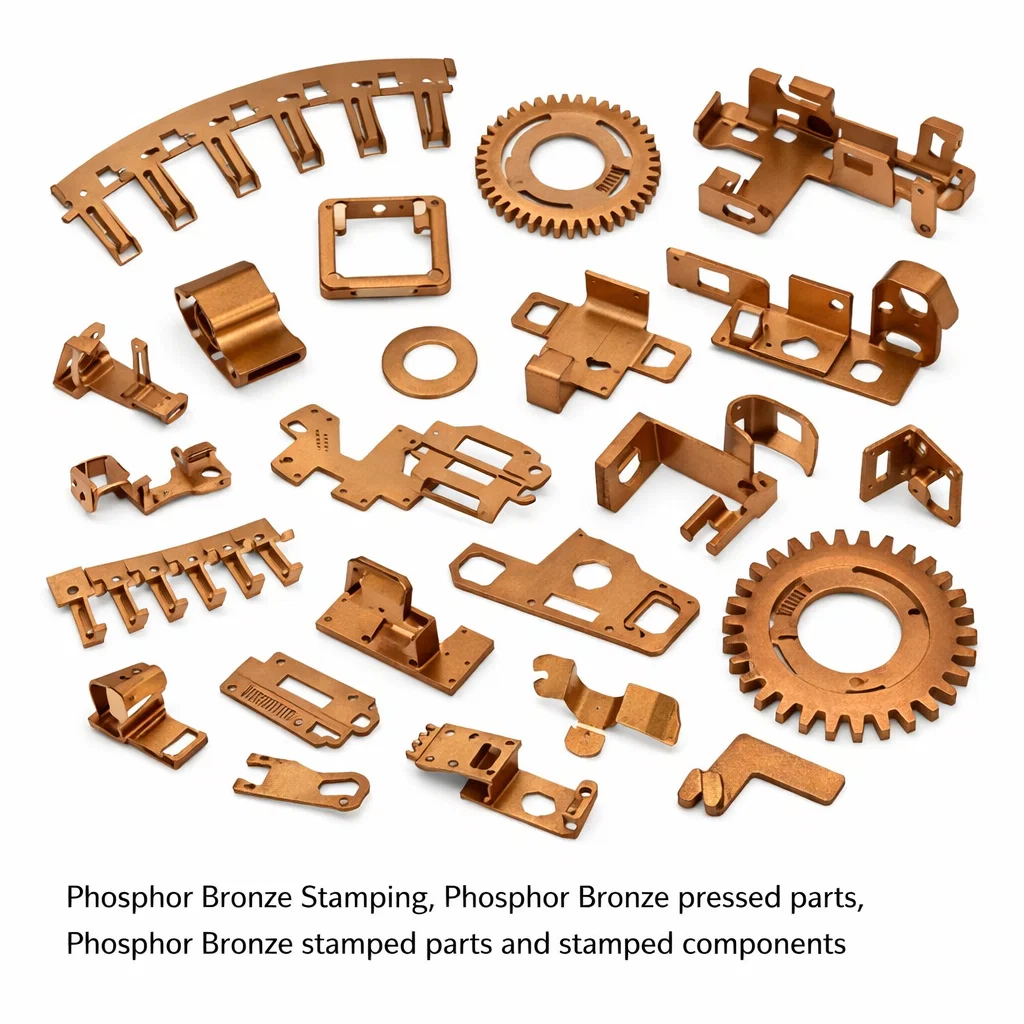

Phosphor Bronze Stamping, Phosphor Bronze pressed parts, Phosphor Bronze Stamped Parts and Stamped Components
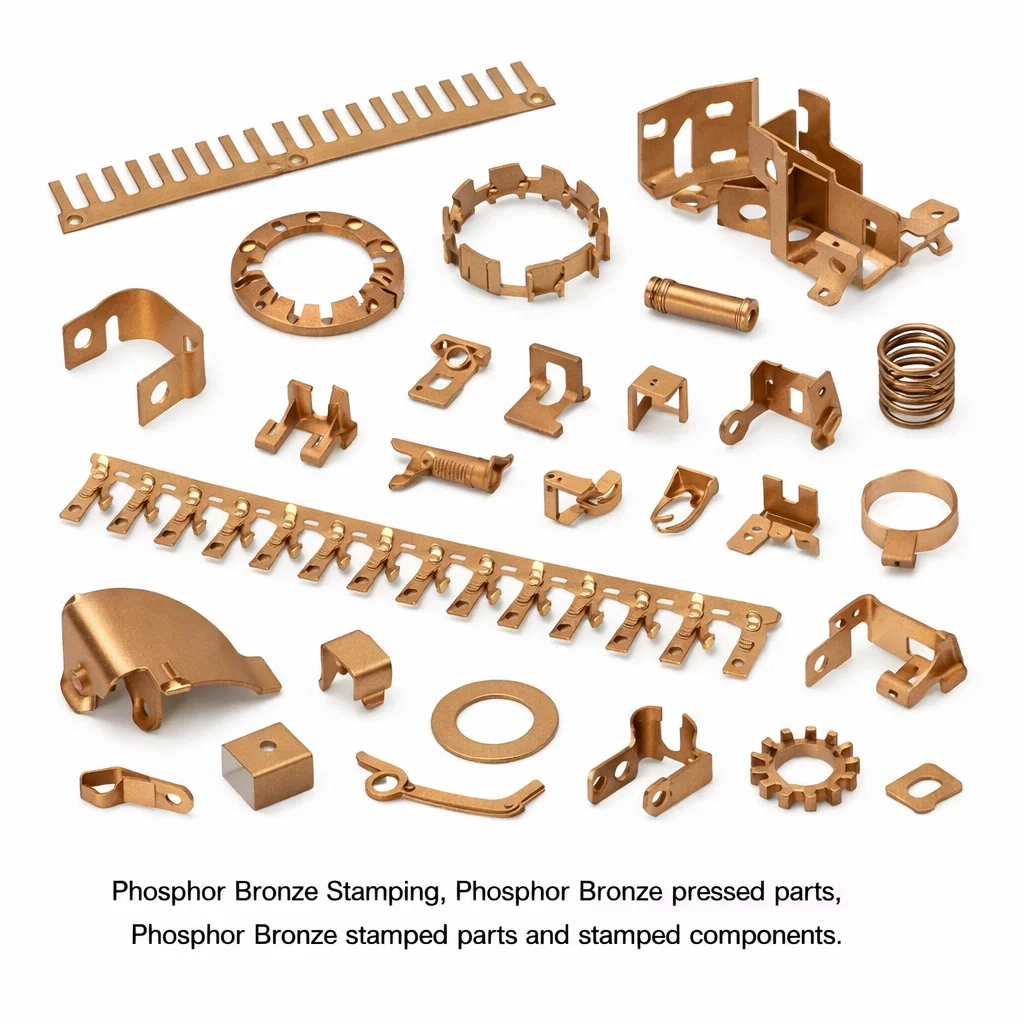
Phosphor bronze stamping is one of the most sought-after metal forming processes in the United States, widely used across electronics, aerospace, automotive, telecommunications, and defense industries. With superior spring properties, excellent electrical conductivity, and outstanding corrosion resistance, phosphor bronze stamped and pressed parts deliver unmatched performance where reliability is non-negotiable.
This comprehensive guide covers everything US engineers, procurement specialists, and OEM buyers need to know about phosphor bronze stamping, including material grades, manufacturing processes, industry applications, tolerances, and how to source the right supplier for your application.
What Is Phosphor Bronze?
Phosphor bronze is a copper-based alloy containing copper (Cu), tin (Sn), and phosphorus (P). The addition of tin enhances strength and corrosion resistance, while phosphorus improves wear resistance, deoxidizes the melt, and adds spring-like elastic behavior. The result is a metal that is hard, tough, and highly workable — perfectly suited for precision stamping and deep drawing operations.
Key characteristics of phosphor bronze include:
- High tensile strength combined with ductility
- Excellent fatigue resistance and spring-back properties
- Superior corrosion resistance in marine and humid environments
- Good electrical and thermal conductivity
- Outstanding cold workability for complex stamping geometries
- Non-magnetic and non-sparking properties
- RoHS compliant (lead-free) formulations available
Phosphor Bronze Material Grades Used in Stamping
Selecting the correct grade of phosphor bronze is critical for achieving the desired mechanical performance in stamped and pressed components. The following grades are most commonly used in US stamping operations:
C51000 – Phosphor Bronze, 5% A (Most Common)
Composition: Cu 94.5–96%, Sn 4.2–5.8%, P 0.03–0.35%
Tensile Strength: Up to 105 ksi (725 MPa) in spring temper
Applications: Electrical contacts, springs, connectors, clips, washers
Tempers Available: Annealed, Quarter Hard, Half Hard, Hard, Spring, Extra Spring
C51100 – Phosphor Bronze, 5% A Modified
Composition: Cu 95.6–98.5%, Sn 1.0–2.0%, P 0.01–0.35%
Tensile Strength: Up to 90 ksi
Applications: Bearing shells, bushings, thrust washers, stamped contact parts
Note: Lower tin content, excellent formability for intricate stampings
C52100 – Phosphor Bronze, 8% C
Composition: Cu 91.0–93.2%, Sn 7.0–9.0%, P 0.03–0.35%
Tensile Strength: Up to 120 ksi in spring temper
Applications: High-stress springs, connectors, high-cycle electrical contacts
Note: Higher strength than C51000; preferred where fatigue life is paramount
C52400 – Phosphor Bronze, 10% D
Composition: Cu 89.0–91.0%, Sn 9.0–11.0%, P 0.03–0.35%
Tensile Strength: Up to 130 ksi
Applications: Heavy-duty springs, high-load electrical contacts, switch components
Note: Maximum strength grade; slightly reduced formability compared to C51000
C50500 – Phosphor Bronze, 1.25%
Composition: Cu 98.5% min, Sn 1.0–2.0%, P 0.01–0.35%
Tensile Strength: Up to 75 ksi
Applications: Low-stress stampings, architectural hardware, decorative parts
Note: Highest conductivity in the phosphor bronze family
Temper Designations for Phosphor Bronze Stampings
Temper selection dramatically affects the forming behavior and final part performance:
- O (Annealed): Fully soft; maximum formability, minimum strength
- H01 (Quarter Hard): Moderate formability, improved strength
- H02 (Half Hard): Good balance of formability and strength
- H04 (Hard): High strength, limited bending; suited for flat stampings
- H06 (Extra Hard): Very high strength, minimal formability
- H08 (Spring): Maximum elasticity; ideal for contact springs and clips
- H10 (Extra Spring): Highest hardness; used in precision spring contacts
The Phosphor Bronze Stamping Process Explained
Metal stamping is a cold-forming process that converts flat sheet metal or coil stock into net-shape or near-net-shape components using dies and presses. For phosphor bronze, this process is especially effective because of the material’s excellent cold-workability and consistent springback behavior.
Progressive Die Stamping
Progressive die stamping feeds a coil of phosphor bronze strip through a series of stations in a single die set. Each station performs a specific operation — blanking, piercing, forming, bending, coining — until the final part is produced at the last station. This method is ideal for high-volume production of small-to-medium phosphor bronze components such as electrical contacts, terminal pins, and spring clips.
Compound Die Stamping
Compound dies perform multiple operations (typically blanking and piercing) in a single press stroke. They produce highly accurate flat parts with tight tolerances. Phosphor bronze washers, shims, and flat blanks are commonly produced using compound dies.
Transfer Die Stamping
Transfer stamping moves individual blanks from one die station to the next using mechanical fingers or transfer rails. This process is preferred for larger or more complex phosphor bronze stampings that cannot be made on a continuous strip — such as deep-drawn housings, cups, and multi-featured structural brackets.
Deep Drawing
Deep drawing stretches a phosphor bronze blank over a punch and into a die cavity to form a cup or cylindrical shell. The excellent ductility of annealed phosphor bronze (especially C51000 and C51100) makes it ideal for drawn shells used in connectors, capacitor cans, and instrument housings.
Fine Blanking
Fine blanking produces stampings with nearly burr-free, shear-bright edges and very tight tolerances. For phosphor bronze parts requiring precision edges — such as precision switch contacts or relay parts — fine blanking is preferred over conventional blanking.
Bending & Forming
Phosphor bronze in spring temper exhibits predictable springback, which must be compensated for in die design. Skilled stamping engineers account for springback by over-bending the part, ensuring the final geometry meets drawing requirements after elastic recovery.
Key Industries and Applications of Phosphor Bronze Stamped Parts in the USA
Electronics and Electrical Industry
The electronics sector is the largest consumer of phosphor bronze stampings in the United States. The combination of electrical conductivity, spring-back, and solderability makes phosphor bronze the material of choice for:
- PCB (Printed Circuit Board) spring contacts and test probes
- Battery terminal contacts and connector clips
- Switch contact blades and relay parts
- RF (radio frequency) shielding clips
- Socket pins and receptacle contacts
- Fuse clips and fuse holders
- Precision shims and spacers for electronic assemblies
Automotive Industry
The US automotive sector uses phosphor bronze stampings in both internal combustion engine (ICE) vehicles and electric vehicles (EVs):
- Ignition system contacts and distributor points
- Brush springs for DC motors and alternators
- Electrical connector housings and terminal inserts
- Thrust washers and anti-friction bearing liners
- Fuel injector valve seats and flow control components
- EV battery connector clips and bus bar contacts
Telecommunications
- SIM card and memory card contacts
- Coaxial cable connector components
- Antenna ground springs and shielding clips
- Mobile device internal contact springs
- 5G infrastructure connector assemblies
Aerospace & Defense
- Precision relay springs for avionics systems
- Electrical connectors for military-grade hardware (MIL-SPEC)
- Weapon system trigger springs and mechanism parts
- Sensor contact assemblies for aircraft instrumentation
- Anti-corrosion shims for marine aircraft structures
Medical Devices
- Biocompatible probe tips and surgical instrument springs
- Diagnostic equipment electrical contacts
- Implantable device connector components (non-magnetic)
- EEG/ECG electrode contact springs
Industrial Equipment
- Flow meter components and valve discs
- Pump seals and bearing liners
- Circuit breaker contacts
- Precision gears and bushings for instrumentation
Design Considerations for Phosphor Bronze Stampings
Designing for phosphor bronze stampings requires careful attention to material properties, forming limits, and functional requirements. Here are the key engineering parameters US designers should consider:
Minimum Bend Radius
The minimum bend radius for phosphor bronze depends on the temper and strip thickness. In general:
- Annealed (O): Minimum bend radius = 0 to 0.5T (T = material thickness)
- Half Hard (H02): Minimum bend radius = 0.5T to 1.0T
- Hard (H04): Minimum bend radius = 1.0T to 2.0T
- Spring (H08): Minimum bend radius = 2.0T to 3.0T
Bending across the rolling direction (transverse) generally yields tighter radii without cracking. Bending parallel to the rolling direction requires larger radii.
Spring-Back Compensation
Phosphor bronze has a higher yield strength-to-elastic modulus ratio than mild steel, resulting in significant springback. Dies must be designed with overbend to achieve the final desired angle. Springback angles vary by temper and should be confirmed through die trials.
Burr Direction
Stamping produces a burr on the die-exit side of the blank. Designers must specify burr direction on drawings, and in sensitive assemblies (such as electrical contacts), burr-free or deburred edges should be specified.
Strip Layout Efficiency
Optimizing strip layout in progressive dies reduces phosphor bronze material scrap and lowers piece-part cost. Nesting, bridging, and carrier design all contribute to material utilization rates of 80–90% for well-designed progressive dies.
Plating and Surface Finish Compatibility
Phosphor bronze stampings are commonly plated for enhanced performance:
- Tin (Sn) plating: Improves solderability and prevents oxidation
- Gold (Au) plating: Low-resistance contacts in signal-level applications
- Silver (Ag) plating: Power connectors and high-conductivity contacts
- Nickel (Ni) plating: Wear resistance and barrier coating
- Selective plating: Reduces cost by plating only the contact area
Tolerances for Phosphor Bronze Stamped Parts
Phosphor bronze stampings can be manufactured to very tight tolerances, depending on part geometry, thickness, and quantity. Typical achievable tolerances include:
- Blanked dimensions: ±0.001″ to ±0.005″ (±0.025 mm to ±0.127 mm)
- Hole diameter: ±0.001″ to ±0.003″
- Flatness: 0.002″ per inch
- Thickness: Per ASTM B103 or B159 strip tolerances (typically ±5% of nominal)
- Formed angles: ±1° to ±2° (depending on springback and temper)
- Progressive die stampings: Feature-to-feature repeatability of ±0.001″ to ±0.002″
Relevant ASTM Standards for Phosphor Bronze
US manufacturers and buyers reference the following ASTM (American Society for Testing and Materials) standards for phosphor bronze materials and stampings:
- ASTM B103: Standard Specification for Phosphor Bronze Plate, Sheet, Strip, and Rolled Bar
- ASTM B139: Standard Specification for Phosphor Bronze Rod, Bar, and Shapes
- ASTM B159: Standard Specification for Phosphor Bronze Wire
- ASTM B140: Standard Specification for Copper-Zinc-Lead (Leaded Red Brass or Hardware Bronze) Rod, Bar, and Shapes
- UNS C51000, C52100, C52400: Unified Numbering System designations for phosphor bronze alloys
- SAE J461: Wrought and Cast Copper Alloys (SAE aerospace standards reference)
- MIL-C-19311: Military specification for copper alloy strip used in contact springs
Phosphor Bronze vs. Other Spring Contact Materials
When selecting a material for stamped spring contacts and electrical components in US applications, phosphor bronze is often benchmarked against other common alloys. Here’s how it compares:
Phosphor Bronze vs. Beryllium Copper (BeCu)
Beryllium copper (C17200) offers higher strength and better conductivity than phosphor bronze but is significantly more expensive and requires special handling due to beryllium toxicity concerns under OSHA regulations. Phosphor bronze is preferred for cost-sensitive, mid-performance applications, while BeCu is reserved for high-cycle, high-performance connectors.
Phosphor Bronze vs. Brass (C26000)
Cartridge brass is less expensive and easier to form than phosphor bronze, but it has lower strength, fatigue resistance, and corrosion resistance. Phosphor bronze is the preferred choice when long-term spring performance and reliability are required.
Phosphor Bronze vs. Stainless Steel
Stainless steel offers higher strength but significantly lower electrical conductivity. For electrical contact springs, phosphor bronze is vastly superior. For purely mechanical springs with no electrical function, stainless steel may be a viable alternative.
Phosphor Bronze vs. Copper-Nickel (C70600)
Copper-nickel alloys excel in marine corrosion resistance but have lower spring properties and higher cost. Phosphor bronze provides a better balance of spring performance and corrosion resistance for most inland and protected-environment US applications.
Quality Standards and Certifications for US Buyers
When sourcing phosphor bronze stampings for US industries, buyers should ensure their supplier meets the following quality benchmarks:
- ISO 9001:2015: Quality Management System certification
- IATF 16949: Automotive quality management (for automotive stampings)
- AS9100: Aerospace quality management system
- RoHS Compliance: Restriction of Hazardous Substances (no lead, cadmium, etc.)
- REACH Compliance: Chemical safety compliance for exports to the EU
- Material Test Reports (MTR): Certifying alloy composition and mechanical properties
- First Article Inspection (FAI): Per AS9102 for aerospace and defense parts
- PPAP: Production Part Approval Process for automotive parts
Frequently Asked Questions (FAQs) – Phosphor Bronze Stamping
Q1: What is the best phosphor bronze grade for electrical contact springs?
A: C51000 (Phosphor Bronze 5% A) in spring temper (H08) is the most widely used grade for electrical contact springs in the USA. It provides an excellent balance of spring-back, conductivity, and formability. For higher-stress applications or longer fatigue life, C52100 (8% C grade) is recommended.
Q2: Can phosphor bronze stampings be used in marine environments?
A: Yes. Phosphor bronze has excellent corrosion resistance in seawater and humid marine environments. It is widely used in marine hardware, shipboard electrical connectors, and offshore equipment. For maximum marine corrosion resistance, C51000 with a protective coating or plating is preferred.
Q3: What thicknesses of phosphor bronze strip are available for stamping?
A: Phosphor bronze strip for stamping is available in thicknesses from 0.001″ (0.025 mm) up to 0.250″ (6.35 mm). For most contact spring stampings, thicknesses of 0.004″ to 0.040″ are most common. Coil widths range from 0.25″ to 24″ depending on the supplier and alloy grade.
Q4: Is phosphor bronze RoHS compliant?
A: Yes. Standard phosphor bronze alloys (C51000, C52100, etc.) are lead-free and fully compliant with RoHS (Restriction of Hazardous Substances) and REACH directives. They are suitable for use in consumer electronics and other regulated industries. Always request a RoHS certificate of conformance from your supplier.
Q5: What is the typical lead time for phosphor bronze stampings?
A: Lead times vary depending on complexity, quantity, and tooling requirements. For new tooling (progressive dies), lead times are typically 4 to 8 weeks for die fabrication, followed by 2 to 4 weeks for first article production. Repeat orders from existing tooling can typically be shipped within 2 to 4 weeks. Expedited production is available from most US-aligned suppliers.
Q6: Can phosphor bronze stampings be soldered or welded?
A: Phosphor bronze is easily soft-soldered and brazed, making it ideal for PCB and connector assembly. Resistance welding and laser welding are also possible. Gas tungsten arc welding (TIG) is suitable for thicker sections. Tin or silver plating enhances solderability for SMT and through-hole assembly processes.
Q7: What are common secondary operations for phosphor bronze stampings?
A: Common secondary operations include: deburring (tumbling, vibratory finishing, or electropolishing), electroplating (tin, gold, nickel, silver), annealing between forming stages, heat treatment for stress relief, passivation, laser marking, and sub-assembly (welding tabs, inserting press-fit pins, riveting).
Q8: What is the minimum order quantity (MOQ) for phosphor bronze stampings?
A: MOQ varies by supplier and part complexity. For prototype and low-volume orders, MOQs of 500 to 5,000 pieces are common when tooling costs are amortized separately. For high-volume production runs, orders of 100,000 pieces or more benefit from the lowest piece-part prices. Many suppliers offer blanket orders with scheduled releases to minimize inventory carrying costs.
Q9: How does phosphor bronze handle repeated flexing and fatigue?
A: Phosphor bronze exhibits outstanding fatigue resistance, especially in spring temper. C51000 in H08 temper can withstand millions of flex cycles at rated loads, making it ideal for connector contacts that are inserted and withdrawn repeatedly, switch spring blades that actuate thousands of times per day, and precision springs in instrumentation that require long-term consistency.
Q10: What is the difference between stamped and pressed phosphor bronze parts?
A: While the terms are often used interchangeably, “stamping” typically refers to sheet metal operations (blanking, forming, bending, drawing) in a press using flat coil stock. “Pressing” can refer to the same operations or to powder metallurgy pressing, cold heading, or extrusion. In common US industrial usage, phosphor bronze stamped parts and pressed parts both describe components produced from strip or sheet stock in a stamping press.
Q11: Are phosphor bronze stampings magnetic?
A: No. Phosphor bronze is non-magnetic (paramagnetic), making it ideal for applications near sensitive magnetic sensors, MRI-adjacent equipment, compasses, and electronic instruments where ferromagnetic interference must be avoided.
Q12: What surface finish options are available for phosphor bronze stampings?
A: As-stamped surfaces have a clean metallic finish. Available surface treatments include: bright tin plating (matte or bright), selective gold plating over nickel underplate, silver plating, nickel plating (electrolytic or electroless), copper plating for undercoat, chemical passivation, and custom color anodizing equivalents through conversion coatings. Surface roughness Ra values depend on the base material finish and secondary processing.
Q13: What press tonnage is required for phosphor bronze stamping?
A: Press tonnage requirements depend on material thickness, strip width, and the number and complexity of die stations. Most phosphor bronze contact stampings are produced on presses ranging from 15 to 200 tons. High-speed progressive die presses operating at 400–1,500 strokes per minute are commonly used for volume production of thin-strip contact parts.
Q14: Can I get custom alloy temper and thickness combinations for special applications?
A: Yes. Many phosphor bronze strip suppliers in the US and globally (including India, which is a major exporter to the US market) can supply custom-tempered strip with specific thickness, width, and surface finish to exact ASTM specifications. Minimum quantities for custom material production typically apply.
Q15: How does temperature affect phosphor bronze stampings?
A: Phosphor bronze maintains its mechanical properties well across a temperature range of approximately -300°F to +400°F (-185°C to +205°C). Above 400°F, stress relaxation begins, reducing spring force over time. For elevated temperature applications, alternative alloys such as BeCu or nickel silver may be considered. Cryogenic performance is excellent, making phosphor bronze suitable for liquid nitrogen and liquid helium environments.
Why Source Phosphor Bronze Stampings from India for US Applications?
The United States imports a significant volume of precision phosphor bronze stampings from India, driven by a combination of cost competitiveness, manufacturing expertise, and quality alignment with US standards. Here’s why US buyers consistently choose Indian phosphor bronze stamping manufacturers:
- Cost Savings of 30–50% compared to domestic US or European sources, without sacrificing quality
- ISO 9001 and IATF 16949 certified manufacturers capable of supplying automotive, electronics, and defense-grade parts
- Full ASTM and UNS grade compliance with material test reports provided for every lot
- Advanced tooling capabilities including progressive dies, compound dies, and transfer tooling
- Flexible MOQs suitable for prototypes, small batches, and high-volume production
- RoHS and REACH compliant materials with full documentation
- English-speaking engineering teams with US customer experience and responsive communication
- Reliable logistics with airfreight and sea freight options, and US-based stock programs for consignment inventory
How to Specify Phosphor Bronze Stampings – Checklist for US Buyers
To receive accurate quotes and ensure correct production of phosphor bronze stampings, US buyers should provide the following information to their supplier:
- Part drawing or 3D CAD model (STEP, IGES, DXF, DWG formats preferred)
- Material grade (UNS designation: C51000, C52100, etc.)
- Material temper (annealed, half-hard, hard, spring, etc.)
- Strip thickness and width tolerance requirements
- Surface finish and plating specifications (tin, gold, nickel, etc.)
- Plating thickness (e.g., 100 μin gold over 50 μin nickel)
- Critical dimensions and GD&T callouts
- Annual volume and release schedule
- Quality certifications required (ISO, IATF, AS9100, PPAP, FAI)
- Packaging requirements (tape and reel, bulk, blister pack)
- Country of origin documentation requirements (for US customs)
Phosphor Bronze Stamping: Environmental and Sustainability Considerations
Sustainability is increasingly important to US manufacturers and OEMs. Phosphor bronze offers several environmental advantages:
- 100% Recyclable: Copper alloys including phosphor bronze are infinitely recyclable without loss of properties, supporting circular economy goals
- No Lead: Standard phosphor bronze alloys are lead-free and compliant with global regulations
- Long Service Life: The durability and fatigue resistance of phosphor bronze reduce replacement frequency and total lifecycle material usage
- Scrap Reclamation: Stamping scrap (skeletons, slugs) is easily recycled and sold back into the copper scrap market, reducing net material cost
- Low Energy Finishing: Electroplating processes have been significantly optimized for reduced chemical waste and water use in modern certified facilities
Conclusion
Phosphor bronze stamping and pressed parts represent one of the most reliable, versatile, and cost-effective manufacturing solutions for US industries requiring precision metal components with excellent spring, electrical, and corrosion-resistant properties. Whether you are designing a new electrical connector system, upgrading an automotive contact assembly, or sourcing high-reliability springs for aerospace avionics, phosphor bronze stampings offer the performance characteristics and material consistency that US-grade applications demand.
With the right material grade selection (C51000, C52100, C52400), appropriate temper specification, and a qualified manufacturing partner aligned to ASTM standards and US quality requirements, phosphor bronze stamped parts will deliver consistent performance across millions of cycles and decades of service life.
If you are looking for a reliable, quality-certified manufacturer of phosphor bronze stamped and pressed parts for US applications, contact us today to request a quote. We offer competitive pricing, full material traceability, and engineering support for both standard and custom phosphor bronze stampings.