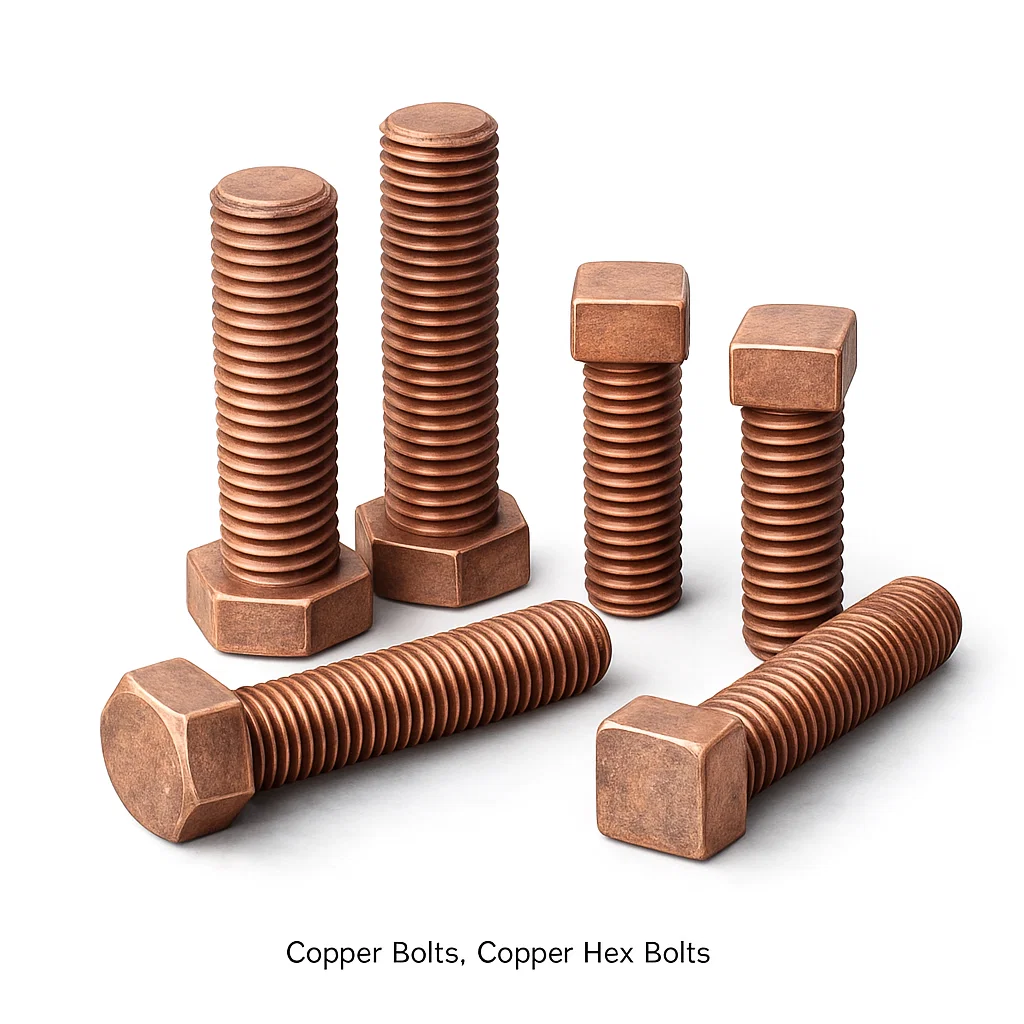

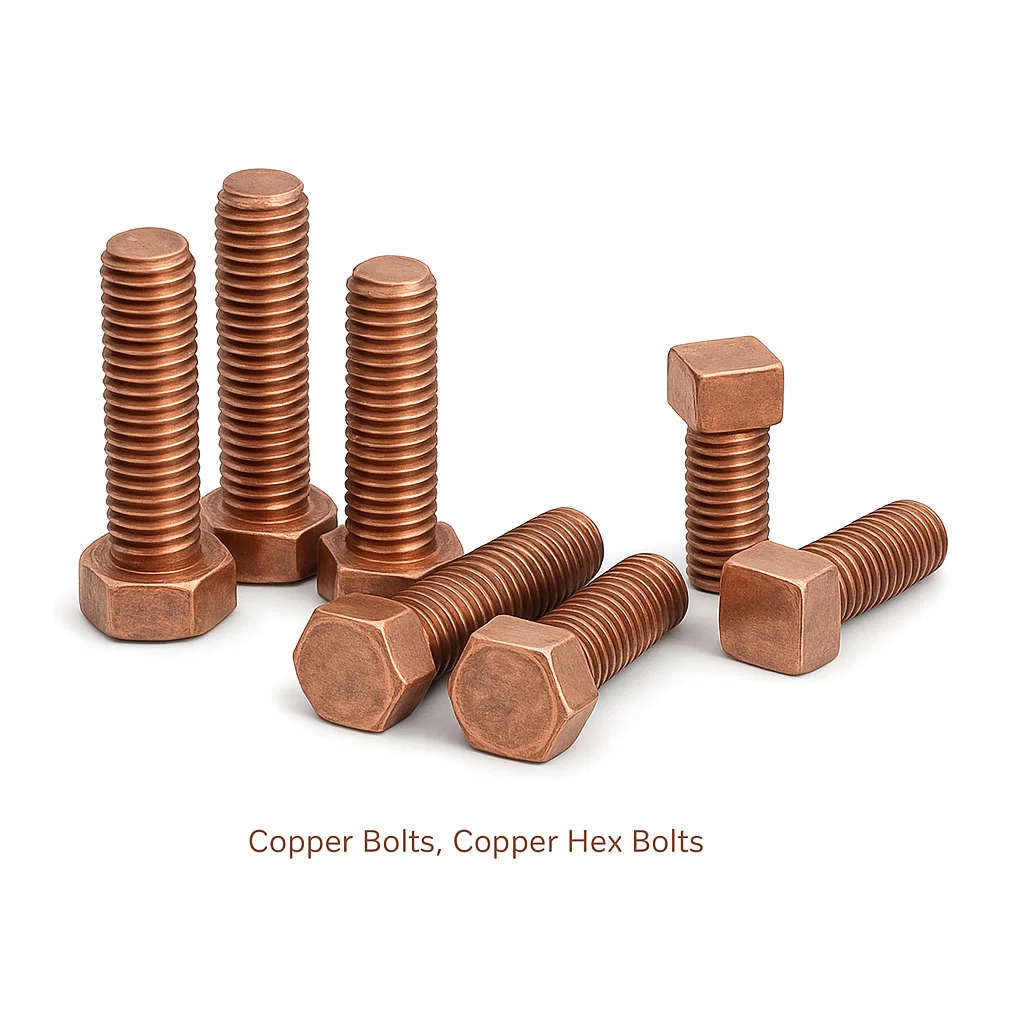
Copper Bolts, Copper Hex Bolts – Technical Specifications & Manufacturing Excellence
Rate: S$ 15.00/kilogram, CIF USA Port
Overview: Premium Copper Fasteners for Industrial Applications
We are one of the leading manufacturers and exporters of Copper Bolts, Copper Hex Bolts, Copper threaded fasteners, and specialty Copper hardware from India. We have been supplying high-quality Copper fastening solutions to the world market for many decades, serving customers across North America, Europe, Australia, and Asia-Pacific regions. Our manufacturing facility specializes in producing precision-engineered Copper bolts that meet stringent international quality standards including ASTM B124, ASTM B152, BS 2874, DIN standards, and JIS specifications. The unique combination of excellent electrical conductivity, superior corrosion resistance, and non-magnetic properties makes Copper bolts indispensable in marine environments, electrical installations, transformer assemblies, and non-sparking applications where safety and reliability are paramount. With over three decades of hands-on experience in Copper component manufacturing, our engineering team understands the critical performance requirements across diverse industries from power generation to telecommunications infrastructure. We maintain comprehensive inventory of various Copper alloy grades and can customize bolt dimensions, thread specifications, head configurations, and surface finishes according to customer blueprints and technical drawings. Our state-of-the-art CNC machining centers, precision forging equipment, and advanced quality control laboratory ensure every Copper bolt leaving our facility meets or exceeds customer expectations for dimensional accuracy, mechanical properties, and surface finish quality.
Copper Bolts – General Purpose Fastening Solutions
Copper bolts represent the fundamental category of non-ferrous fasteners manufactured from high-purity Copper or Copper alloys, designed for applications requiring excellent electrical conductivity combined with moderate mechanical strength. These fasteners are extensively used in electrical busbar connections, grounding systems, lightning protection installations, and marine hardware where corrosion resistance is critical. Our manufacturing process begins with sourcing premium grade Copper from certified suppliers, followed by either hot forging for larger diameter bolts or cold heading for standard sizes up to M16. The Copper material exhibits natural antimicrobial properties, making these bolts suitable for food processing equipment, medical facilities, and water treatment plants where bacterial growth must be controlled. Standard manufacturing tolerances follow ISO 4759 for normal grade (class A) and close tolerance (class B) requirements, with thread specifications conforming to ISO metric standards or ANSI/ASME B1.1 for inch dimensions. Surface treatments include mill finish, polished finish, or protective clear coating to prevent oxidation during storage and transportation. The typical tensile strength of commercially pure Copper bolts ranges from 220-290 MPa depending on the specific alloy composition and heat treatment condition.
Copper Threaded Bolts – Precision Threading for Critical Connections
Copper threaded bolts feature precisely manufactured external threads along the shank length, engineered for secure mechanical fastening in applications demanding reliable electrical conductivity and vibration resistance. The threading process utilizes precision thread rolling dies or CNC thread milling operations to achieve accurate pitch diameter, thread form, and surface finish conforming to ISO 68-1 fundamental thread profile or ANSI B1.1 unified thread standards. Thread classes available include 2A for general purpose applications and 3A for precision assemblies requiring tighter tolerances on major diameter, pitch diameter, and minor diameter dimensions. Our thread rolling process cold-works the Copper material, creating stronger threads with improved fatigue resistance compared to cut threads, particularly important in electrical panel assemblies and switchgear installations subject to thermal cycling and mechanical stress. Thread engagement calculations follow engineering best practices with minimum thread engagement typically 1.5 times the nominal bolt diameter for Copper materials to prevent thread stripping under load. Special thread coatings or dry-film lubricants can be applied to reduce galling during installation while maintaining electrical conductivity requirements. Threaded length specifications can be customized as fully threaded bolts, partially threaded with specific grip length requirements, or double-end studs for specialized mounting applications.
Copper Hex Bolts – Industry Standard Hexagonal Head Design
Copper hex bolts feature the universally recognized six-sided hexagonal head configuration that provides superior wrench grip and torque transmission during installation and removal operations. The hexagonal head geometry conforms to ISO 4017, DIN 933, or ASME B18.2.1 dimensional standards depending on customer requirements, with across-flats dimensions precisely controlled to ensure compatibility with standard wrench sizes and socket tools. Manufacturing involves either hot forging the hex head from Copper rod stock or cold heading operations for smaller diameters, followed by precision machining of head dimensions and thread manufacturing. The hex head design offers significant advantages over slotted or Phillips drive systems by distributing installation torque across six load-bearing surfaces, reducing the risk of head damage or fastener failure during tightening. Copper hex bolts find extensive application in electrical transformer assemblies, busbar connections, marine hardware installations, and non-sparking tool applications in explosive atmospheres. Head height specifications typically follow h = 0.7d formula where d represents nominal bolt diameter, providing adequate material thickness for wrench engagement without excessive protrusion above the installation surface. Surface finish on hex heads includes mill finish, polished faces, or stamped grade identification marks for traceability in critical applications.
Copper Square Bolts – Enhanced Anti-Rotation Design
Copper square bolts incorporate a four-sided square head geometry specifically engineered to prevent rotation during nut tightening operations, particularly valuable in wood construction, timber framing, and applications where access to the bolt head side is restricted. The square head dimensions conform to ASME B18.2.1 standards with across-flats dimensions providing positive engagement with square-hole washers or embedding into softer materials like wood, plastic, or composite materials. Manufacturing processes include upset forging to create the square head geometry from round Copper bar stock, followed by heat treatment if required and precision thread manufacturing operations. This head configuration eliminates the need for holding the bolt head with a wrench during nut installation, significantly reducing installation time in assemblies requiring multiple fasteners. Applications include architectural Copper roofing systems, decorative metalwork, electrical equipment mounting in wooden enclosures, and restoration projects requiring period-authentic hardware matching historical construction methods. The square head geometry provides four distinct load-bearing surfaces, distributing installation torque effectively while creating an aesthetically distinctive appearance compared to conventional hex head designs. Surface treatments can include natural mill finish that develops protective patina over time, or clear protective coatings maintaining bright Copper appearance.
Copper Metric Bolts – ISO Standard Dimensioning
Copper metric bolts are manufactured with thread pitch and dimensional specifications conforming to ISO metric standards, featuring coarse thread pitch (standard series) or fine thread pitch for applications requiring enhanced vibration resistance or thin-wall thread engagement. Standard sizes range from M3 through M24 in our regular production inventory, with larger diameters up to M36 available through special manufacturing runs with appropriate lead times. The metric thread designation follows ISO 68-1 fundamental profile with 60-degree thread angle, precisely controlled pitch diameter, and major diameter dimensions ensuring compatibility with metric nuts and threaded holes worldwide. Thread pitch options include coarse pitch (1.5mm for M10, 1.75mm for M12, 2.0mm for M14) for general applications and fine pitch (1.25mm for M10, 1.25mm for M12, 1.5mm for M14) for precision assemblies or materials with lower thread engagement strength. Bolt length measurements follow ISO 4753 standards specifying nominal length as the distance from underhead bearing surface to the end of the shank, including threaded portion. Manufacturing tolerances conform to ISO 4759 medium tolerance class providing balanced dimensional control appropriate for industrial applications, with tighter tolerances available for precision assemblies requiring exact fit in dowel pins or location holes.
Copper Transformer Bolts – Specialized Electrical Hardware
Copper transformer bolts represent specialized fastening hardware specifically engineered for electrical transformer assembly applications, featuring unique design characteristics including large diameter heads for optimal electrical contact area, extended thread lengths for multi-layer busbar connections, and precise conductivity specifications. These bolts are manufactured from high-conductivity Copper alloys conforming to ASTM B187, ASTM B188, or equivalent specifications guaranteeing minimum 98% IACS (International Annealed Copper Standard) electrical conductivity essential for minimizing resistive heating in high-current connections. The head configuration typically features broad, flat bearing surfaces that maximize contact area with busbar assemblies while maintaining sufficient thickness for wrench engagement during installation torque application. Thread specifications include fine pitch options to increase effective thread engagement area and reduce contact resistance in busbar stacks consisting of multiple Copper plates. Manufacturing processes incorporate precision CNC machining to achieve tight tolerances on head flatness, perpendicularity between head and shank, and thread concentricity critical for uniform current distribution across connection interfaces. Special attention is paid to surface finish quality, with controlled surface roughness specifications ensuring low contact resistance and preventing oxidation in service conditions. Heat treatment protocols may include solution annealing to achieve optimal balance between electrical conductivity and mechanical strength properties required for high-vibration transformer environments.
Material Grades & International Standards
Our Copper bolts are manufactured from certified raw materials conforming to multiple international specifications:
International Standards: Commercially Pure Copper C11000 (UNS designation), C10200 (Oxygen-Free Electronic Copper), Copper Alloy C14500 (Tellurium Copper), C17200 (Beryllium Copper for high-strength applications)
ASTM Standards: ASTM B124 (Copper Rod, Bar, and Shapes), ASTM B152 (Copper Sheet and Strip), ASTM B187 (High-Conductivity Copper Busbar), ASTM B188 (Seamless Copper Bus Pipe and Tube)
British Standards: BS 2870 (Copper Sheet and Strip), BS 2874 (Copper Rod and Bar), BS 6017 (Copper Alloys for Electrical Engineering)
DIN Standards: DIN 1787 (Copper Rod), DIN 17666 (Copper for Electrical Purposes), DIN 40500 (Electrical Connection Materials)
Japanese Standards: JIS H3250 (Copper Rod and Bar), JIS H3100 (Copper Sheet and Strip), JIS C3101 (Tough Pitch Copper Wire and Bar)
Indian Standards: IS 191 (Copper Rod and Sections), IS 1897 (High Conductivity Copper for Electrical Purposes)
Chinese Standards: GB/T 2040 (Copper Rod), GB/T 5231 (Copper Sheet and Strip)
Manufacturing Processes & Machinery
Our production facility employs advanced manufacturing technologies ensuring precision, consistency, and quality in every Copper bolt produced. The manufacturing sequence begins with material verification using optical emission spectrometry to confirm chemical composition and alloy grade identification. Raw Copper rod stock undergoes cold heading operations on high-speed automated forging machines for diameters up to M16, creating the bolt head geometry through progressive die forming sequences that work-harden the material while maintaining dimensional accuracy. Larger diameter bolts utilize hot forging processes where Copper blanks are heated to 750-850°C before forming the head configuration in closed impression dies mounted on mechanical or hydraulic forging presses rated from 250 to 1000 tons capacity.
Thread manufacturing employs precision thread rolling machines for superior thread strength and surface finish, where rotating cylindrical dies cold-work the Copper surface to create the thread profile without material removal. This process increases thread root radius, enhancing fatigue resistance compared to cut threads produced by single-point turning or thread milling operations. For specialized thread requirements or small production quantities, CNC turning centers equipped with thread milling capabilities provide flexible manufacturing options with quick setup times. Secondary operations include CNC machining of special features such as reduced shank diameters, hex sockets, or custom head profiles using modern machining centers with automatic tool changers and programmable logic controllers.
Quality control equipment includes coordinate measuring machines (CMM) for dimensional verification, thread gauges conforming to ISO 1502 or ASME B1.2 standards, surface roughness testers measuring Ra and Rz parameters, and hardness testing equipment (Vickers and Rockwell scales) for mechanical property verification. Non-destructive testing capabilities include visual inspection under magnification, penetrant testing for surface crack detection, and electrical conductivity testing using eddy current instruments calibrated to IACS standards.
Copper Material Properties
| Property | Commercially Pure Copper (C11000) | Oxygen-Free Copper (C10200) | Tellurium Copper (C14500) |
|---|---|---|---|
| Electrical Conductivity | 101% IACS minimum | 101% IACS minimum | 90-95% IACS |
| Tensile Strength (Annealed) | 220-290 MPa | 220-270 MPa | 240-310 MPa |
| Yield Strength | 70-125 MPa | 70-120 MPa | 140-195 MPa |
| Elongation | 40-50% | 45-55% | 25-40% |
| Density | 8.94 g/cm³ | 8.94 g/cm³ | 8.94 g/cm³ |
| Thermal Conductivity | 391 W/m·K | 391 W/m·K | 335 W/m·K |
| Melting Point | 1083°C | 1083°C | 1075°C |
| Corrosion Resistance | Excellent | Excellent | Excellent |
Standard Dimensions & Thread Specifications
| Size Designation | Nominal Diameter (mm) | Pitch (Coarse Thread) | Across Flats (Hex Head) | Head Height | Standard Length Range |
|---|---|---|---|---|---|
| M3 | 3.0 | 0.5 | 5.5 mm | 2.0 mm | 6-30 mm |
| M4 | 4.0 | 0.7 | 7.0 mm | 2.8 mm | 8-40 mm |
| M5 | 5.0 | 0.8 | 8.0 mm | 3.5 mm | 10-50 mm |
| M6 | 6.0 | 1.0 | 10.0 mm | 4.0 mm | 12-60 mm |
| M8 | 8.0 | 1.25 | 13.0 mm | 5.3 mm | 16-80 mm |
| M10 | 10.0 | 1.5 | 17.0 mm | 6.4 mm | 20-100 mm |
| M12 | 12.0 | 1.75 | 19.0 mm | 7.5 mm | 25-120 mm |
| M16 | 16.0 | 2.0 | 24.0 mm | 10.0 mm | 30-150 mm |
| M20 | 20.0 | 2.5 | 30.0 mm | 12.5 mm | 40-200 mm |
| M24 | 24.0 | 3.0 | 36.0 mm | 15.0 mm | 50-250 mm |
Surface Finishes & Plating Options
While Copper bolts are valued for their natural corrosion resistance and electrical conductivity, various surface treatments can be applied depending on application requirements and environmental conditions. Mill finish represents the as-manufactured surface condition without additional treatment, exhibiting characteristic Copper color that develops natural patina over time when exposed to atmospheric conditions. This patina layer, consisting primarily of Copper oxide and Copper carbonate, provides self-healing corrosion protection in many environments. Bright Copper finish involves mechanical polishing or electropolishing to achieve mirror-like surface appearance preferred for decorative applications, architectural hardware, or electrical connections requiring maximum initial conductivity.
Clear passivation coatings utilize chromate conversion processes or organic clear lacquers creating transparent protective films that maintain bright metallic appearance while preventing tarnishing during storage and early service life. Nickel plating over Copper substrate provides enhanced corrosion resistance in harsh chemical environments, though the plating thickness must be carefully controlled to maintain acceptable electrical conductivity for current-carrying applications. Tin plating represents common surface treatment for electrical connector bolts, providing excellent solderability, preventing Copper migration in electronics assemblies, and maintaining electrical conductivity within acceptable ranges for most applications. Surface roughness specifications typically range from Ra 1.6 to Ra 6.3 micrometers depending on manufacturing process and customer requirements, with smoother finishes preferred for electrical contact surfaces.
Industries & Applications
Electrical Power Generation & Distribution: Copper hex bolts are extensively employed in transformer busbar assemblies, switchgear connections, circuit breaker installations, and high-voltage transmission equipment where superior electrical conductivity and reliable mechanical fastening combine to ensure safe power transmission. The non-magnetic properties of Copper prevent eddy current losses in alternating current applications, making these fasteners preferred choices in generator assemblies, motor connections, and induction equipment.
Marine & Offshore Engineering: The exceptional corrosion resistance of Copper in seawater environments makes Copper bolts ideal for boat hardware, dock construction, offshore platform installations, and underwater equipment assembly. Marine-grade Copper fasteners resist dezincification, stress corrosion cracking, and biological fouling that compromise steel fasteners in saltwater exposure, providing decades of reliable service in demanding offshore conditions.
Telecommunications Infrastructure: Copper bolts secure grounding systems, antenna mounting hardware, lightning protection equipment, and RF shielding assemblies in telecommunications towers, data centers, and broadcast facilities. The electrical conductivity ensures effective electromagnetic interference (EMI) shielding and proper equipment grounding for safety and signal integrity.
Chemical Processing Plants: Non-sparking characteristics and corrosion resistance make Copper bolts essential safety components in petrochemical facilities, paint manufacturing, solvent handling systems, and explosive atmosphere locations classified as hazardous areas under ATEX or NEC 500 regulations. Copper fasteners eliminate ignition risk from mechanical friction sparks during maintenance operations.
Renewable Energy Systems: Solar panel mounting frames, wind turbine electrical connections, geothermal power installations, and battery energy storage systems utilize Copper bolts for combining mechanical strength with electrical conductivity requirements in renewable power generation infrastructure.
Water Treatment Facilities: Antimicrobial properties of Copper reduce bacterial contamination in potable water systems, wastewater treatment equipment, and desalination plant installations. Copper fasteners provide corrosion-resistant connections in chlorinated water environments, ozone treatment systems, and marine water intake structures.
Manufacturing Tolerances & Quality Standards
Dimensional accuracy in Copper bolt manufacturing follows internationally recognized tolerance standards ensuring interchangeability and reliable assembly performance. Thread tolerances conform to ISO 965-1 tolerance system for metric threads, specifying tolerance zones for major diameter (6g common tolerance class for external threads), pitch diameter, and minor diameter dimensions. Thread class 6g provides normal clearance fit appropriate for general industrial applications, while tighter 4h6h tolerance classes serve precision assemblies requiring minimal thread play. Head dimensions including across-flats measurements, head height, and bearing surface flatness follow ISO 4759 medium tolerance class providing practical manufacturing capability balanced with functional requirements.
Straightness tolerances limit total indicator runout to 0.5% of nominal length for bolts up to 100mm length, increasing proportionally for longer fasteners. Perpendicularity between head bearing surface and shank axis is controlled to 3 degrees maximum angular deviation, ensuring proper load distribution when bolts are installed in through-holes or tapped holes. Thread concentricity with shank axis follows ISO 1947 specifications limiting permissible runout based on thread pitch and nominal diameter. Surface finish requirements specify maximum surface roughness Ra 6.3 micrometers for standard mill finish, with smoother Ra 3.2 or Ra 1.6 finishes available for electrical contact surfaces or precision applications requiring reduced friction coefficients.
Our quality management system operates under ISO 9001:2015 certification framework, implementing documented procedures for incoming material inspection, in-process verification, final inspection protocols, and statistical process control monitoring. Material certificates trace each production lot to original mill test reports confirming chemical composition, mechanical properties, and electrical conductivity values. First article inspection procedures validate new production setups against engineering drawings and customer specifications before releasing production quantities.
Production Turnaround Time
Standard production lead time for Copper bolts ranges from 4 to 6 weeks from purchase order confirmation, depending on order quantity, size range, and specification complexity. This timeline includes raw material procurement from certified Copper suppliers, manufacturing operations, quality inspection, surface treatment if required, and final packaging preparation. Rush orders can often be accommodated with expedited processing for critical project requirements, subject to production schedule availability and material stock levels. Custom specifications requiring special tooling, non-standard dimensions, or unique head configurations may extend lead time to 8-10 weeks to account for tool manufacturing and production setup activities.
Our flexible manufacturing approach maintains strategic inventory of common Copper alloy grades and standard fastener sizes, enabling faster response for frequently ordered items. Production planning systems coordinate with purchasing, manufacturing, quality assurance, and shipping departments ensuring on-time delivery performance that consistently meets customer project schedules. Partial shipments can be arranged for large quantity orders, providing early delivery of initial quantities while remaining production continues, helping customers manage construction timelines and cash flow requirements.
Why Choose Our Copper Bolts – Competitive Advantages
Three Decades of Manufacturing Excellence: Our company has accumulated over 30 years of hands-on experience manufacturing precision Copper components for global markets, developing deep expertise in material properties, manufacturing processes, and application engineering. This extensive experience translates directly into superior product quality, technical support capabilities, and reliable delivery performance that customers depend upon for their critical projects.
Engineering Support & Technical Consultation: Our qualified engineering team works collaboratively with customers from initial design concept through final production, offering valuable insights on material selection, dimensional optimization, tolerance analysis, and manufacturing feasibility. We frequently suggest technical drawing improvements that reduce manufacturing costs, improve assembly performance, or enhance product functionality based on our practical manufacturing knowledge and application experience.
Complete Customization Flexibility: Unlike distributors limited to standard catalog items, our manufacturing capability enables complete customization of bolt dimensions, thread specifications, head configurations, material grades, and surface finishes matching exact customer requirements. Whether requiring metric or imperial sizing, special length dimensions, unique head styles, or proprietary alloy compositions, our production facility adapts to deliver precisely what your application demands.
Responsive Communication & Customer Service: We recognize that successful business relationships depend upon clear communication, prompt responsiveness, and proactive problem-solving. Our customer service team maintains regular contact throughout the order cycle, providing production status updates, coordinating shipping arrangements, and addressing technical questions with knowledgeable answers. Multiple communication channels including email, phone, WhatsApp, and video conferencing ensure convenient access regardless of time zone differences.
Customized Packaging Solutions: We accommodate customer-specific packaging requirements including branded labels, company logos on boxes, bar code identification, special protective packaging materials, and quantity per package configurations. This flexibility simplifies your receiving operations, inventory management, and internal distribution processes while reinforcing your brand identity when selling components to end customers.
Global Export Experience: Decades of international shipping experience means we thoroughly understand export documentation requirements, customs regulations, freight forwarding procedures, and international quality standards. Our export department manages all documentation including commercial invoices, packing lists, certificates of origin, material test certificates, and shipping instructions, ensuring smooth customs clearance and on-time delivery to destination ports worldwide.
Competitive Pricing Structure: Direct manufacturer pricing eliminates distributor markups, providing cost advantages particularly valuable for large volume requirements or ongoing supply agreements. Our efficient manufacturing processes, strategic supplier relationships, and optimized production planning deliver excellent value without compromising quality standards or delivery reliability.
Quality Assurance & Traceability: Comprehensive quality documentation accompanies every shipment including material test reports, dimensional inspection results, thread gauge verification, and photographic quality records. Complete traceability links finished products back through production operations to original raw material certifications, providing confidence in product authenticity and regulatory compliance.
Comprehensive Technical Questions & Answers
Question 1: What electrical conductivity percentage should I specify for Copper transformer bolts in busbar assemblies carrying high amperage loads?
For transformer busbar applications handling substantial electrical current, specify Copper bolts manufactured from high-conductivity alloys achieving minimum 98% IACS (International Annealed Copper Standard) conductivity. This conductivity level ensures minimal resistive heating at connection points, maintaining energy efficiency and preventing thermal degradation of connection integrity. Oxygen-free Copper C10200 typically provides conductivity values between 101-103% IACS, representing optimal choice for critical electrical connections. Lower conductivity alloys like Tellurium Copper C14500, though offering superior machinability, provide only 90-95% IACS and should be avoided in high-current applications where connection resistance directly impacts system efficiency and reliability.
Question 2: Can Copper hex bolts be used safely in outdoor marine environments without additional surface protection?
Yes, Copper hex bolts demonstrate excellent natural corrosion resistance in marine environments due to formation of protective patina layers consisting of Copper oxide and Copper carbonate compounds. This patina develops gradually when Copper is exposed to atmospheric moisture, oxygen, and salt spray, creating self-healing corrosion barrier that prevents progressive metal loss unlike steel fasteners subject to rust degradation. For optimal long-term performance in severe saltwater splash zones, consider applying clear protective lacquer coatings during initial installation period, which can be allowed to weather naturally after patina formation begins. Avoid coupling Copper bolts with dissimilar metals like aluminum or galvanized steel without proper electrical insulation, as galvanic corrosion accelerates in seawater electrolyte environments when dissimilar metals contact each other.
Question 3: What torque specifications should be used when installing Copper hex bolts to prevent thread stripping or head deformation?
Copper bolt installation torque must be carefully controlled because Copper’s lower strength compared to steel means excessive tightening force causes thread stripping or head damage. General guideline suggests maximum installation torque approximately 30-40% of values used for equivalent strength steel fasteners. For M10 Copper hex bolt with standard coarse pitch thread, typical maximum torque ranges from 15-20 Nm depending on lubrication condition and required clamping force. Always use calibrated torque wrenches rather than impact tools when installing Copper fasteners, and consider using anti-seize compounds containing Copper particles to prevent galling between mating threads. Consult specific torque-tension relationships for your application, accounting for factors including joint material compressibility, washer specifications, and required preload force to maintain connection integrity under operational loads and thermal cycling.
Question 4: Are fine pitch metric threads available for Copper bolts, and what applications benefit from fine thread specifications?
Yes, our manufacturing capability includes fine pitch metric threads for Copper bolts across standard diameter ranges. Fine pitch threads provide several performance advantages in specific applications including increased effective thread engagement area particularly valuable in thin-wall materials, enhanced resistance to loosening from vibration in electrical equipment subject to mechanical shock, and improved precision for alignment-critical assemblies. For example, M12 x 1.25 fine pitch offers greater thread engagement compared to M12 x 1.75 coarse pitch when threading into softer materials or thin Copper busbars. Fine threads also reduce radial expansion stress in tapped holes, minimizing risk of cracking in brittle materials. However, fine threads require more installation rotations to achieve equivalent clamping length, and thread strength per unit length decreases compared to coarse threads, so selection should match specific application requirements and material constraints.
Question 5: What quality certifications and material test documentation do you provide with Copper bolt shipments?
Every Copper bolt shipment includes comprehensive quality documentation providing complete traceability and regulatory compliance verification. Standard documentation package contains material test certificates from original Copper mill confirming chemical composition analysis, mechanical property test results including tensile strength and elongation percentages, electrical conductivity measurements in IACS percentage, and alloy grade identification against international specifications. Dimensional inspection reports verify critical parameters including thread pitch diameter measurements using calibrated thread gauges, across-flats dimensions for hex heads, overall length tolerances, and perpendicularity measurements between head and shank. Photographic quality records document surface finish condition and absence of manufacturing defects. Additional certifications available upon request include third-party inspection reports, EN 10204 Type 3.1 material certificates, RoHS compliance declarations for electronics applications, and REACH registration documentation for European Union exports.
Question 6: Can you manufacture Copper square bolts in imperial inch dimensions rather than metric specifications?
Absolutely, our manufacturing capability accommodates both metric and imperial dimensioning systems, producing Copper square bolts in standard inch sizes including 1/4″, 5/16″, 3/8″, 1/2″, 5/8″, and 3/4″ nominal diameters with UNC (Unified National Coarse) or UNF (Unified National Fine) thread specifications conforming to ASME B1.1 standards. Square head dimensions follow ASME B18.2.1 specifications ensuring compatibility with standard imperial washers and installation tools. Imperial sizing often proves necessary for maintenance applications, restoration projects requiring period-authentic hardware, or projects in countries predominantly using inch-based measurement systems. Manufacturing lead times and minimum order quantities remain comparable to metric production, with complete flexibility on length specifications, thread length requirements, and material grade selection matching application needs.
Question 7: What minimum order quantities apply for custom Copper bolt specifications, and can you accommodate small prototype quantities?
We understand that development projects, machinery prototypes, and specialized equipment often require small quantities of custom fasteners before committing to full production volumes. Our flexible manufacturing approach accommodates prototype orders starting from 100 pieces for standard customizations involving non-standard lengths, special thread specifications, or alternative head configurations. More complex custom requirements like unique head profiles, proprietary alloy compositions, or tight tolerance specifications may require higher minimum quantities (250-500 pieces) to justify custom tooling investment and setup costs. For ongoing production requirements, volume pricing becomes increasingly favorable at quantities exceeding 1000 pieces, with additional cost reductions at 5000, 10000, and higher volume levels. We encourage customers to discuss anticipated usage volumes during initial quotation stage so optimal pricing structure can be developed balancing prototype needs with production scaling plans.
Question 8: How do I specify thread length requirements for partially threaded Copper hex bolts used in busbar stack assemblies?
Partial threading specifications require clearly communicating grip length (unthreaded shank portion) and threaded length dimensions on technical drawings or purchase order documentation. Standard designation format identifies nominal diameter, thread pitch, overall length, and threaded length, for example: M12 x 1.75 x 80mm, threaded length 40mm. This specification produces bolt with 40mm grip length plus 40mm threaded portion totaling 80mm overall length. For busbar applications, grip length should equal or slightly exceed combined thickness of busbar stack to prevent threads engaging busbar holes, which reduces effective contact area and increases connection resistance. Industry best practice suggests adding 2-3mm clearance beyond busbar stack thickness before thread commencement. Our engineering team can review your assembly drawings and recommend optimal grip length specifications ensuring proper thread engagement in nuts while maintaining maximum busbar contact area.
Question 9: What packaging methods prevent Copper bolt tarnishing during international shipping and storage?
Proper packaging protects Copper bolts from atmospheric moisture, chemical fumes, and physical damage during transportation and warehouse storage. Our standard packaging employs VCI (Vapor Corrosion Inhibitor) poly bags creating protective atmosphere around fasteners, preventing oxidation and tarnish formation even in humid environments. Individual sizes are separated in labeled compartments within corrugated boxes meeting international shipping standards for stacking strength and moisture resistance. Desiccant packets absorb residual moisture inside sealed packages, maintaining dry conditions essential for preserving bright Copper appearance. For large quantity shipments, we utilize wooden crates or export-grade plywood boxes with internal foam cushioning preventing mechanical damage during handling. Custom packaging options include blister packs, plastic tubes, or compartmentalized boxes with customer labels and part numbers simplifying your receiving operations and inventory management. All packaging materials comply with ISPM-15 standards for wood packaging materials in international trade.
Question 10: Are Copper bolts suitable for use in explosive atmospheres or hazardous locations requiring non-sparking tools?
Yes, Copper bolts represent critical safety components in classified hazardous locations where mechanical sparks from steel tools or fasteners could ignite explosive atmospheres. Copper’s relatively soft metallurgical structure prevents spark generation during mechanical impact or friction contact, unlike hardened steel that produces high-temperature sparks through fracture and oxidation mechanisms. This non-sparking characteristic makes Copper fasteners mandatory in many petrochemical facilities, paint manufacturing plants, grain handling operations, coal mines, and ammunition factories classified under ATEX Zone 1/2 in European regulations or NEC Class I Division 1/2 in North American standards. However, note that Copper bolts alone cannot eliminate all ignition sources—comprehensive explosion protection requires grounding systems preventing static electricity accumulation, proper equipment bonding, and ventilation systems maintaining vapor concentrations below explosive limits.
Question 11: Can your engineering team modify existing bolt designs to reduce manufacturing costs while maintaining functional performance?
Yes, value engineering represents core service we provide to customers seeking cost optimization without compromising product functionality. Our experienced engineering team frequently identifies opportunities including standardizing custom dimensions to more readily available tooling sizes, adjusting tolerance specifications to practical manufacturing capabilities rather than unnecessarily tight requirements, modifying head configurations to simpler geometries requiring less machining time, or substituting alternative Copper alloys offering equivalent performance at lower material costs. Recent example involved customer specification calling for M14 x 1.25 fine pitch threads and tight h6 tolerance on shank diameter; engineering analysis determined coarse M14 x 2.0 pitch provided adequate vibration resistance for the application while h9 tolerance maintained acceptable fit, reducing manufacturing time 30% and total cost by 22%. We encourage customers to engage our engineering team early in design phases where optimization potential remains greatest.
Question 12: What inspection methods verify thread quality and dimensional accuracy on finished Copper bolts?
Comprehensive thread inspection employs multiple measurement techniques ensuring conformance to specified tolerances and thread form accuracy. Primary method utilizes GO/NOGO thread ring gauges manufactured to ISO 1502 or ASME B1.2 standards, where GO gauge must thread completely onto bolt while NOGO gauge should not advance beyond two thread turns, confirming pitch diameter falls within acceptable tolerance band. Thread pitch verification uses optical comparators or thread micrometers measuring actual pitch against nominal specification. Major diameter measurements employ outside micrometers or coordinate measuring machines (CMM) equipped with cylindrical probes for non-contact dimensional verification. Minor diameter inspection requires optical methods or CMM measurement at thread root locations. Thread form accuracy including flank angles, thread height, and root radius undergoes verification using thread profile projectors magnifying thread geometry 20-50x for visual comparison against standard profile templates. Surface roughness measurement utilizes contact profilometers quantifying Ra and Rz parameters ensuring adequate thread finish for assembly requirements.
Question 13: How does Copper bolt performance compare to Brass fasteners in marine applications, and when should each material be specified?
Copper bolts and Brass fasteners both offer excellent corrosion resistance in marine environments, but material selection depends on specific performance priorities in your application. Pure Copper provides superior electrical conductivity (approaching 100% IACS) compared to Brass alloys (typically 25-40% IACS), making Copper essential for electrical connections, grounding systems, and lightning protection hardware where current-carrying capacity matters. However, Brass alloys demonstrate higher mechanical strength (tensile strength 400-600 MPa versus 220-290 MPa for annealed Copper) supporting higher clamping loads in structural connections. Brass exhibits better wear resistance in dynamic applications involving sliding contact or repeated installation/removal cycles. Dezincification susceptibility affects some Brass grades in seawater but does not concern Copper materials. Cost considerations generally favor Brass for non-electrical applications, while Copper’s superior conductivity justifies premium pricing in electrical systems. For underwater applications requiring both mechanical strength and corrosion resistance without electrical conductivity requirements, consider marine-grade Brass (Naval Brass C46400) or Bronze alloys as alternatives.
Question 14: What factors influence lead time for custom Copper bolt orders beyond standard 4-6 week delivery schedules?
Several variables affect production timeline for custom specifications beyond our standard delivery windows. Custom head geometries requiring new forging dies or special machining fixtures extend lead time 2-4 weeks to accommodate tool design, manufacturing, and verification before production begins. Non-standard thread specifications using pitch combinations outside our existing tap inventory necessitate special tooling procurement, adding 1-2 weeks to baseline schedule. Unusual Copper alloy grades not maintained in regular stock inventory require mill order placement with extended material procurement timelines, potentially adding 4-6 weeks depending on mill production schedules and alloy availability. Large quantity orders exceeding our weekly production capacity may require staged delivery schedules spreading shipments across multiple production runs. Specialized surface treatments involving third-party plating vendors introduce scheduling dependencies beyond our direct control. Complex inspection requirements including third-party testing, specific calibration certifications, or extensive dimensional documentation extend quality assurance cycle time. Communicating all specification requirements clearly during initial quotation enables accurate lead time estimation and production planning.
Question 15: Do you provide technical support for proper bolt installation procedures and torque specifications in our specific application?
Absolutely, comprehensive technical support throughout your project lifecycle represents fundamental aspect of customer service we provide. Our application engineering team assists with installation procedure development including recommended torque values considering joint materials, washer specifications, lubrication conditions, and required clamping force calculations. We provide guidance on proper tool selection avoiding impact drivers that damage Copper fasteners, recommending calibrated torque wrenches for controlled installation. Thermal expansion calculations account for Copper’s relatively high thermal expansion coefficient (17 x 10⁻⁶ /°C) affecting joint preload in applications experiencing temperature cycling. Thread engagement calculations ensure adequate thread strength preventing pullout or stripping failures under operational loads. We offer recommendations on compatible washers, lock washers, or threadlocking compounds appropriate for your vibration environment and maintenance accessibility requirements. Assembly training sessions can be arranged for your installation teams either at your facility or through video conferencing, ensuring proper techniques and preventing installation errors that compromise connection reliability. Our technical documentation includes installation instructions, torque charts, and troubleshooting guidelines supporting successful implementation.
Customer Testimonials
R. Mitchell, Senior Electrical Engineer, Houston, USA: “We’ve been sourcing Copper transformer bolts from BPI for our substation projects across North America for the past eight years, and their consistency in quality has been outstanding. The electrical conductivity testing results consistently meet or exceed our stringent specifications, and we’ve never experienced field failures related to these fasteners. What really sets them apart is their engineering team’s responsiveness—when we needed custom grip lengths for a unique busbar stack configuration on a rush project in Dallas, they not only delivered prototype samples within ten days but also suggested a threading modification that improved our installation time by 30%. The material certifications are always complete and accurate, which streamlines our quality documentation for utility customers. Their understanding of North American electrical codes and ASTM standards makes technical communication seamless. Delivery schedules are reliable even during peak construction seasons, and their willingness to accommodate our custom packaging requirements with labeled compartments matching our inventory system demonstrates genuine customer focus. We consider them a valued partner rather than just a supplier, and regularly recommend them to other contractors in our industry network.”
James Thornton, Procurement Manager, Southampton, UK: “After experiencing chronic corrosion problems with standard steel fasteners in our offshore platform maintenance operations, we transitioned to Copper hex bolts supplied by BPI three years ago, and the improvement has been remarkable. The Copper material’s natural corrosion resistance in seawater environments has virtually eliminated our replacement cycles for below-waterline hardware, significantly reducing maintenance costs and operational downtime. We particularly appreciate their flexibility in manufacturing both metric and BSW thread specifications, as our legacy platform structures require British Standard Whitworth sizing. The quality documentation including EN 10204 Type 3.1 certificates satisfies our classification society requirements without additional testing costs. Communication across time zones has never been problematic—their team responds to technical queries within hours, not days like other international suppliers we’ve dealt with. During our recent North Sea platform refurbishment project, they expedited a critical order of large-diameter Copper square bolts, coordinating air freight delivery that met our weather window deadline. The competitive pricing compared to European suppliers, combined with consistently superior product quality, makes the extended lead time completely acceptable for our planning schedules. We’ve already expanded our relationship to include Bronze and Brass components for other marine applications, confident in their manufacturing capabilities and professional service standards.”
Packaging & Shipping
Proper packaging ensures Copper bolts arrive at destination facilities in pristine condition, protected from physical damage, moisture exposure, and atmospheric contamination during international transportation. Our standard packaging methodology begins with VCI (Vapor Corrosion Inhibitor) poly bags creating protective microenvironment around fasteners, preventing oxidation and tarnish formation even in high-humidity shipping containers. Individual size ranges are separated in compartmentalized inner boxes clearly labeled with part numbers, dimensions, material specifications, and quantity counts facilitating efficient receiving inspection and inventory management at customer facilities.
Primary shipping containers utilize double-wall corrugated boxes meeting international shipping standards for compression strength and moisture resistance, with internal dimensions optimized for standard shipping pallet configurations. Box weights are controlled within carrier handling limits (typically 25 kg maximum) preventing manual handling injuries during warehouse operations. Exterior markings include shipping addresses, handling instructions (“Fragile—Non-Ferrous Metal Components”), orientation arrows, and gross/net weight declarations complying with international freight regulations. For large quantity orders or heavy items, wooden crates or export-grade plywood boxes provide enhanced protection, with internal foam cushioning preventing movement during transportation and customs inspection procedures.
All wood packaging materials comply with ISPM-15 international standards requiring heat treatment or fumigation to prevent pest introduction into destination countries, with certification stamps visible on crate exteriors. Custom packaging options accommodate specific customer requirements including blister packs for retail sales, plastic tubes preventing surface abrasion, or customer-branded boxes with company logos reinforcing your brand identity. Shipment documentation includes detailed packing lists, commercial invoices with harmonized tariff codes (typically 7415.10 for Copper fasteners), certificates of origin, material test reports, inspection certificates, and shipping instructions coordinated with freight forwarders.
International shipping typically employs ocean freight for economical delivery of large volumes, with transit times ranging 4-6 weeks to North American ports, 4-5 weeks to European destinations, and 2-3 weeks to Middle East or Southeast Asian ports. Air freight expedites delivery for urgent requirements, reducing transit to 5-7 days for most international destinations though at significantly higher transportation cost. We coordinate with established freight forwarding partners maintaining competitive shipping rates and reliable cargo tracking systems providing real-time shipment visibility from our facility through customs clearance to final delivery location. Door-to-door shipping arrangements including customs brokerage services simplify import procedures for customers less experienced with international trade documentation.
Glossary of Technical Terms
IACS (International Annealed Copper Standard): Reference standard for measuring electrical conductivity of materials, with 100% IACS defined as conductivity of fully annealed pure Copper at 20°C, equal to 58.0 MS/m or 0.58 × 10⁸ S/m.
Pitch Diameter: Theoretical diameter of thread where width of thread ridge equals width of thread groove, critical measurement for ensuring proper thread fit and mating with nuts or tapped holes.
Major Diameter: Largest diameter of external thread measured at thread crest, corresponding to nominal bolt size designation (e.g., 12mm for M12 bolt).
Minor Diameter: Smallest diameter of external thread measured at thread root, defining maximum stress concentration area and determining thread stripping strength.
Thread Class: Tolerance designation specifying allowable variation in thread dimensions, with 2A representing normal fit for general applications and 3A indicating precision tight fit for critical assemblies.
Grip Length: Unthreaded shank portion of partially threaded bolt designed to extend through bolted joint without threads engaging in bolt holes, maximizing clamping surface area.
UTS (Ultimate Tensile Strength): Maximum stress material withstands before fracture, measured in MPa or psi, indicating maximum load-carrying capacity of fastener.
Proof Load: Maximum tensile load bolt must withstand without permanent deformation, typically 85-90% of ultimate tensile strength, defining safe working load range.
Dezincification: Selective corrosion mechanism affecting Brass alloys where zinc leaches from alloy structure leaving porous Copper matrix with severely degraded mechanical properties, particularly problematic in hot water applications.
VCI (Vapor Corrosion Inhibitor): Chemical compounds releasing protective vapor molecules that deposit on metal surfaces forming monomolecular protective layers preventing oxidation and corrosion during storage and shipping.
Thread Rolling: Cold-forming manufacturing process where rotating cylindrical dies press into blank shank creating threads through plastic deformation rather than material removal, producing stronger threads with improved fatigue resistance.
Across Flats: Distance between opposite parallel flat surfaces of hexagonal or square bolt heads, defining wrench size required for installation and removal operations.
Thread Engagement: Length of mating thread contact between external bolt threads and internal nut or tapped hole threads, typically specified as minimum percentage of bolt nominal diameter to ensure adequate connection strength.
Galling: Surface damage occurring when mating metal surfaces experiencing high contact pressure and sliding motion undergo localized welding and material transfer, particularly problematic with soft materials like Copper without proper lubrication.
RoHS (Restriction of Hazardous Substances): European directive restricting use of specific hazardous materials including lead, mercury, cadmium, and certain flame retardants in electrical and electronic equipment, requiring compliance certification for components used in electronics assembly.
Related Parts/Terms
Copper bolts manufacturer India, high conductivity Copper fasteners, marine grade Copper hex bolts, Copper square bolts for timber, electrical Copper transformer bolts, metric Copper threaded bolts, custom Copper bolt specifications, non-sparking Copper fasteners, Copper bolts for busbar connections, ASTM B124 Copper bolts, corrosion resistant Copper hardware, Copper bolt dimensions and sizes, Copper bolt material properties, antimicrobial Copper fasteners, oxygen-free Copper bolts, Copper bolt suppliers exporters, Copper hex bolt torque specifications, fine pitch Copper metric bolts, imperial Copper square bolts, Copper bolts for switchgear, grounding system Copper bolts, telecommunications Copper hardware, offshore platform Copper bolts, C11000 Copper hex bolts, C10200 high conductivity bolts, Copper bolt thread specifications, marine hardware Copper fasteners, architectural Copper bolts, Copper bolt surface finishes, precision machined Copper bolts, Copper transformer busbar bolts, non-magnetic Copper fasteners, explosion-proof Copper bolts, chemical resistant Copper hardware, renewable energy Copper bolts, customized Copper bolt manufacturer.
Why Copper is the Superior Choice for Electrical and Marine Applications
Copper represents the material of choice for demanding fastening applications combining requirements for excellent electrical conductivity, superior corrosion resistance, and reliable mechanical performance in challenging environmental conditions. The fundamental electrical properties of Copper—achieving 100% IACS conductivity in pure form—ensures minimal resistive losses in current-carrying connections critical for transformer assemblies, busbar systems, and grounding installations where connection resistance directly impacts system efficiency and safety. Unlike aluminum alternatives offering lower conductivity with greater oxidation susceptibility, or steel fasteners requiring plating treatments that degrade over time, Copper bolts maintain consistent electrical performance throughout decades of service life.
Marine and offshore applications particularly benefit from Copper’s exceptional corrosion resistance in saltwater environments where protective patina layers form naturally, creating self-healing barriers against progressive metal deterioration. The absence of iron content eliminates rust formation entirely, while Copper’s nobility in the galvanic series prevents accelerated corrosion when coupled with most common structural metals given proper electrical isolation. This corrosion resistance extends product lifespan dramatically compared to steel alternatives requiring frequent replacement, reducing total lifecycle costs despite higher initial material investment. The non-magnetic characteristics prevent eddy current losses in alternating current applications and eliminate magnetic interference concerns in sensitive instrumentation systems.
Copper’s inherent antimicrobial properties, scientifically documented to eliminate bacteria, viruses, and fungi upon surface contact, make these fasteners valuable in healthcare facilities, food processing equipment, and water treatment installations where microbial contamination control matters. The non-sparking characteristics prevent ignition hazards in explosive atmospheres, providing essential safety in petrochemical facilities and hazardous material handling operations. Environmental sustainability considerations favor Copper’s complete recyclability without performance degradation, supporting circular economy principles in manufacturing and construction industries worldwide.
Updated: December 2025-206
Request Your Custom Quote Today
Ready to specify Copper bolts, Copper hex bolts, or specialized Copper fasteners for your next project? Our experienced technical sales team stands ready to discuss your specific requirements, answer application questions, and provide detailed quotations tailored to your dimensional specifications, material grades, quantity requirements, and delivery schedules. Contact us today through any of these convenient methods: