
C36000 Free-Cutting Brass · CDA 360 Brass Rods · C36000 CNC Machined Parts · CZ124 Brass Turned Components
C36000 — also written CDA 360, Alloy 360 or simply “free-cutting brass” — is the most machinable copper alloy in the world and the benchmark against which every other grade is rated at a machinability of 100%. This leaded alpha-beta brass combines roughly 61.5% copper, 35.5% zinc and 3% lead to deliver effortless high-speed turning, clean threads and outstanding surface finish. This guide covers its full chemistry, mechanical and physical properties, standard sizes, the parts it is used for and the industries it serves — plus a built-in round & hex bar weight calculator.
What Is C36000 Brass?
C36000 is a leaded alpha-beta (α+β) brass in which finely dispersed lead particles act as internal chip-breakers and lubricants. Those particles are what let the alloy be turned, drilled, tapped and threaded at very high feeds and speeds while still producing short, easily cleared chips and a bright finish — which is exactly why it is the reference alloy for the 100% machinability scale. It carries the UNS number C36000, the CDA/ASTM name “Alloy 360 Free-Cutting Brass”, the UK legacy grade CZ124, and the nearest EN grade CuZn36Pb3 (CW603N). It is the default choice for automatic screw-machine and Swiss-turned production wherever high volume and tight tolerances meet.
Chemical Composition
| Element | Symbol | Content (%) |
|---|---|---|
| Copper | Cu | 60.0 – 63.0 |
| Lead | Pb | 2.5 – 3.7 |
| Iron (max) | Fe | 0.35 |
| Zinc | Zn | Balance (≈ 35.5) |
Copper + named elements = 99.5% min. Lead is deliberately alloyed as the free-machining agent; it is insoluble in brass and disperses as fine particles.
Mechanical Properties
| Property | Value | Unit |
|---|---|---|
| Tensile strength (Rm) | 340 – 470 | MPa |
| 0.2% proof stress (Rp0.2) | 125 – 310 | MPa |
| Elongation at fracture (A) | 18 – 25 (soft up to 53) | % |
| Hardness | 65 – 80 | HRB |
| Machinability rating | 100 (benchmark) | % |
C36000 is not hardenable by heat treatment — strength is set by the degree of cold drawing. Soft/annealed rod is very ductile; harder tempers raise strength and hardness at the expense of elongation.
Physical Properties
| Property | Value | Unit |
|---|---|---|
| Density | 8.50 | g/cm³ |
| Melting range | 885 – 900 | °C |
| Modulus of elasticity | ≈ 97 | GPa |
| Thermal conductivity | ≈ 115 | W/(m·K) |
| Coefficient of thermal expansion (20–300 °C) | 20.5 | ×10⁻⁶/K |
| Electrical conductivity | ≈ 26 | % IACS |
Machinability & Fabrication
The defining feature of C36000 is its machining behaviour. On multi-spindle automatics, cam and CNC Swiss lathes it allows the most aggressive feeds and speeds of any brass, produces short broken chips that clear cleanly, and delivers mirror-like finishes with exceptional tool life. It drills, taps, knurls, saws and roll-threads with ease, hot-forges and stamps at 650–750 °C, and accepts nickel, chrome and tin plating for decorative or corrosion-resistant finishes. It is the alloy to specify when cycle time and tool cost dominate the part price.
Typical Sizes & Product Forms
Brass Parts India supplies C36000 in a full range of drawn and extruded forms. Common stock dimensions:
| Form | Size range | Standard |
|---|---|---|
| Round rod / bar | 2 – 120 mm dia | ASTM B16 / EN 12164 |
| Hexagonal rod (across flats) | 3 – 80 mm A/F | ASTM B16 |
| Square rod | 3 – 60 mm | ASTM B16 |
| Hollow / bored rod | Custom bore | ASTM B16 |
| Forging stock & profiles | To drawing | ASTM B283 |
| Wire | 1 – 12 mm | ASTM B134 |
Common Parts Manufactured from C36000 Brass
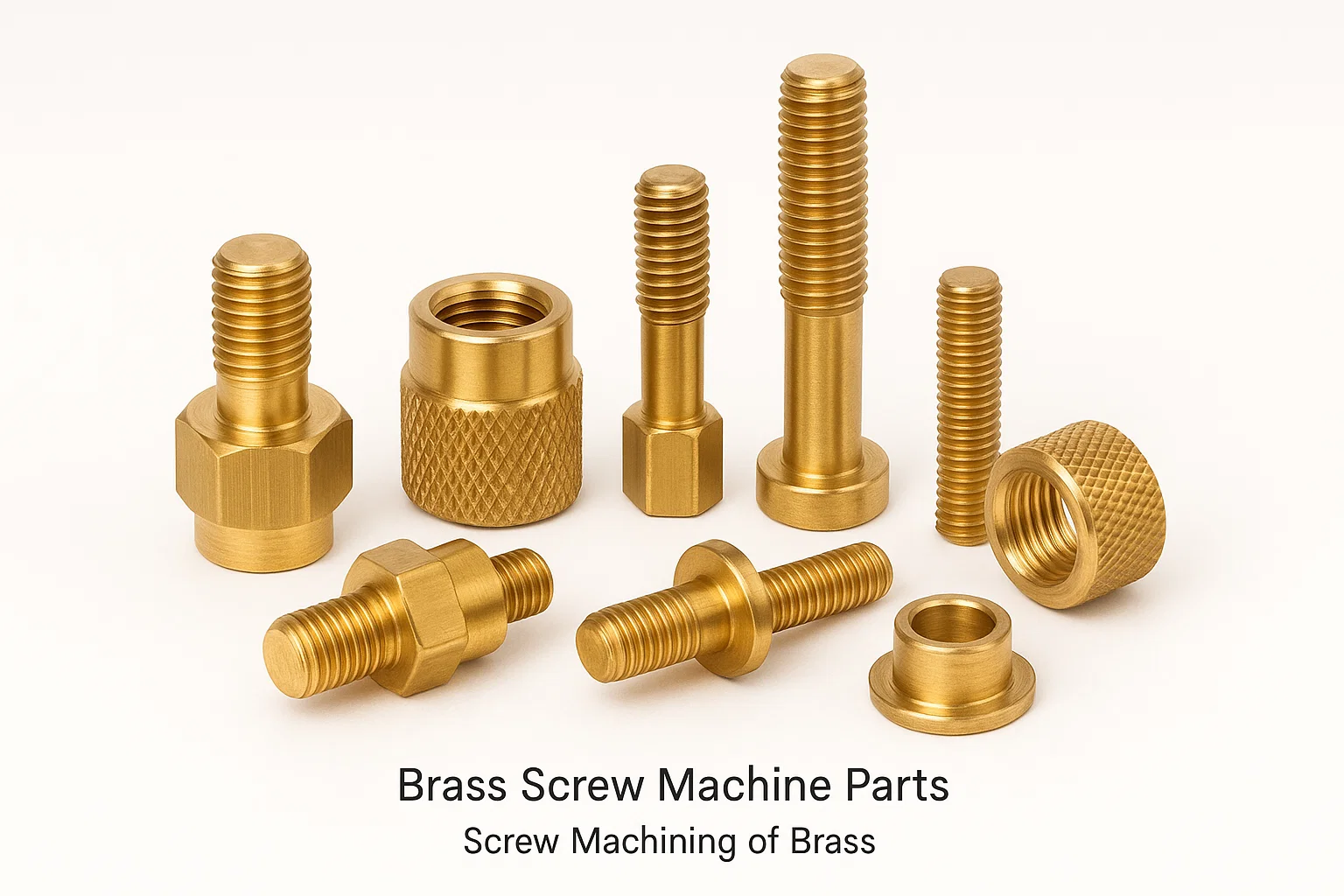
- Screw-machine products
- Precision turned inserts
- Nuts, bolts & fasteners
- Threaded fittings & adaptors
- Valve stems & bodies
- Gears & pinions
- Hose & pneumatic fittings
- Terminal pins & connectors
- Gas & water meter parts
- Automotive sensor bodies
- Plumbing tailpieces
- Electrical accessories
Industries Served
- Automotive & EV
- Plumbing & sanitary
- Electrical & electronics
- Instrumentation
- Industrial hardware
- Telecommunications
- HVAC & refrigeration
- General engineering
C36000 Brass Weight Calculator
Enter a diameter (round bar) or across-flats size (hex bar) and a length to estimate the weight of C36000 / CDA 360 based on a density of 8.50 g/cm³.
C36000 Brass Weight Calculator — Round & Hex Bars
Per piece4.171kg
Per metre4.171kg/m
Total41.71kg
Indicative only. Based on C36000 Brass density 8.5 g/cm³ (8500 kg/m³). Round: area = π/4 × d². Hex: area = (√3/2) × A/F². Actual weights vary with tolerance and exact alloy composition.
Quick Reference — Weight per Metre (kg/m)
| Size (mm) | Round bar (kg/m) | Hex bar A/F (kg/m) |
|---|---|---|
| 6 | 0.240 | 0.265 |
| 8 | 0.427 | 0.471 |
| 10 | 0.668 | 0.736 |
| 12 | 0.961 | 1.060 |
| 16 | 1.709 | 1.884 |
| 19 | 2.410 | 2.657 |
| 20 | 2.670 | 2.944 |
| 25 | 4.172 | 4.601 |
| 30 | 6.008 | 6.625 |
| 36 | 8.652 | 9.540 |
| 40 | 10.681 | 11.778 |
| 50 | 16.690 | 18.403 |
International Equivalents
| Standard / Region | Designation |
|---|---|
| USA (UNS) | C36000 |
| USA (CDA/ASTM name) | Alloy 360 — Free-Cutting Brass |
| EN (Europe, nearest) | CuZn36Pb3 / CW603N |
| UK (legacy BS) | CZ124 |
| Germany (old DIN) | 2.0375 |
| ISO | CuZn36Pb3 |
Frequently Asked Questions
What is C36000 brass?
C36000 is a leaded free-cutting brass (about 61.5% copper, 35.5% zinc and 3% lead) and the single most machinable copper alloy. Its machinability is rated 100%, the benchmark against which all other copper alloys are measured.
Is C36000 the same as CDA 360, Alloy 360 or CZ124?
Yes. CDA 360, Alloy 360 and “free-cutting brass” are all names for UNS C36000. CZ124 is the legacy British designation for the same metal, and CuZn36Pb3 (CW603N) is the nearest European equivalent.
Why is C36000 so easy to machine?
The 3% lead is insoluble in brass and forms fine particles throughout the metal. They break the chip and lubricate the cutting edge, so the alloy turns and drills at very high speed with short chips, low tool wear and an excellent finish.
What is the density of C36000 brass?
8.50 g/cm³ (8,500 kg/m³). Our weight calculator above uses this value to estimate bar and component weights.
What is the tensile strength of C36000?
Typically 340–470 MPa depending on temper, with 0.2% proof stress from about 125 MPa (soft) up to 310 MPa (hard drawn).
Can C36000 be hardened by heat treatment?
No. Like other alpha-beta brasses it is not heat-treatable. Strength and hardness are increased by cold drawing, not by quench-and-temper.
What is the melting range of C36000?
Approximately 885–900 °C. It is hot-worked (forged/stamped) around 650–750 °C.
Is C36000 suitable for potable / drinking water parts?
What parts are made from C36000?
High-volume turned and threaded parts: screw-machine products, fasteners, valve components, fittings, gears, meter parts, connector pins and precision inserts.
Does C36000 resist corrosion?
Can C36000 be plated?
Yes. It readily accepts nickel, chrome, tin and other electroplated finishes for decorative appeal or added corrosion resistance.
What tempers are available?
From soft/annealed (O) through half-hard (H02) to hard-drawn (H04). Higher tempers give more strength and hardness but lower elongation. Specify the temper to suit machining vs. mechanical needs.
What standard sizes do you supply?
Round bar 2–120 mm diameter, hex 3–80 mm across flats, square up to 60 mm, plus hollow rod, wire and forging stock. Custom sizes are produced to drawing.
How do I calculate the weight of a C36000 bar?
Use the calculator above, or multiply the cross-sectional area by length and by the density (8.50 g/cm³). Round area = π/4 × d²; hex area = (√3/2) × (across-flats)².
Is C36000 recyclable?
Yes. Brass is fully and repeatedly recyclable without loss of properties, and machining swarf has good scrap value — one reason free-cutting brass remains cost-effective in high-volume production.
What are the alternatives if I need a lead-free version of C36000?
Can Brass Parts India machine finished C36000 parts to my drawing?
Yes. We CNC-turn, mill, forge, stamp and plate finished C36000 components to print, with full material traceability and export packing for global delivery.
Related Brass Alloys
Comparing grades? Explore our companion guides — each with full specifications, typical parts and a live weight calculator.
C69300 / Eco Brass (CW724R)Lead-free silicon brass — high strength, dezincification-resistant.Read guide →C27450 DZR BrassLead-free DZR brass — NSF/ANSI 372 compliant.Read guide →CZ132 / CW602N DZR BrassArsenical DZR brass — for aggressive & chlorinated waters.Read guide →
Need C36000 / CDA 360 Components?
Brass Parts India machines, forges and stamps C36000 free-cutting brass to your drawings — from a 90,000 sq ft integrated Jamnagar facility exporting to the USA, UK, Canada, Australia and beyond. Send us your part print for a fast quotation.
Request a Quote →