
Brass NPT Hose Barbs
Brand: Cable Glands india | Price: US$ 16.00/Kg
Brass NPT hose barbs connect flexible hose to a female National Pipe Taper port using a ribbed hose stem and a male tapered pipe thread. Cable Glands india offers this product family for OEM equipment, EPC utility packages, distributor inventories and plant maintenance. Select the hose end by actual hose inside diameter and construction, then specify the NPT port size separately. The listed product price is US$ 16.00/Kg; the approved drawing and quotation define the supplied configuration.
Explore Brass Hose Barbs & Nipples
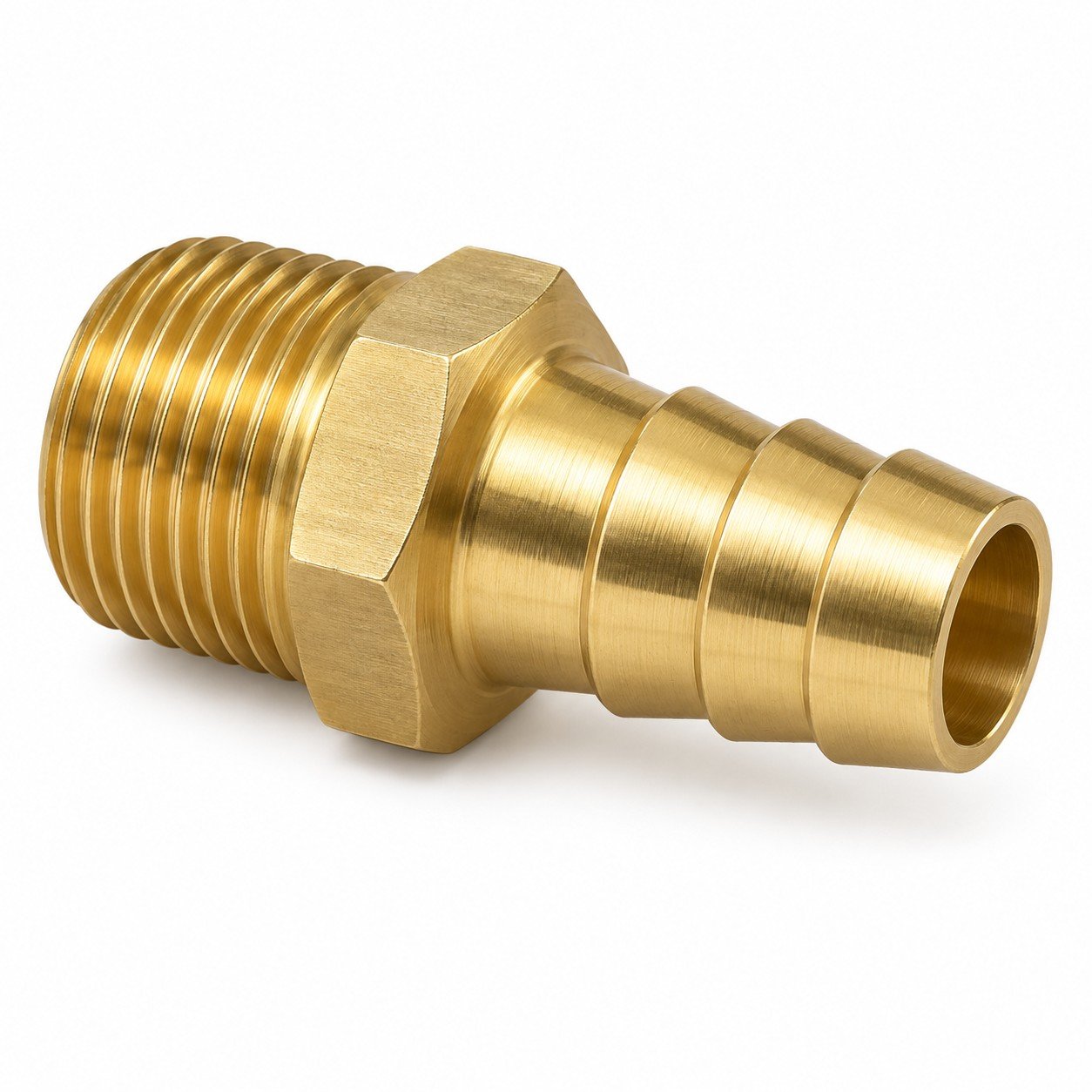
Detailed product overview
Male NPT adapters for equipment ports
A male NPT hose barb provides a direct transition between a flexible hose and a tapped valve, manifold, filter or equipment housing. Its hexagon gives the installer a defined wrenching surface, while the hose stem supports the flexible tube over its engagement length. This arrangement can reduce the number of separate adapters in a compact assembly. The threaded port and hose connection perform different sealing functions, so both interfaces must be specified. A matching nominal pipe size does not establish a matching hose diameter. Record both dimensions on the purchase drawing and identify the mating component before ordering.
Thread sealing and engagement
NPT threads use a tapered form. Assembly normally requires a compatible thread sealant selected for the fluid, temperature and equipment instructions. Sealant helps close the helical leakage path; it does not correct damaged threads or an incorrect thread family. Start engagement by hand and apply a wrench to the fitting flats. Avoid driving the male thread excessively into a thin female housing, because wedging loads can damage the port. The assembly procedure should define acceptable engagement and orientation rather than relying on a universal tightening torque for every size and material.
Hose stem geometry and retention
The hose end combines a lead-in, successive barbs, intervening roots and a supporting shank. These features influence insertion effort, hose deformation and resistance to pull-off. A sharp profile is not automatically a better profile: excessive edges may cut the hose liner. Choose the barb diameter, spacing and engagement length around the specified hose construction. Reinforced PVC, rubber and thermoplastic hoses respond differently to compression. A compatible clamp or ferrule must be selected as part of the complete connection. Validate the finished assembly with the actual hose and retention hardware.
Bore continuity and fluid routing
The smallest internal passage influences flow restriction, especially when several adapters sit in series. Define the required minimum bore and transitions at the threaded end, hex shoulder and hose stem. Deburring matters because loose chips can reach solenoid valves, regulators or small control orifices. For vacuum or suction duty, consider air ingress as well as liquid leakage. A fitting with a large outside diameter may still have a restricted internal passage. Request a section drawing when pressure drop, cleanliness or connection weight affects the equipment design.
Electrical OEM and utility package integration
These fittings serve auxiliary fluid circuits associated with electrical manufacturing and power equipment rather than carrying electrical current as terminals. Potential duties include cabinet cooling water, machine air, pneumatic actuation and service connections on packaged equipment, subject to application approval. Route hoses away from sharp sheet-metal edges and hot surfaces, and support them so movement does not load the threaded port. Separate the fitting requirement from electrical enclosure protection requirements. An NPT hose barb does not establish an enclosure IP rating or a hazardous-area approval for the complete machine.
Procurement and repeat production
For repeat supply, identify the part by a controlled drawing number, revision, alloy, finish and two independent connection sizes. Include the hose manufacturer’s reference where available. Distributors can then distinguish similar-looking NPT adapters from BSPT and dryseal versions. Specify packaging that keeps machined threads from striking each other in transit. Review first-article dimensions before releasing recurring orders, particularly where the stem is tailored to a customer hose. This approach gives purchasing and assembly teams a consistent definition without assuming every brass hose barb is interchangeable.
Key features
- Specified male tapered NPT connection
- Machined brass body with defined wrenching surfaces
- Barbed hose stem selected for the actual hose construction
- Bore, engagement length and finish controlled by drawing
- Material and inspection documentation agreed with the order
- Standard-family and custom configurations subject to quotation
NPT thread identification
Identify the thread family, size and required inspection on the purchase drawing. A controlled connection definition makes receiving inspection and assembly more consistent. Keep mating-port details with the fitting specification so replacement orders retain the same interface. Where the thread is coated, state the finished condition in which acceptance applies. Gauge results should be interpreted using the selected standard rather than a visual comparison with an unrelated adapter. Preserve the approved part reference on packing labels and delivery documentation.
Barb-to-hose matching
Hose selection begins with inside diameter, wall construction, hardness and the manufacturer’s fitting guidance. Nominal hose size alone does not define insertion force or pull-off resistance. Match the stem and retention method to the actual hose sample, particularly when changing suppliers. Clamp width and position should suit the supported portion of the stem. A qualified combination can then be recorded as an assembly specification. Any later change to hose material, clamp type or barb geometry should trigger a review of that combination.
Wrench flats and port protection
Critical metal dimensions include the wrenching envelope, minimum wall, connection length and bore transitions. Specify tolerances according to function rather than applying an unnecessarily tight tolerance to every surface. Check that the assembled fitting leaves room for tools and surrounding hoses. The approved drawing should identify inspection datums and finished dimensions. This supports meaningful first-article review and prevents a cosmetic dimension from obscuring an important fit requirement. Packaging should protect the surfaces used for sealing, retention and dimensional verification.
Clean bores for pneumatic equipment
Machined passages should be free from loose chips and damaging burrs. The required cleanliness level depends on downstream equipment and the service medium. Small pneumatic valves and control passages may need a more explicit cleanliness requirement than general water-transfer equipment. Agree any washing, drying, particle inspection or protective capping requirement in the quotation. Evaluate leakage and retention on the completed hose assembly using an appropriate procedure. Do not infer a working-pressure rating from the fitting’s appearance, material description or heavy-duty label.
Finish and sealant compatibility
Natural brass, nickel and chrome finishes require different procurement details. A coating changes surface dimensions and may affect hose insertion, thread engagement or compatibility with the fluid. Specify the finish, relevant thickness and acceptance condition where coating is required. Sealants and installation lubricants must also be selected for the application. The completed connection should remain accessible for inspection and maintenance. Document the approved assembly sequence, replacement criteria and any restrictions on reusing the fitting after service.
Technical specifications
| Parameter | Selection and ordering requirement |
|---|---|
| Product category | Hose Fittings > Brass Hose Barbs & Nipples |
| Brand | Cable Glands india |
| Threaded connection | male tapered NPT |
| Thread reference | ASME B1.20.1 |
| Family nominal size range | 1/8 inch to 2 inch; confirm each thread and hose combination in quotation. |
| Hose end | Barbed stem for specified hose inside diameter and construction. |
| Body configuration | Straight adapter; custom lengths and profiles require drawing review. |
| Raw material | Approved brass grade and product form; see material tables. |
| Finish | Natural brass; nickel or chrome options by agreement. |
| Bore and dimensional tolerance | Defined on the accepted product drawing. |
| Pressure and temperature | Application-specific complete assembly limits; qualification required. |
| Retention | Compatible clamp, ferrule or explicitly qualified hose system. |
| Price | US$ 16.00/Kg |
| Supply and sales markets | India and international B2B inquiries; destination requirements confirmed at quotation. |
Raw material grades
The following are material options for technical review, not a declaration that every grade is stocked in every size. State the required material standard and supply condition. Lead content, corrosion behavior and manufacturing route must suit the final application.
| Grade | Material family | Engineering consideration |
|---|---|---|
| C36000 | Free-cutting leaded brass | Machined rod or bar components; assess lead restrictions. |
| CW614N / CuZn39Pb3 | European machining brass designation | Confirm product standard, temper and actual certificate. |
| CW617N / CuZn40Pb2 | Brass commonly specified for hot forming | Consider for a forged blank followed by machining. |
| C37700 | Forging brass | Potential forged component material; drawing approval required. |
| CW602N / CuZn36Pb2As | Dezincification-resistant brass family | Require the specified processing condition and corrosion evidence. |
| C69300 | Silicon-containing brass with low lead content | Consider for lead-restricted specifications; confirm finished-part requirements. |
International equivalents and sourcing comparisons
An equivalent trade description is not sufficient evidence of full interchangeability. The relationships below distinguish designation references from approximate alternatives. The approved drawing and certificate govern acceptance; do not substitute based solely on a catalog cross-reference.
| Specified designation | Related international or legacy term | Status of comparison |
|---|---|---|
| CW614N | CuZn39Pb3; legacy CZ121 terminology | Designation relationship; verify the applicable legacy and current specifications. |
| CW617N | CuZn40Pb2; C37700 often considered for similar forging duties | Functional comparison only; chemistry and acceptance limits may differ. |
| C36000 | CW614N / CZ121 machining-brass family | Common sourcing comparison, not a certified one-to-one substitute. |
| CW602N | CuZn36Pb2As; C35330 DZR family comparison | DZR behavior depends on composition, processing and test requirements. |
| C69300 | Silicon brass option | Do not assign an automatic EN equivalent without certificate review. |
Product types and variants
| Variant | Typical design purpose | Information to specify |
|---|---|---|
| NPT straight hose adapter | Direct port-to-hose transition | Pipe size, hose bore and overall length |
| Short hose stem | Compact assembly envelope | Qualified hose engagement and clamp space |
| Extended hose tail | Additional supported hose length | Stem dimensions and required bend clearance |
| Heavy or light body profile | Match the application envelope and material mass | Minimum walls and validated assembly limits |
| Natural or plated brass | Application-specific surface condition | Finish, thickness where applicable and inspection |
| Drawing-based custom part | OEM connection integration | Drawing revision, alloy, quantity and documentation |
An NPT connection should be identified as NPT on the drawing, not simply as an American thread. Similar diameters can occur in different pipe-thread systems. Check the equipment manual, thread gauge results and port specification before substituting an adapter. Where a component uses a straight thread with an O-ring, a tapered NPT fitting is not an automatic replacement.
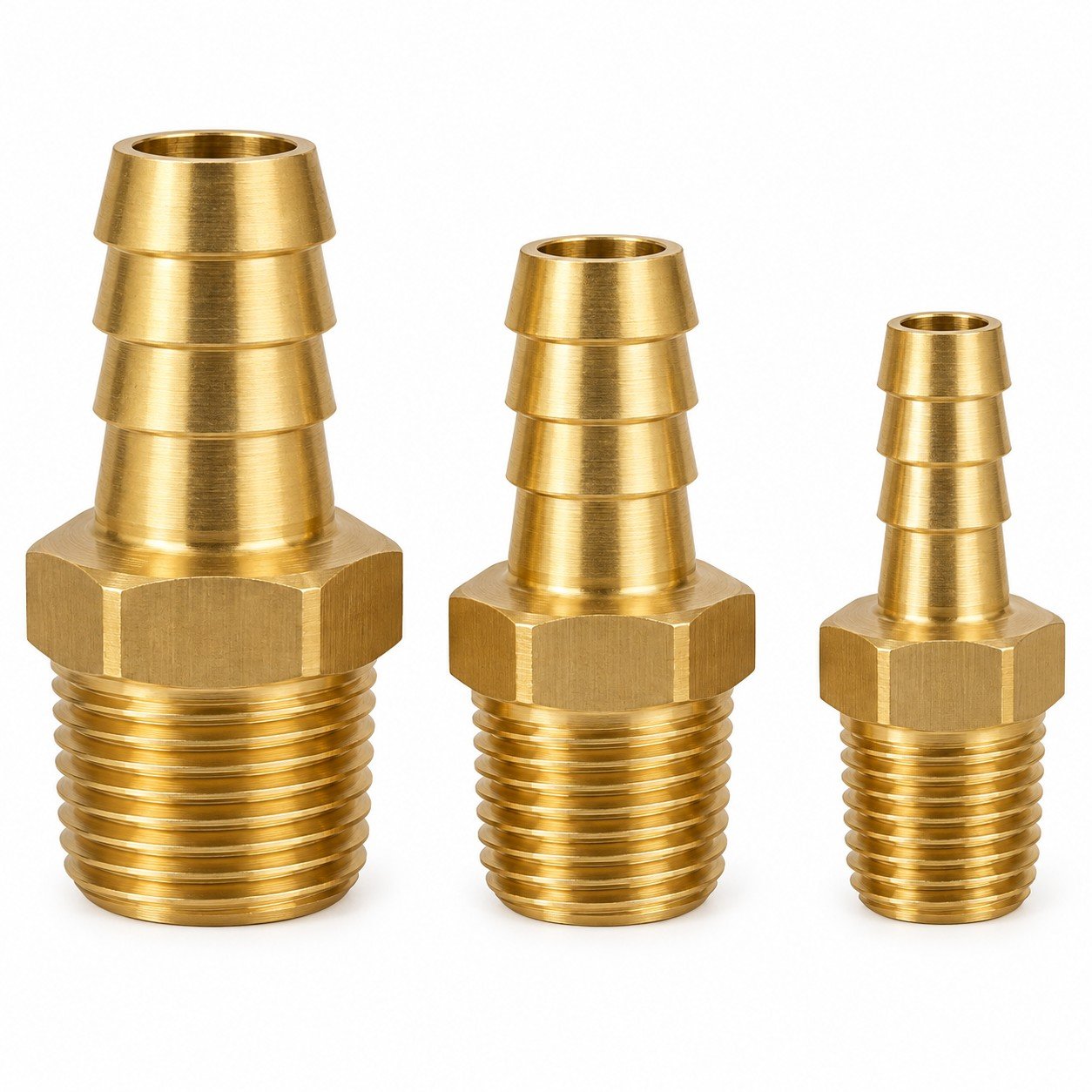
Applications in industry
| Customer / industry | Potential application | Selection priority |
|---|---|---|
| Electrical OEMs | Auxiliary cooling and machine-air connections | Specify fluid cleanliness and hose routing around live equipment. |
| EPC contractors | Skid-mounted utility hose transitions | Match the equipment NPT port schedule and installation procedure. |
| Power utilities | Approved maintenance and auxiliary service lines | Confirm assembly limits and plant material requirements. |
| Distributors | NPT-to-hose adapter stock | Label hose bore and pipe thread independently. |
Application examples identify possible uses after engineering approval. They do not assign suitability for hazardous fluids, high-pressure hydraulics, fuel gas or critical safety systems. Assess fluid compatibility, pressure cycling, external loading and hose retention for the actual equipment. Electrical OEMs should integrate the fluid connection into their machine risk and maintenance review.
Manufacturing process
Drawing review and material preparation
Manufacturing starts with an agreed drawing and inspection plan. The review establishes thread identity, hose geometry, minimum bore, material condition and finish. Suitable rod or bar can be prepared for machining; a forging route may be considered when the design and selected alloy justify it. Material identification should remain associated with the production batch. A change in stock form or grade requires review against the accepted specification.
Machining, threading and finishing
Turning forms the hose stem, shoulders and body features, while drilling or boring produces the flow passage. The threaded end is machined with tooling appropriate to the specified connection. Deburring removes loose edges at the entry, barb transitions and bore exits. Cleaning precedes any agreed coating operation. Finished dimensions and thread acceptance must account for the surface treatment so that a compliant uncoated blank does not become an unacceptable finished fitting.
Inspection, packing and release
Inspect critical dimensions and threads using the agreed methods. Where performance testing is specified, define the test medium, procedure, sample plan and acceptance criteria before production. Protect machined connections during packing and identify the part number and revision on the shipment. Retain the agreed inspection evidence for customer review. Assembly qualification uses the intended hose and retention hardware; checking the bare metal fitting alone cannot establish complete hose connection performance.
Quality standards and certifications
| Reference / document | Relevant scope | What to confirm |
|---|---|---|
| ASME B1.20.1 | Thread definition for the ordered variant | Applicable edition, class and inspection requirements. |
| Material product specification | Chemistry and properties of the selected stock | Grade, product form, temper and certificate traceability. |
| Dimensional inspection report | Drawing compliance | Critical dimensions and acceptance tolerances. |
| ISO 9001 certificate, if contractually required | Supplier quality management system | Current certificate, issuing body, location and scope. |
| Regulatory or application approvals | Destination and service-specific requirements | Evidence for the actual finished product; no blanket approval implied. |
| Assembly test documentation | Agreed leakage or retention validation | Actual hose, clamp, conditions and acceptance criteria. |
References to standards describe requirements that may be specified; they are not claims of third-party certification. Confirm required certificates during procurement. Do not infer potable-water, food-contact, oxygen-service, pressure-equipment or hazardous-area approval from the product family name. Documentation and any special tests must be expressly included in the accepted order.
Why choose Cable Glands india
Use Cable Glands india as a sourcing contact for a clearly specified brass hose connection. A useful industrial quotation connects the drawing, material, thread system, hose requirement and inspection scope to the ordered part. This makes technical comparisons more meaningful than comparing nominal size and price alone. OEMs can submit repeat-production requirements, while EPC buyers can include project documentation and destination conditions. Distributors should request consistent variant identification and packaging details for their inventories.
The product information supports a practical engineering review: select the correct interface, check the hose assembly and confirm documentation before order release. The listed kilogram price gives a common commercial reference, while finished-part mass determines the material-weight basis for a particular configuration. Discuss custom geometry, surface treatment and testing in the same inquiry so the quotation describes the required supply rather than an assumed generic fitting.
Frequently Asked Questions – Brass NPT Hose Barbs
What is Brass NPT Hose Barbs?
Brass NPT Hose Barbs is a fluid connection fitting used in hose and pneumatic systems. Final suitability depends on the approved specification and application conditions.
Where is Brass NPT Hose Barbs commonly used?
Typical applications include hose and pneumatic systems. Confirm load, environment, mating parts and applicable standards before selection.
Which materials are available for Brass NPT Hose Barbs?
Specify brass, stainless steel or a media-compatible alloy. State the exact grade because similar commercial alloys can differ in composition and performance.
Which sizes can be supplied for Brass NPT Hose Barbs?
Standard and custom sizes can be reviewed from hose size, port thread, media, pressure and temperature. Nominal size alone may not define compatibility.
What dimensions are required to order Brass NPT Hose Barbs?
Provide hose size, port thread, media, pressure and temperature, with units, tolerances and drawing revision.
Can Brass NPT Hose Barbs be made to a custom drawing?
Yes. Custom geometry, threads, tolerances and features can be assessed from a dimensioned drawing or approved sample.
Which thread standards are available for Brass NPT Hose Barbs?
Relevant Metric, BSP, BSPT, NPT, NPTF, PG, BA or BSW threads may be considered. Specify form, size, pitch, class and engagement length.
Which finishes are offered for Brass NPT Hose Barbs?
Options may include natural, plated or passivated. Specify coating type, thickness, appearance and corrosion or conductivity needs.
What tolerances can be maintained on Brass NPT Hose Barbs?
Tolerance depends on material, size, geometry and process. Mark critical dimensions and fits clearly on the drawing.
How should Brass NPT Hose Barbs be installed?
Check mating dimensions, orientation, sealing or retention method and specified tightening torque before use.
How is Brass NPT Hose Barbs inspected?
Inspection can cover material identity, critical dimensions, threads, finish and drawing-specific functional checks.
Which quality documents are available for Brass NPT Hose Barbs?
Material certificates, dimensional reports and coating or test records can be agreed at quotation stage.
Are samples available for Brass NPT Hose Barbs?
Prototype or pre-production samples can be reviewed for new custom parts, subject to tooling and material requirements.
What are the MOQ and lead time for Brass NPT Hose Barbs?
Minimum quantity and lead time vary with material, size, tooling, finish, inspection and order volume.
What is needed for a Brass NPT Hose Barbs quotation?
Provide the drawing or specification, material, dimensions, tolerances, finish, quantity, inspection, packing and destination.