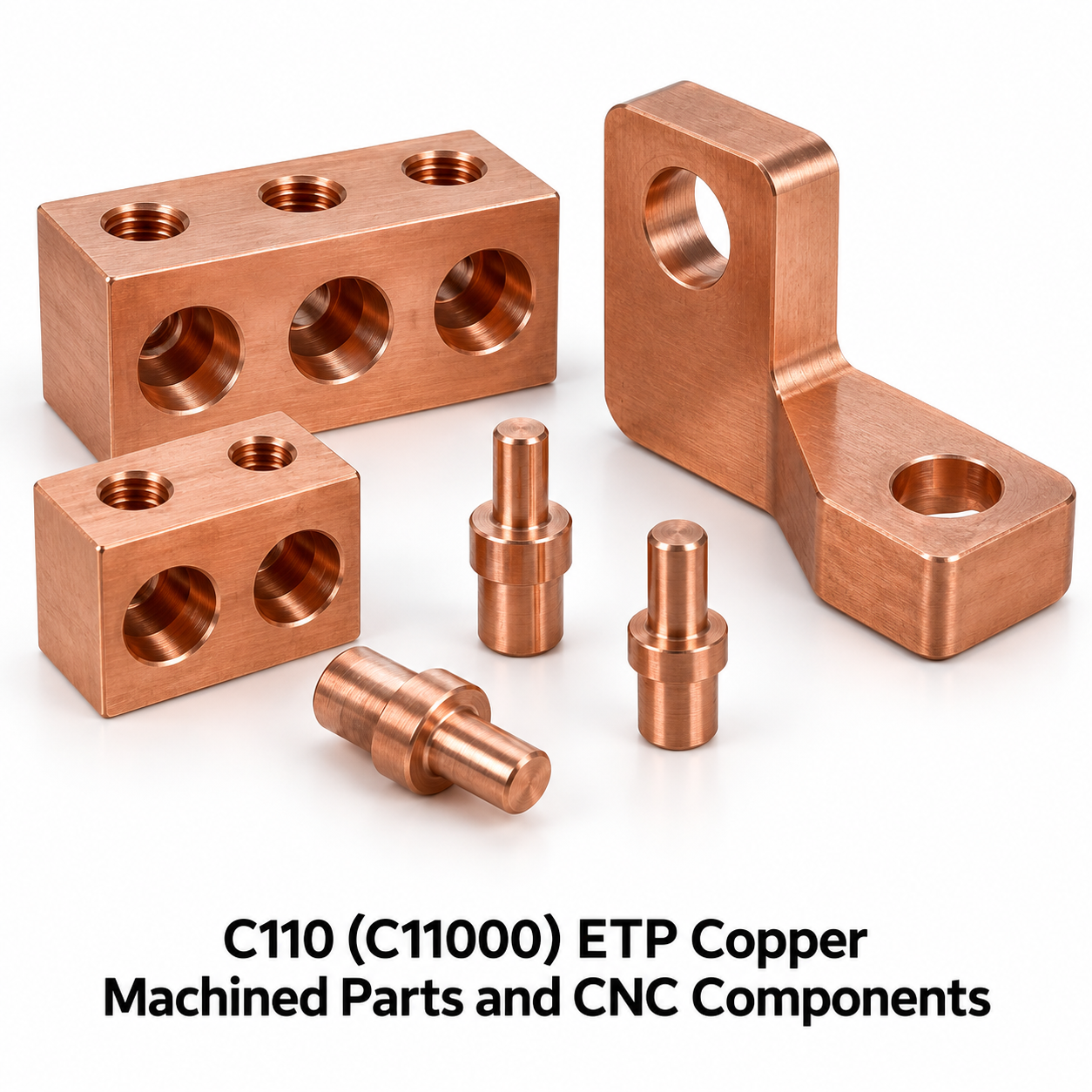
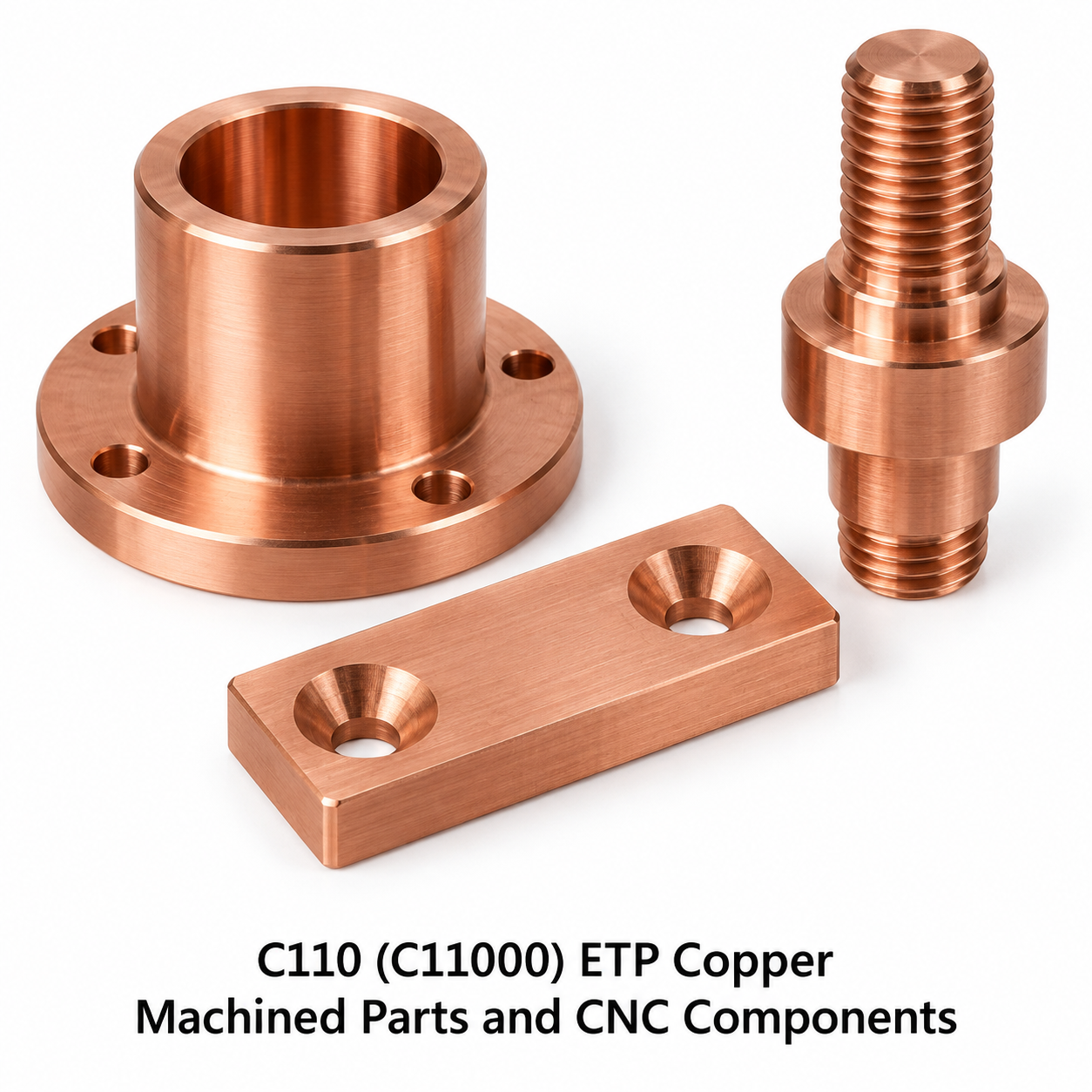
C110 (C11000) ETP Copper Machined Parts and CNC Components
C110 (UNS C11000) ETP copper machined parts are drawing-based conductive components made from electrolytic tough-pitch copper. Brass Parts India supplies CNC turned and milled terminals, contact blocks, sleeves and busbar connection pieces for electrical OEMs, EPC contractors, power utilities and distributors. Specify C11000 when high conductivity and conventional electrical service are required, with the stock form, temper and finish defined by the application. The listed rate is US$ 19.50/kg; the final quotation confirms the manufacturing and delivery scope.
Price: US$ 19.50/kg
Brand: Brass Parts India. Manufacturing location: Jamnagar, Gujarat, India. Enquiries are welcome from domestic and international industrial buyers; delivery terms are confirmed for the destination.
Detailed product overview
C11000 ETP copper grade and material identity
ETP means electrolytic tough-pitch copper. UNS C11000 is a commercially pure, oxygen-bearing copper widely used for conductive components. Its material identity should be stated in full on drawings and purchase orders because short designations such as C110 and C101 can mean different things in different national systems. Specify the product standard and stock condition with the grade. Bar, plate and other stock forms may have different dimensional and mechanical requirements. A supplier cross-reference helps procurement locate material, but the approved specification remains the acceptance basis for the actual batch.
Electrical terminals and current-carrying interfaces
C110 copper is a practical choice for terminal blocks, conductive studs, connection pads and busbar adapters where electrical performance is a central requirement. The current path should have sufficient cross-section and an appropriate contact area. Machining produces holes, shoulders, flats and seating faces that connect the conductor to the surrounding assembly. Bulk conductivity does not establish the finished joint’s ampacity. Joint pressure, bolt arrangement, plating, ambient conditions and temperature rise need engineering review. Contact surfaces must also remain protected during handling so the manufactured geometry supports the intended connection.
Thermal components and heat-transfer paths
ETP copper can also form heat-spreading blocks, mounting pads and machined thermal interfaces. A useful design connects the heat source, contact face and cooling path with adequate material and controlled surface geometry. Specify flatness and texture where a face mates with another component, and distinguish those limits from general linear tolerances. Cross holes and mounting threads should not weaken critical sections unnecessarily. Thermal performance depends on the complete assembly, including interface material, clamping and cooling conditions. A copper grade designation alone cannot establish the operating temperature or heat-removal capacity of the finished equipment.
Turning and milling ductile copper
C11000 is ductile and can produce persistent burrs, smeared surfaces or long chips during cutting. The process therefore needs sharp tools, suitable edge geometry and controlled support of thin sections. Turned shoulders, bored sleeves and milled terminal blocks each require a sequence suited to the geometry. Deep recesses and intersecting holes should be assessed for tool access and deburring. A drawing that permits realistic corner radii and clear datum references is easier to manufacture consistently. Inspection should focus on functional features instead of assuming that every machined surface needs the same tolerance.
Joining conditions and oxygen content
The oxygen present in ETP copper matters when components are exposed to high temperatures in a hydrogen-containing or reducing atmosphere. Such conditions can create embrittlement concerns that need review before brazing or welding. Do not select C11000 for a demanding joining process solely because its conductivity is high. Where oxygen-free electronic copper is required, compare the C10100 alternative against the complete material and process specification. Joint design, filler, atmosphere and cleaning remain part of process qualification. Soldered, bolted and brazed assemblies should each be evaluated on their own service requirements.
OEM purchasing and grade alternatives
For conventional conductive parts, start with the C11000 specification and identify the required material condition, dimensions and finish. An OEM may prioritize a contact face, while an EPC buyer may need project documentation and a utility may require an approved replacement drawing. Distributors should preserve the original grade and revision across repeat orders. Consider C10100 when a controlled oxygen-free grade is required, or C14500 when complex machining makes a tellurium-bearing copper appropriate. These are engineering alternatives rather than automatic substitutions. Obtain approval for any change that affects chemistry, conductivity, joining or functional performance.
Key features
- UNS C11000 electrolytic tough-pitch copper specified by grade and stock condition
- Conductive terminals, busbar connectors and thermal contact components
- CNC turned, drilled, bored, threaded and milled geometries
- General dimensional tolerance ±0.05 mm where agreed; critical features individually defined
- Bare machined surfaces or specified coating systems
- Drawing revision, inspection and material records agreed with the order
Drawing-controlled dimensions and datums
A controlled drawing defines the part more precisely than a catalogue photograph. Identify the primary axis, locating face and secondary datum before specifying diameters or hole positions. General dimensional tolerance is ±0.05 mm where agreed; individual tolerances, geometric controls and surface roughness require separate callouts. Tell the supplier which dimensions affect assembly, electrical contact or sealing. Include units, drawing revision and the finished condition for inspection. This helps distinguish functional requirements from dimensions that can tolerate normal manufacturing variation.
Threads, bores and mating interfaces
Specify metric or unified threads by size, pitch, class and usable engagement length. Identify blind holes separately from through holes and allow for drill points and thread runout. Bores used for alignment need different acceptance criteria from clearance passages. Coating thickness can change thread fit and internal diameters, so state whether inspection occurs before or after plating. Include entry chamfers and burr limits at cross-hole intersections. Assembly torque and joint loading should be supplied when they influence wall thickness or thread design.
Contact surfaces and coating options
Machined copper can be supplied with a drawing-defined bare finish or an agreed surface treatment. Tin, silver or nickel systems should be specified by function, thickness and masking requirements rather than appearance alone. Contact resistance depends on surface condition, joint pressure and the complete interface. Flatness and roughness therefore deserve explicit limits on critical contact faces. Identify surfaces that must remain uncoated and define any post-treatment inspection. A bright finish is not evidence of a particular alloy or verified electrical performance.
CNC turning, milling and secondary operations
Turning creates concentric diameters, shoulders, grooves and bores; milling adds flats, slots, pockets and mounting patterns. The manufacturing route depends on access, workholding and the relationship between features. A part with a long unsupported section may need a different sequence from a compact terminal block. State internal corner radii that can be accepted and identify surfaces that cannot receive clamping marks. Combining operations can reduce assembly interfaces, but the final geometry still needs drawing review before production commitments are made.
Inspection records and batch identification
Inspection planning begins with the drawing revision and material requirement. Critical features may require dedicated gauges, a dimensional layout or first-article approval according to the purchase order. Define the sampling plan and reporting format before manufacture. Material identification should remain connected to the stock batch through processing and packing where traceability is specified. A certificate of chemical composition does not prove dimensional conformity, and a dimensional report does not prove alloy chemistry. Request each type of evidence according to the risk and function of the component.
Handling, packaging and repeat supply
Copper contact faces and fine threads benefit from packaging that prevents abrasion and impact during transport. Separate similar components by part number, revision and material grade. Specify package quantities, batch labels and any cleanliness or storage conditions required by the receiving operation. Repeat orders should refer to the latest approved drawing and recorded deviations. Distributors can simplify replenishment by maintaining separate line items for visually similar alloys. Packaging and release documentation should be included in the quotation when they go beyond the normal supply arrangement.
Technical specifications
| Parameter | Specification / ordering information |
|---|---|
| Product | C110 (C11000) ETP Copper Machined Parts and CNC Components |
| Brand | Brass Parts India |
| Material | UNS C11000; ETP / Cu-ETP |
| Copper content | 99.90% minimum under the applicable grade specification; confirm reporting basis |
| Electrical conductivity | 100% IACS minimum in annealed condition; verify required product standard |
| Oxygen condition | Oxygen-bearing tough-pitch copper; review high-temperature reducing atmospheres |
| Stock form and temper | Bar, plate or suitable approved stock; condition stated on order |
| Geometry | Terminals, contact blocks, sleeves, studs and busbar connection parts to drawing |
| Manufacturing | CNC turning and milling with drawing-defined secondary operations |
| General dimensional tolerance | ±0.05 mm where agreed; individual drawing requirements take precedence |
| Threads and surface finish | Drawing-defined type, class, roughness and coating |
| Price | US$ 19.50/kg |
Material properties depend on stock form and temper. Confirm required values against the ordered specification and material documentation; they are not finished-assembly ratings.
Raw material grades and international equivalents
The following table identifies common grade families for purchasing discussion. International references are not unconditional substitutes: chemistry limits, stock form, temper and test requirements can differ. Use the exact approved standard and revision. Do not confuse C10100 OFE with C10200 OF or a legacy national C101 designation.
| UNS grade | European reference | Other reference / procurement note |
|---|---|---|
| C11000 ETP | Cu-ETP / CW004A | JIS C1100 reference; oxygen-bearing copper |
| C10100 OFE | Cu-OFE / CW009A | JIS C1011 reference; oxygen-free electronic grade |
| C10200 OF | Cu-OF / CW008A | JIS C1020 reference; distinct from C10100 |
| C14500 tellurium copper | CuTeP / CW118C | Tellurium-bearing machining copper; check full chemistry |
Product types and variants
| Variant | Drawing features to define |
|---|---|
| Terminal and contact blocks | Drilled or tapped connections with controlled contact faces |
| Stepped pins and studs | Concentric diameters, shoulders and thread engagement |
| Busbar connector pads | Hole spacing, thickness, seating faces and edge condition |
| Flanged sleeves and bushes | Bore fit, flange geometry and concentricity |
| Thermal interface blocks | Mating flatness, pockets and mounting pattern |
| Custom conductive adapters | Combined turning and milling features |
Industrial applications
| Customer / industry | Potential component role | Engineering information required |
|---|---|---|
| Electrical OEMs | Switchgear terminals and conductive connection blocks | Joint design, contact resistance and assembly temperature rise |
| EPC contractors | Project-specific busbar interface and equipment connection pieces | Approved drawings, schedules and documentation |
| Power utilities | Replacement terminal hardware and maintenance components | Original material, equipment approval and service conditions |
| Distributors | Repeat supply of identified C11000 machined parts | Part numbers, batch separation and packaging |
| Power electronics | Thermal pads and conductive mounting components | Interface flatness, cooling path and complete assembly validation |
Manufacturing process
1. Engineering and purchase-order review
Review the material designation, stock form, dimensions, quantity and intended service together. Resolve incomplete thread notes, inaccessible burrs, conflicting tolerances and uncertain finish requirements. Establish the drawing revision and identify features requiring first-article approval. Any proposed material substitution or geometry change needs agreement before production begins.
2. Material selection and stock preparation
Select bar, plate or another suitable stock form against the approved material specification. Check the required certificate and condition, then plan cutting allowances and identification. Stock size affects machining waste and the commercial weight basis. Keep different copper grades segregated because their colour alone cannot reliably distinguish them.
3. CNC machining and feature completion
Program the sequence around the functional datums and practical tool access. Roughing removes excess material; finishing establishes critical diameters, faces and bores. Add drilling, tapping, slotting and milling as the geometry requires. Tool condition, chip removal and workholding must suit the selected copper rather than a generic metal-cutting setup.
4. Deburring, cleaning and surface treatment
Remove burrs at thread starts, drilled intersections and machined edges without damaging functional geometry. Clean away chips and process residues using an agreed method. Apply specified coatings with the required masking and dimensional allowance. For sensitive assemblies, define cleanliness acceptance and subsequent handling requirements explicitly in the order.
5. Final inspection and dispatch
Verify the agreed features in their required finished condition. Review dimensional results, material records and coating documentation against the purchase order. Identify accepted parts and protect them for shipment. Release documentation, packing lists and batch details should match the supplied items so receiving teams can trace each delivery to the correct specification.
Quality standards and certification requirements
Specify quality requirements for the actual component and intended market. ISO 9001 concerns a supplier’s management system; it does not certify an individual copper part for a current rating, pressure rating or equipment approval. Request the current certificate, issuing body, validity and manufacturing scope when certification is part of vendor qualification. Agree material documentation and dimensional reports before ordering. Restricted-substance declarations and coating evidence must cover the supplied material and finish, rather than a different alloy family.
| Requirement | Information to agree |
|---|---|
| Material conformity | Exact UNS or EN grade, applicable product standard, stock form, temper and batch documentation |
| Inspection documentation | Drawing revision, critical dimensions, acceptance limits and report format |
| EN 10204 documents | Specify the required document type and confirm availability for the selected supply route |
| Surface treatment | Coating system, thickness, masking, adhesion or other agreed acceptance checks |
| RoHS / REACH requirements | Applicable market requirements and evidence for the actual material and finish |
| Project approval | OEM, utility or EPC approval requirements for the complete assembly |
Why choose Brass Parts India?
Brass Parts India provides an Indian sourcing point for drawing-based metal components in the CNC and VMC machined parts range. The enquiry can combine the required copper grade, turning or milling features, finishing and inspection documentation under one technical specification. This is useful when an electrical OEM, EPC contractor, utility buyer or distributor needs comparable offers for several related parts. The published kilogram rate makes the starting commercial basis visible; the approved drawing and written quotation define the deliverable.
Price, quotation basis and ordering
Price: US$ 19.50/kg. The rate is stated per kilogram, not per individual component. A written quotation should identify the chargeable weight basis, drawing complexity, order quantity, machining operations, finish, inspection documents, packaging, freight and taxes. Confirm whether the price uses finished-part weight or another explicitly agreed basis. Do not calculate a final order value from a photograph or nominal bar size alone.
Related parts and internal product links
Compare this grade with the other copper CNC machined components, or discuss prismatic geometry through the copper VMC milling range. Material alternatives require engineering approval.
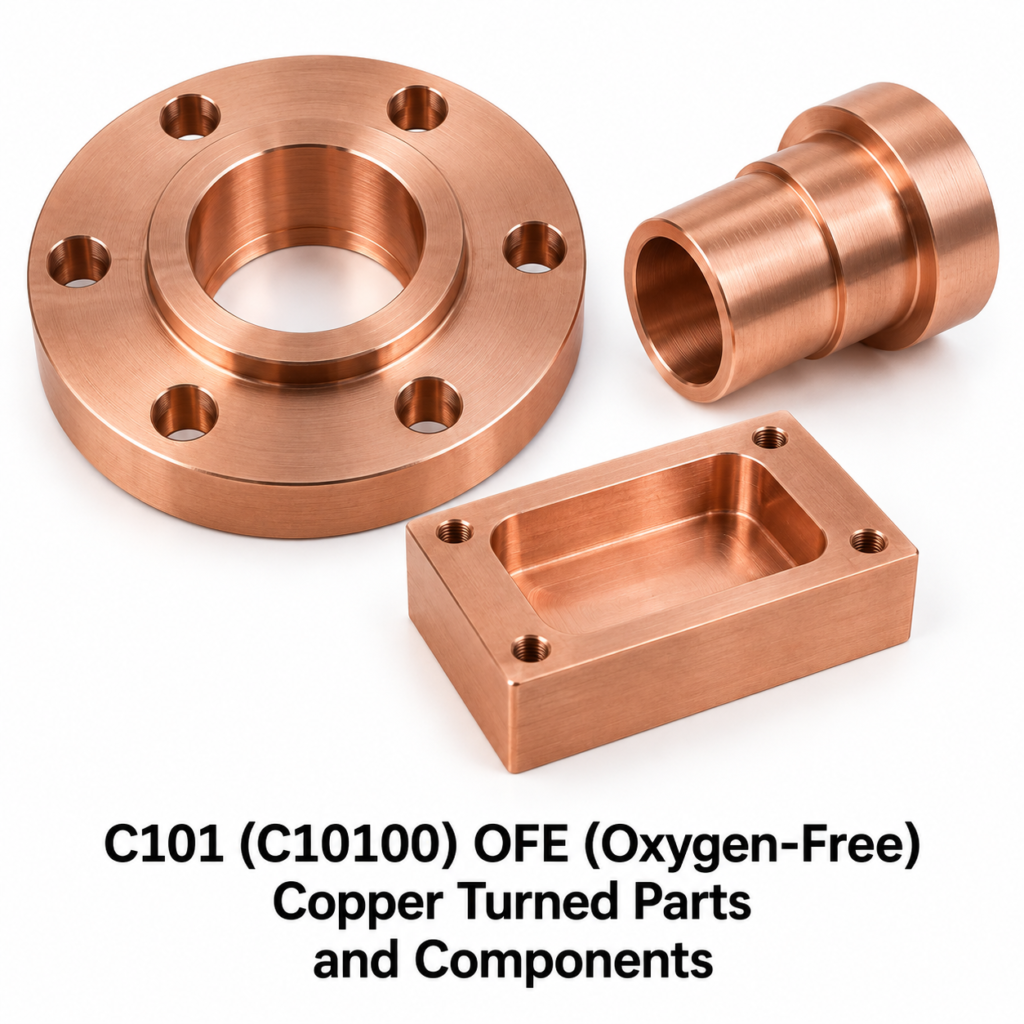
- C101 (C10100) OFE (Oxygen-Free) Copper Turned Parts and Components
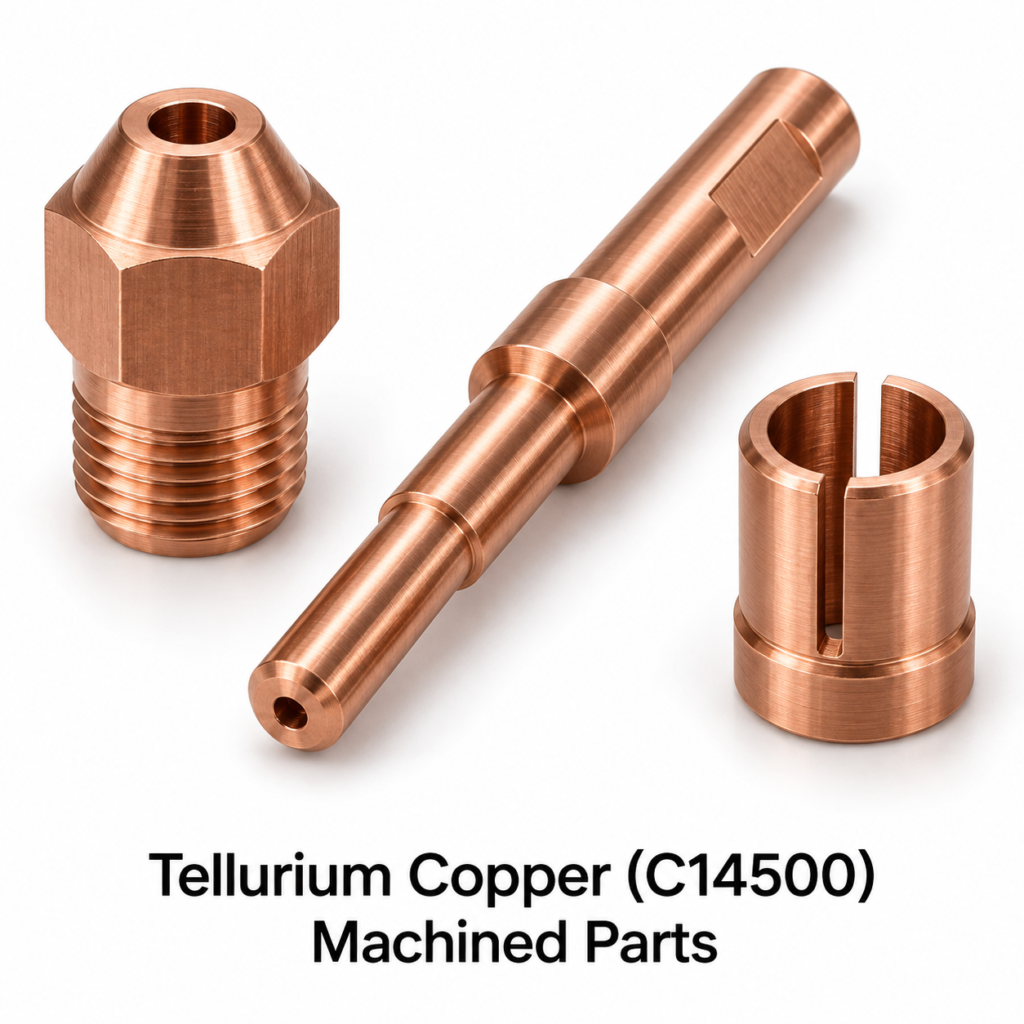
- Tellurium Copper (C14500) Machined Parts
- Copper CNC machined components
- Copper VMC milled components and parts
- Free-cutting brass CNC machined parts
- Lead-free brass CNC machined components
- Aluminum CNC turned parts
- Stainless steel 316 CNC machined parts
Equivalent product terms in other languages
Use these related purchasing terms together with C11000 and the controlled drawing. Translated search terms do not replace a material specification.
| Language | Related terms |
|---|---|
| Spanish | piezas de cobre mecanizadas CNC; componentes de cobre torneados; contactos eléctricos de cobre |
| Russian | медные детали с ЧПУ; точёные медные компоненты; медные электрические контакты |
| French | pièces en cuivre usinées CNC; composants en cuivre tournés; contacts électriques en cuivre |
| Portuguese | peças de cobre usinadas CNC; componentes de cobre torneados; contatos elétricos de cobre |
| Italian | parti in rame lavorate CNC; componenti in rame torniti; contatti elettrici in rame |
Frequently asked questions
Is C11000 the same as oxygen-free copper?
No. C11000 is electrolytic tough-pitch copper and contains oxygen. C10100 is oxygen-free electronic copper with a different chemistry specification. Choose the grade from the electrical, joining and cleanliness requirements rather than treating all commercially pure copper as interchangeable.
Can C110 ETP copper be used for busbar components?
It is commonly considered for conductive busbar connection pieces, terminal pads and adapters. The complete assembly still needs suitable cross-section, contact pressure, insulation clearances and temperature-rise assessment. Machined geometry and material conductivity alone do not establish an equipment current rating.
What does the C101 designation mean in an enquiry?
A short designation is ambiguous without its national standard. This page uses UNS C11000 for ETP copper. If a drawing uses a legacy British C101 designation, confirm its governing specification rather than confusing it with US shorthand for UNS C10100 oxygen-free electronic copper.
What is the price per kilogram?
The listed price is US$ 19.50/kg. Request a written quotation confirming the chargeable weight basis, drawing complexity, quantity, machining, finish, inspection documents, packaging, freight and taxes. The kilogram rate is not a fixed per-piece price for every geometry.
Can you manufacture to our drawing?
Send the controlled drawing and revision, material specification, order quantity and STEP model if available. Identify critical dimensions, datums, mating interfaces, threads and finish requirements. Manufacturing feasibility and the inspection scope are confirmed against that information before an order is finalized.
What dimensional tolerance should we specify?
The general dimensional tolerance is ±0.05 mm where agreed. Critical dimensions, geometric tolerances, thread classes and surface roughness require individual drawing limits. State whether inspection applies before or after coating and identify dimensions affected by subsequent assembly or joining operations.
Which surface finishes can be requested?
Request a bare machined finish or a specified coating such as tin, silver or nickel, subject to application review and quotation. Define thickness, contact zones, masking and finished dimensions. The required electrical or corrosion behaviour must be assessed for the complete surface system.
What certificates and inspection records are available?
Agree the material certificate, dimensional report, coating evidence and traceability requirements with the quotation. Where a quality-system certificate is required, request its current scope and validity. Certification is not implied merely by listing an alloy, standard or possible industrial application.
Do the images show stocked components?
The images are representative product illustrations showing possible component forms. They do not prove alloy chemistry or stock availability. Supplied geometry, grade, dimensions, surface treatment and inspection requirements follow the approved drawing and purchase order.
How should distributors place repeat orders?
Quote the part number, drawing revision, exact material grade, quantity and agreed finish for each item. Include the previous approval reference and identify any changes. Keep similar-looking copper alloys on separate order lines and specify packaging labels when batch identification is required.
Request a technical quotation
Contact Brass Parts India for C110 ETP copper components. Send your drawing revision, exact material specification, quantity, finish, inspection requirements and destination. Reference the listed US$ 19.50/kg rate and request confirmation of the chargeable weight, manufacturing scope and delivery terms. Identify your critical interfaces so the technical review addresses the features that matter to your assembly.